

Fishing Nets Are Becoming A Powerful Counter To War Drones
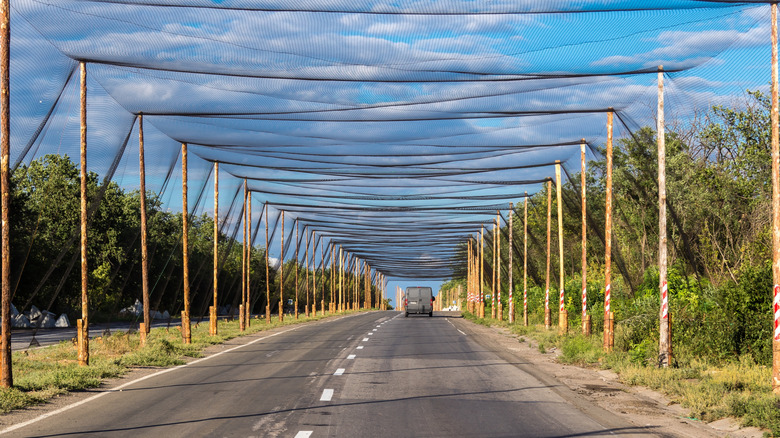
A wave of new technologies are changing military tactics, as artificial intelligence and robotics deliver a flurry of innovations to the battlefield. At the center of these changes are the proliferation of small, relatively cheap drones, or UAVs, that have inflicted incalculable damage in conflict zones like Ukraine. Combatting these new weapons systems has been difficult, due in large part to both the scale of the attacks and the disproportionate costs of defending against them.
Similar to mass aerial bombings in World War II, the impact of these bombardments have expanded beyond military targets, inflicting devasting damage on civilians and critical infrastructure. For instance, drones now inflict the majority of the casualties on both sides of the Russo-Ukrainian conflict. Although Ukraine has deployed drones to find success against a rival whose military budget was 10x larger than its own before the conflict, their proliferation has also placed civilians in the cross hairs. Expanding the geographic scope of UAV attacks has firmly placed Ukrainian cities, hospitals, and public infrastructure — positioned far beyond the battlefront — in the line of fire. Warding off these attacks has proven challenging.
Worldwide, militaries are developing new strategies to fend off drones, ranging from the United Kingdom's ship-mounted DragonFire laser beams to China's anti-drone microwave weapon. To date, however, none have developed a catch-all solution, particularly in civilian-heavy areas. So, Ukraine and Russia have gone analog to foil the destructive technology, deploying nets to ensnare enemy drones. Suspended over roads, hospitals, military vehicles, and critical infrastructure, the converted fishing nets are a back-to-basics moment for global militaries.
Using nets to catch drones
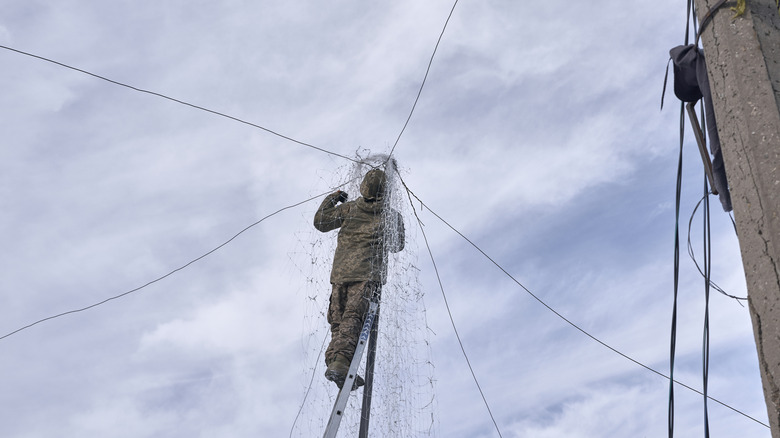
Over the past few years, Russia has launched drones targeting Ukrainian supply lines, electricity infrastructure, and convoys. The expanded use of first-person view drones has been correlated with increased civilian casualties. According to the United Nations, civilian casualties from short-range drone strikes increased by 120% in 2025.
To ward off the incursions, Ukraine has begun erecting giant repurposed fishing nets to ensnare explosive-laden attack drones. Laced between poles to form tunnels, Ukraine has placed these structures around public roads, bridges, medical camps, hospitals, and other key infrastructure projects. In Kherson, a frontline city that has felt the brunt of these attacks, they've become essential for preserving what locals call the "roads of life", connecting the besieged city to the rest of the country. So far, Ukraine has covered hundreds of miles of roads with such netting.
Ukraine's supply of fishing nets is largely sourced from Europe, where fishermen in countries like France, Denmark, and Norway have contributed thousands of tons of netting. In the Netherlands, farmers have donated lightweight polyethylene nets, used to cover tulip bulbs, that can disrupt small UAVs. Fishing nets, particularly those made of reinforced horsehair for trawling the seabed, are capable of catching larger drones like Russia's Lancet, which can deliver over five pounds of explosives at more than 90 mph.
Simple solution for a difficult problem
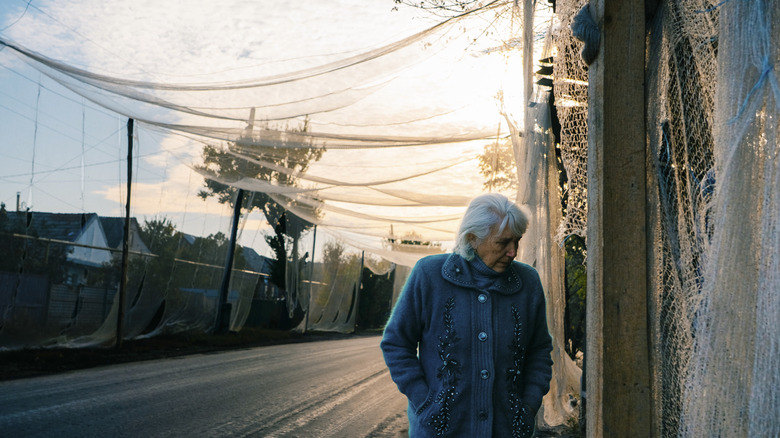
Ukraine's use of nets underscore broader issues underpinning drone warfare. Often launched in swarms, UAVs are difficult to defend against with with artillery. Exacerbating the issue is that kinetic defenses are extremely costly compared to the drones they eliminate. For instance, Russia's Iran-made Shahed drones cost around $35,000, while U.S.-made Patriot missiles, a staple of Ukraine's air defenses, cost $4 million and anti-drone Hellfire missiles are about $200,000. Dwindling ammunition supplies can compound the problem, limiting their usage to select targets.
These limitations can be deadly in regions like Kherson, which sees approximately 2,500 attacks every week. Nets, meanwhile, are a low-cost option capable of extending protection throughout a region and are better suited for densely populated areas, as they lower the risk of collateral damage from falling debris. Other means of defense, like signal jamming, present technical issues. Jamming, which downs drones by disrupting radio frequencies, can also disrupt local communications systems. Meanwhile, electromagnetic pulse and high-power microwave technology can cause severe damage to energy grids and infrastructure.
These concerns are amplified by the development of new UAVs, such as Russia's jet-powered drone that is immune to electronic warfare. Given the unpredictability, geographic range, and costs of Russian drone attacks, Ukraine has had to formulate an efficient means of protecting large swaths of urban and rural areas. The seemingly simple approach of fishing nets, and the international effort buoying it, is one of the many incredible stories to come out of the conflict.