

5 Visionary '60s Gadgets That Predicted The Future
When you think of 1960s technology, you probably picture things like the Space Race or nostalgic gadgets every boomer will remember using back in the day. Though much of it seems quaint in 2026, the '60s were a time of incredible technological advancement. This was the decade when humanity managed to land on the moon, and inventions like the laser, Kevlar, and the artificial heart quickly proved their usefulness. However, other creations from the decade would not come into wide use until much later.
For some of these, the technology wasn't quite there yet to allow for widespread adoption. Others, like new telephone or light bulb technology, weren't yet affordable to use or produce, nor were the products actually compelling for consumers at the time. Even if they wouldn't be appreciated until much later, these visionary inventions from the '60s were far ahead of their time, predicting or setting the groundwork for things we use or are still working on to this day.
The internet

While not really a gadget, the internet is worth mentioning based on how important it is and the fact that not many people realize how far back it dates. The internet as we know it was created when the World Wide Web became public in 1993, but the foundations were set nearly a quarter of a century earlier. The Advanced Research Projects Agency Network (ARPANET) was created in 1969 by the U.S. Department of Defense as a way for researchers to securely communicate and share information through computers in different cities, or even countries.
What made it possible was the development of packet switching, which allowed data to make its way through a network and reassemble itself without relying on any one node. Otherwise, one device going down would take the entire network with it. ARPANET was a far cry from the modern internet, but further work on it led to the creation of TCP/IP (Transmission Control Protocol/Internet Protocol), protocols that are still used to connect devices across networks. It's no exaggeration to say that the introduction of the web changed everything, and we have 1960s engineers to thank for it.
The Picturephone
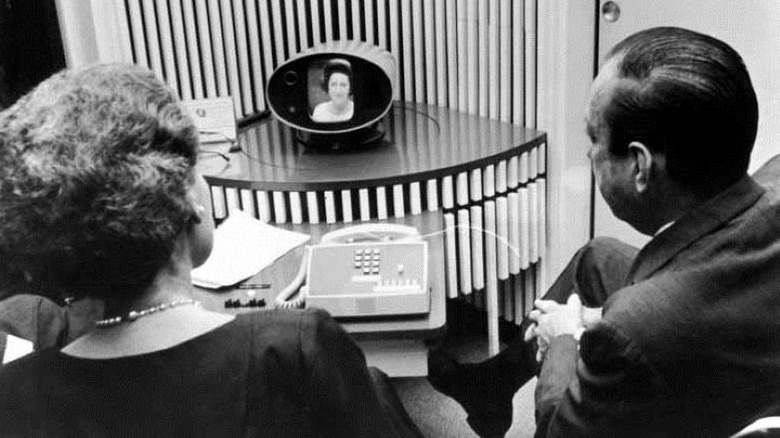
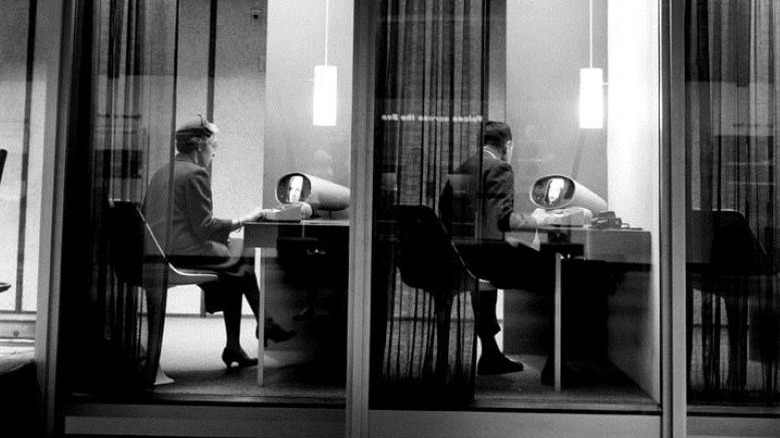
Skype, FaceTime, and similar platforms popularized video calling, but the technology to see the person you're speaking on the phone with goes all the way back to 1964. That April, AT&T's Bell Labs introduced the Picturephone at the World's Fair in New York City. The demo consisted of eight booths where visitors could video call each other, or sometimes, an additional booth installed at Disneyland in Anaheim, California.
The exhibit was popular, but future trials didn't go as well. In June 1964, AT&T installed Picturephone rooms in New York City, Chicago, and Washington, D.C. that anyone could use. However, few actually used them, peaking with only 71 calls in the first six months. A commercial Picturephone service introduced in Pittsburgh, Pennsylvania in 1970 also failed to gain any traction. Bell Labs continued developing Picturephone technology until 1973, when a new AT&T CEO came in and ended the project.
Much of the Picturephone's failure came down to cost. In June 1964, renting two rooms for a conversation cost $16–$27 for the first three minutes, which is $171.88–$290.05 adjusted for inflation. For Pittsburgh, AT&T charged $160/month for the equipment, service, and first 30 minutes of calls, plus $0.25/minute for any additional calls ($1,373.28/month and $2.15/minute). The cost to operate and use video calling had to significantly come down before it could reach enough people to actually be useful, which is why it took decades before the technology would be widely adopted.
Light-emitting diodes (LEDs)

LED lights are pretty much everywhere now, but they were invented way earlier than you probably thought. The science behind them was discovered back in the 1900s and 1920s, but the first LED lights that were practical for commercial use were invented in 1961, and Texas Instruments released the first LED product the following year. However, they were far more expensive than incandescent bulbs, and it would take decades for the costs of LEDs to drop enough for widespread use to be feasible.
Early LEDs were inefficient and dim, and it took a long time to develop blue LEDs, which were key to making bright white lights and full-color displays for things like smartphones. That challenge was so significant that the scientists who finally managed to create blue LEDs received the Nobel Prize in physics for their work. Since then, LEDs have come a long way, and scientists continue to make breakthroughs in LED tech that show they aren't going away anytime soon.
Wearable computers
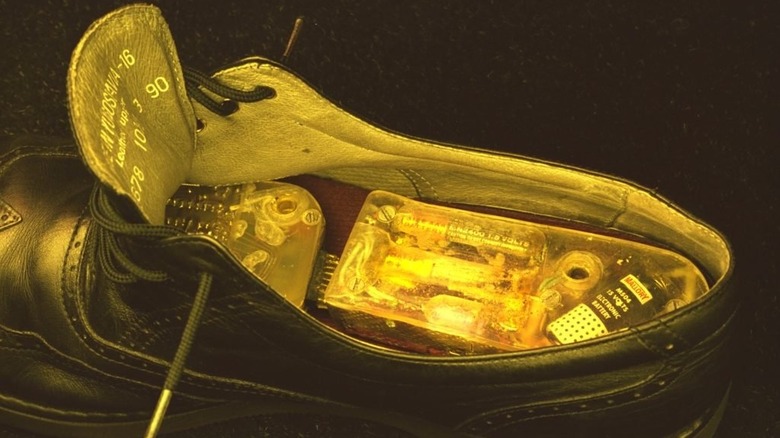
Smartwatches and other cool wearables have become popular for health, fitness, and productivity, but the first wearable computer was actually invented long before the average person even had a PC. In 1961, two MIT mathematicians named Edward Thorp and Claude Shannon developed a small computer for predicting roulette outcomes. Yes, the first wearable was made to cheat at gambling.
The computer, only the size of a cigarette pack, was hidden on the person of a nearby observer and was operated by a switch inside the person's shoe. The wearer would time the wheel, using their big toe to input data. The computer would then calculate the most likely outcome, providing a significant advantage, and send the information to a receiver in the bettor's ear as different audio tones.
Thorp and Shannon tested it out in Las Vegas and found it to be pretty accurate, though the wires connected to the speakers frequently broke. Despite their success, the two decided not to pursue the project further out of concern about being caught by the casino, a place likely run by the Mafia in that era. Thorp went on to invent more devices for gamblers until the state of Nevada outlawed them in 1985, after which he published a paper explaining the origin, development, and successful use of the first wearable computer.
Shakey the robot
Artificial intelligence is everywhere these days, from chatbots like ChatGPT, Gemini, and Claude that can help out with everyday tasks and answer questions to robots that are starting to take over the human labor industry. While those humanoid household bots we were promised in sci-fi stories have yet to manifest, AI advancements are making that future more of a possibility. That's why it may surprise you to learn that the first AI robot was actually made back in the 1960s.
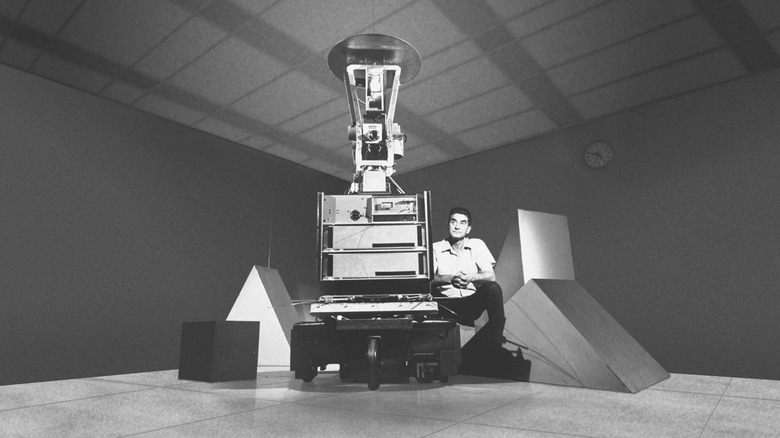
Shakey the Robot was a project that SRI International carried out from 1966 to 1972, and it's considered the first mobile robot with the ability to perceive its surroundings and reason based on them. According to SRI, Shakey could "perform tasks that required planning, route-finding, and the rearranging of simple objects." These functions are basic but incredibly impressive given the era.
Creating and improving Shakey led to the development of new techniques like the A* search algorithm still used in computer science to find the shortest path and the Hough transform used to find geometric shapes like lines within digital images. In 1970, Life magazine's Brad Darrach called Shakey the "first electronic person." Shakey's impact on robotics and artificial intelligence can't be overstated, which is why it was inducted into the Robot Hall of Fame in 2004 and now resides at the Computer History Museum in Mountain View, California.