

This Forgotten Cold War Nuclear Base Gives Us An Unexpected Perspective On Earth's Climate
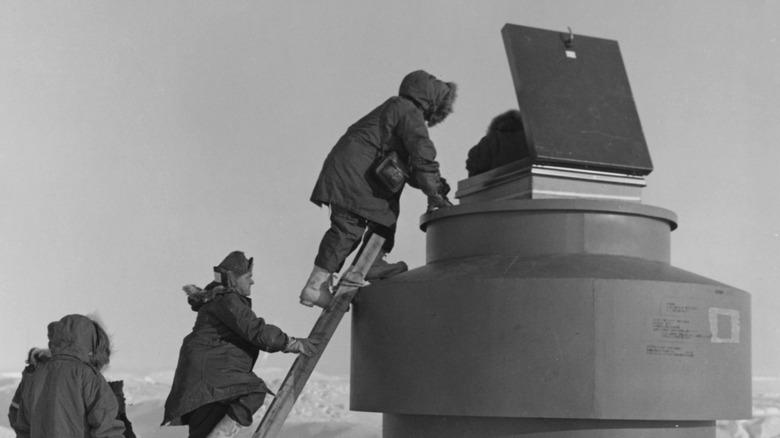
During the Cold War, the U.S. Army devised a secret plan to hide nuclear missiles inside of Greenland's ice sheet. While the missiles never actually arrived, scientists found something more interesting below the surface: sediments that could teach us more about Greenland's history with climate change. A new study published in Climate of the Past found that the site of the plan was completely free of ice around 416,000 years ago. Back then, the Greenland summers were about 8.5 degrees Fahrenheit (4.7 degrees Celsius) warmer than they are today.
For the location, known as Camp Century, to be ice-free, the study says that the Greenland Ice Sheet would have had to retreat more than 60 miles (97 kilometers) from where its edge sits in that part of Greenland today. "It's striking that a period of moderately warmer temperatures coincided with such a substantial retreat of the ice sheet," says John Michael Aguilar, the study's first author and a postdoctoral fellow at the University at Buffalo.
The surprising bit here is that the ice sheet had retreated so much despite the temperature only being modestly warmer. However, the researchers believe they may have discovered the cause of this. While studying the sediment, they have come to the conclusion that the length of the warm time period may actually be just as important as how much warmer it was.
Greenland was this warm before and Camp Century kept its ice
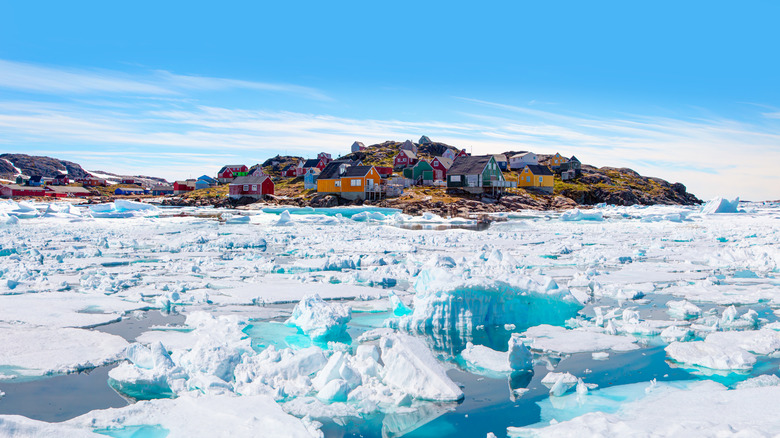
What makes the length of the warm period so important is that Greenland has been this warm before. Between 5,000 and 10,000 years ago, Greenland had similar summers, but the ice at Camp Century didn't melt away. The researchers believe the biggest difference here is that the warm period that occurred 416,000 years ago, which scientists call Marine Isotope Stage 11, could have gone on for tens of thousands of years. This would have given the ice sheet a much longer period of time to melt and shrink.
Greenland is estimated to be losing about 270 billion tons of ice a year, based on NASA satellite data gathered since 2002. Additionally, a 2024 study found that Greenland's ice sheet lost more ice than previously believed because of glaciers retreating where they meet the sea. Elizabeth Thomas, the study's corresponding author, doesn't see this as a reason to relax, though. "Today's human-caused warming is more intense than the warm period 400,000 years ago," Thomas says. "And climate projections suggest that this warmth could persist for hundreds or thousands of years."
It's also worth keeping in mind that Greenland is feeling climate change differently than most places. As the ice melts, the land underneath it rises and the ice sheet's gravity doesn't pull as much ocean water toward the island. That means relative sea levels around most of Greenland are expected to fall.
Why we're only learning this now
Camp Century itself has quite the history. The U.S. Army Corps of Engineers built the base in 1959 by digging it into the ice sheet in northwestern Greenland. The goal was to figure out whether Project Iceworm, the Army's plan to keep missiles inside the ice, was even possible. Of course, that plan never worked out, and the Army abandoned Camp Century in 1967. However, before that, the drill crew had made it almost a mile down to the bottom of the ice. Scientists have been studying the sediment found there to figure out what it was like.
Chester Langway, the scientist in charge of drilling at Camp Century, took the sediment back to the University at Buffalo in 1975. It later ended up at the University of Copenhagen, where nobody paid it much attention for more than 20 years. That changed in 2018, when the samples turned up during a freezer cleanout. A 2023 study used the sediment to show that Camp Century was ice-free around 416,000 years ago, and this new study builds on that by estimating how warm the summers were during that time.
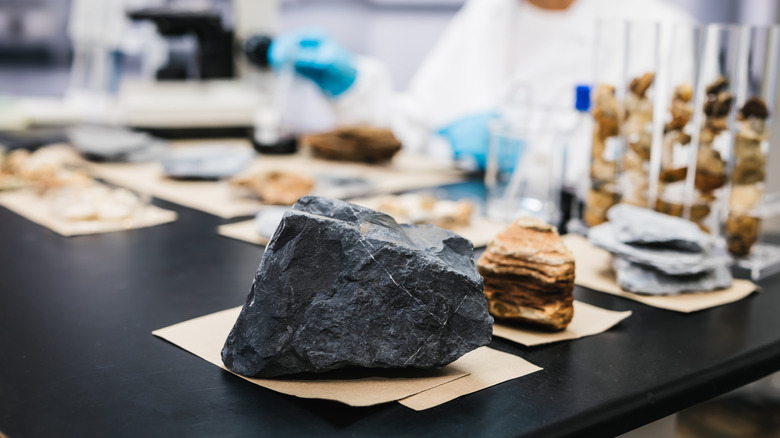
To figure out the temperature, the researchers looked at fatty molecules that bacteria left behind in the sediment. "The types and proportions of these molecules change depending on the temperature," Aguilar explains. "By comparing them with similar molecules found in modern Arctic lakes, we were able to estimate how warm it was at Camp Century." Of course, the 8.5-degree estimate isn't exact, and the study gives it a margin of error of 5.7 degrees Fahrenheit (3.2 degrees Celsius). But, it does give us more insight into the history of Greenland and its ice sheet, and even how climate change affected it in the past.