

Comet 3I/Atlas Is Emitting A Radio Signal - Here's What We Know
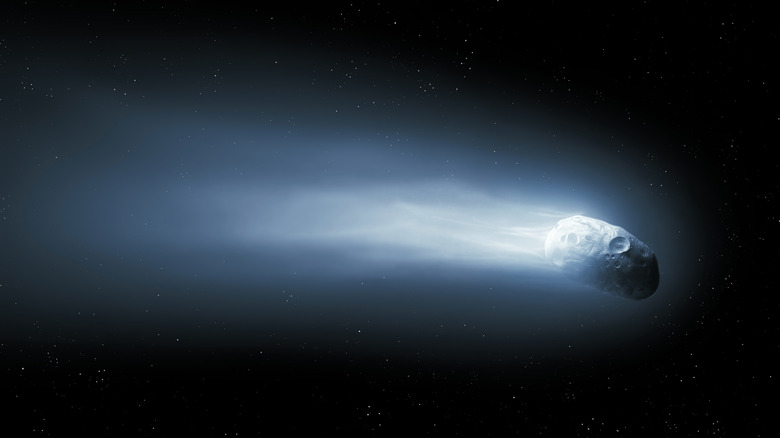
The most sensational story of the year for astronomers has been the discovery of the comet 3I/ATLAS, which was first observed on July 1, 2025 by NASA's Asteroid Terrestrial-impact Last Alert System (ATLAS). Although comets regularly pass by Earth, the most famous being Halley's Comet, there's something extra-special about this new find. Halley's and other well-known comets originated within our solar system, birthed from the same planet-forming disk that the sun, Earth, and all the other planets emerged from. What makes 3I/ATLAS so fascinating is that it originated somewhere beyond the solar system, and made its way here through interstellar space. As if that weren't an exciting enough discovery, a radio telescope has noticed that the comet is emitting something.
The MeerKAT radio telescope in South Africa picked up on 3I/ATLAS in late October, as the comet was nearing its closest point to the sun. This finding was widely reported as radio signals emitting from 3I/ATLAS, which prompted conspiracy theorists to speculate that the object may actually be a piece of alien technology. This isn't quite accurate though. Technically, everything gives off electromagnet radiation, and what MeerKAT found wasn't an audio transmission like the kind we hear on a car radio. What it actually found were gaps in the radio spectrum caused by the absorption of radio waves by OH molecules, also known as hydroxyl radicals. OH molecules — the remnants of water torn apart by solar radiation — are regularly observed in comets that pass within range of Earth, which seemingly puts to bed any speculation that the 3I/ATLAS is anything other than a comet. However, it doesn't answer the question of where 3I/ATLAS originated from.
Astronomers still aren't sure where 3I/ATLAS came from
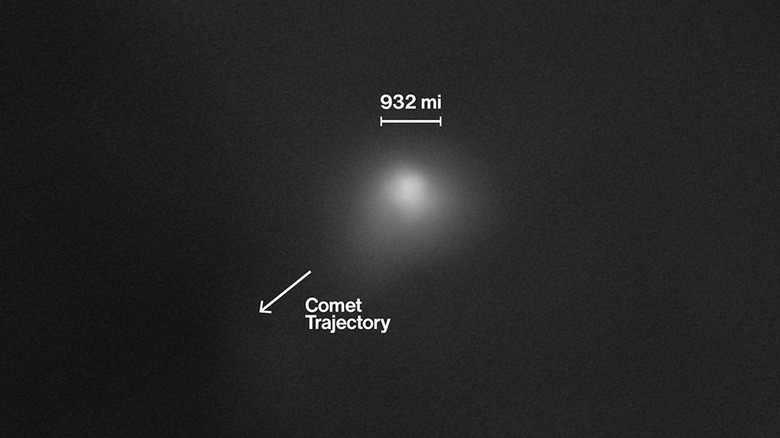
The discovery of 3I/ATLAS marked just the third time that astronomers have observed an interstellar object passing through our solar system. The "3I" in its name actually stands for "third interstellar" for this reason. The previous two interstellar objects observed by astronauts were 1I/'Oumuamua and 2I/Borisov, discovered in 2017 and 2019 respectively. The fact that all known interstellar visitors to our solar system were discovered in the past decade is a sign of great strides in astronomical technology, but it also means that we have been able to gather very little data thus far about interstellar comets. One thing does stand out, however. Both 1I/'Oumuamua and 2I/Borisov came from the direction of the Milky Way's center, but 3I/ATLAS is coming from a perpendicular angle.
Based on the trajectory, it's likely that the comet originated in a part of the galaxy that astronomers haven't even observed yet. NASA is gathering images of 3I/ATLAS, as is the European Space Agency, and both expect to have more satellite and probe data ready to analyze by early 2026; however, it is highly unlikely that we'll ever be able to pinpoint the exact origin of the comet. While scientists don't know where it came from, they do have a good idea of where 3I/ATLAS is going, and you can rest assured that it won't hit Earth. In fact, the comet won't even come as close to us as the sun is.
Why some people still think 3I/ATLAS is a piece of alien technology
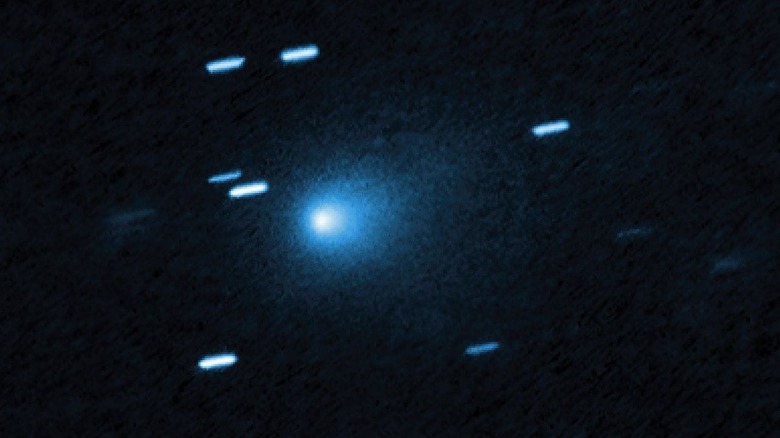
The intrusion of an interstellar object into our solar system immediately caught the attention of every alien enthusiast out there, and not just the typical podcast conspirators. A professor at the Harvard Center for Astrophysics is arguing that 3I/ATLAS could be a piece of alien technology. Professor Avi Loeb has published numerous articles about the interstellar object on his blog, going against the consensus of his peers in the scientific community. He argues that 3I/ATLAS exhibits several anomalies compared to the previous two interstellar comets that have been tracked through our solar system. Compared to that pair, 3I/ATLAS is far more massive, yet moves faster. He also notes that the gas plume surrounding 3I/ATLAS contains similar levels of nickel to industrial alloys.
The recently recorded radio signals from 3I/ATLAS are yet another dent in Loeb's theory, which has been roundly rebuked by other astrophysicists. Counterarguments point out that comets often show inconsistent features. It's impossible to say what is normal and what is anomalous, and that is especially true in the case of interstellar comets. Loeb actually hits the nail on the head in an article titled, The Tale of 3I/ATLAS and Sterile Neutrinos, wherein he asks, "How can anyone claim to be an expert of interstellar objects when the sample size includes only two previously known examples?" In all likelihood, many of our questions about 3I/ATLAS won't be answerable until we have observed other interstellar comets in the future.