

Tesla Optimus Robot's Public Failure Has To Be Seen To Be Believed

When Tesla demonstrated its humanoid robot Optimus at its autopilot technology showcase in Miami in early December 2025, it was a sensation, but not for the reasons the company hoped. Recorded at the company's "Autonomy Visualized" show, a leaked video shows an Optimus robot supposedly autonomously handing out water bottles to guests before knocking over its wares, raising its hands in mock disbelief, and falling backward in a cascade of flailing limbs. While it circulated on social media as an undoubtedly genius piece of slapstick comedy, the video also garnered harsh criticism, with critics noting that the Keatonesque gag points to broader issues within Tesla's robotics business, revealing the company may be farther from reaching its lucrative goals than advertised.
Much of this criticism is rooted in the wildly optimistic promises of Tesla head Elon Musk, who has spent years hyping up the advancements of his company's humanoid robotics program. In February 2025, for instance, Musk predicted that Tesla's bipedal robot Optimus alone would drive more than $10 trillion in revenue. In light of several public setbacks, including the above mentioned tumble, many observers are skeptical of such eye-popping predictions.
Of course, Musk isn't the only billionaire hoping to capitalize on the market, as several of the world's most powerful technology giants, including Nvidia, OpenAI, Alphabet, and Meta, all heavily invested in the burgeoning market. The greatest competitive concern for Musk, however, may come from China, where a nation-wide investment strategy has reportedly produced embodied AI capable of dexterous movements currently eluding American firms, such as Unitree's $16,000 G1 humanoid robot. Despite these developments, many insiders are cautious about the industry's immediate potential. So if you're concerned about an AI robot uprising, put your mind at ease with the viral Optimus video.
An unfortunate fall from grace
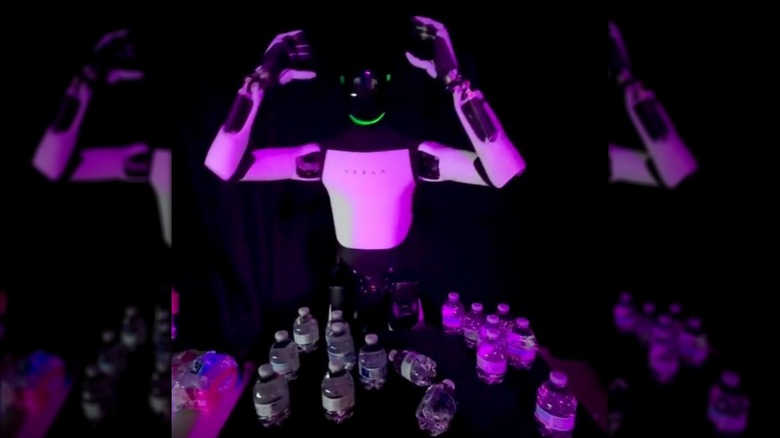
The schadenfreude-inducing video is much more than a simple reel of scattered water bottles and tumbling animatronics. Several armchair engineers have speculated that the gestures, in which the humanoid robot reaches towards its face before falling over, reflect not a human-like emotion of aghast shock, but of an unseen operator taking off their VR headset. Such speculation is somewhat warranted, as Tesla has used unseen remote operators in past demonstrations of its Optimus robot, including at its "We, Robot" event in October 2024, according to the Los Angeles Times.
To date, neither Tesla nor Elon Musk has commented on the incident. However, in an October 2025 investor call, the billionaire touted the increased capabilities of Optimus, detailing how the robot "was at the Tron premier doing kung fu" alongside star Jared Leto, per Fortune. Previously, Musk stressed in an X post that the robot's martial arts skills were "AI, not tele-operated." Even if the video doesn't reveal what Elecktrek called a "'Wizard of Oz' moment," it could have major implications for investors looking to gauge Tesla's progress towards a fully autonomous robot, which Musk previously declared as potentially "the biggest product ever."
The mishap comes shortly after Tesla released a series of videos showing the 160-pound robot's increased mobility, including an X video of the robot reaching a personal record speed in Tesla's lab. However, a July 2025 report by The Information revealed that the EV giant was severely behind its stated goal of building 5,000 Optimus robots by the end of 2025, with the manufacturing totals reaching only the hundreds. For what it's worth, in November 2025, Tesla announced that it expected to begin production of its Gen 3 line in 2026, which it was aiming to retail at roughly $20,000.
A growing AI battlefield
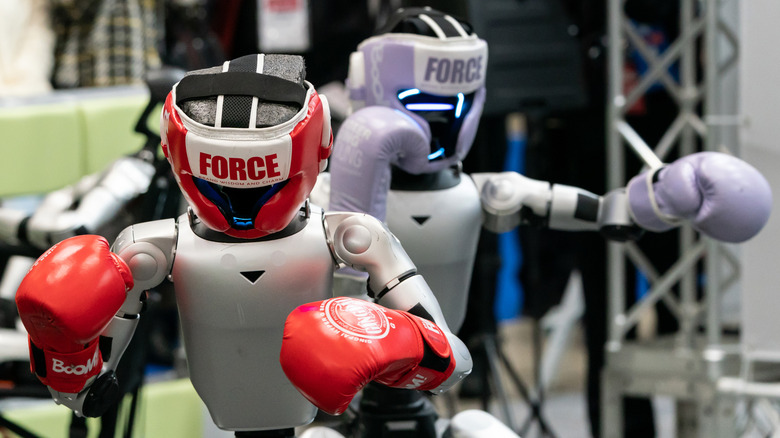
The stakes behind these robots are high, as Tesla looks to pioneer what Morgan Stanley predicted will grow into a $5 trillion industry, with 1 billion humanoid robots potentially flooding the market by 2050. Musk himself has predicated much of his company's further success with the technology, stating in June 2024 that Optimus could push the company's market cap to roughly $25 trillion. But Tesla is far from the only domestic firm betting big on robotics. Startup Figure AI, for instance, lists OpenAI, Nvidia, Microsoft, Intel, and Amazon amongst its list of investors. Meta, meanwhile, is ready to spend billions on its "Metabot" and the AI software enabling it, according to reporting by The Verge. Alphabet, for its part, debuted its Gemini Robotics program in March 2025, as it aims to develop embodied AI software. Boston Dynamics, which is majority owned by Hyundai, is another major domestic competitor.
Tesla's greatest competition, however, may come from several Chinese firms, including EngineAI Robotics, Unitree, and UBTech. Embodied AI is a strategic priority in Beijing's race towards AI dominance, potentially revolutionizing its manufacturing and military expansion efforts. However, some observers have voiced bubble concerns, noting that China's investment in the industry may vastly outpace the rate of its technological development. As it stands, China sports 150 embodied AI manufacturers, garnering over $5 billion in investment in 2025 alone — roughly equaling the totals of the past half decade. Whether China can capitalize on this investment to the same degree as its EV industry remains to be seen.
Despite this enthusiasm, industry professionals stress patience. According to a report by The Wall Street Journal, AI insiders warn that there is a significant technological gap between delivering acrobatic videos and "well defined products." As Tesla's viral mishap attests, an "I, Robot"-style economy isn't likely in the immediate future.