

Can You Beat The World's Most Annoying Captcha?
It's been a quarter of a century since the invention of the CAPTCHA. The great gatekeeper of the internet was originally created by students at Carnegie Mellon University to prevent bots from rigging online polls. Inspired by the famous Turing Test (which ChatGPT also passed), they dubbed it the Completely Automated Public Turing Test to Tell Computers and Humans Apart (CAPTCHA). The first CAPTCHA was the distorted-text kind, but they've become increasingly challenging as technology has advanced. One creative programmer decided to take this trend to a ludicrous extreme by inventing the world's most challenging CAPTCHA, and the result might actually make you lose your mind.
Neal Argawal's I'm Not a Robot challenges players to complete 48 levels of increasingly complex CAPTCHA challenges. It starts out simple: click the box, select the squares with a stop sign, decipher the distorted text — the standards. Then, things start getting weird, as you'll have to win tic-tac-toe, play a game of whack-a-mole, and find Waldo. Before long, you're tumbling down a rabbit hole of Rorschach tests, eye exams, trigonometry, and a series of "park the car" challenges that will give you road rage from the comfort of your own home!
By the time the game challenges you to a "reverse Turing test," you'll be questioning your sanity, but if you make it through, you'll be rewarded with a certificate of humanity from Luis von Ahn, co-inventor of CAPTCHA (and Duolingo!). The journey is clever, silly, and absolutely infuriating. It's also a masterful example of the real technology behind CAPTCHA.
How CAPTCHAs actually work
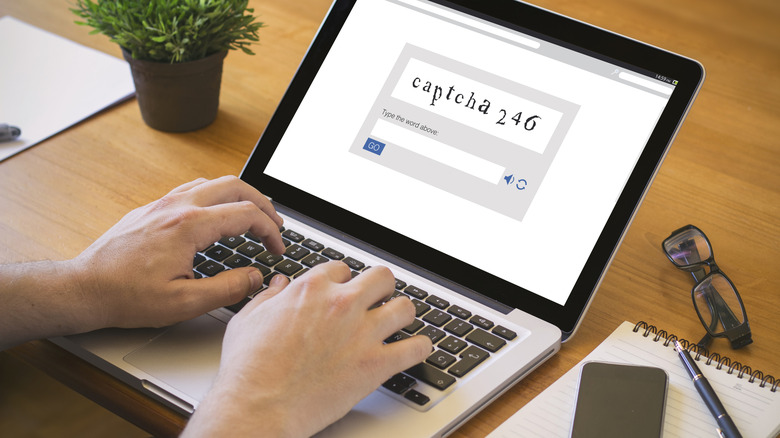
"I'm Not a Robot" features memorable levels inspired by games like Candy Crush and Minecraft (which Google's AI played without training), but most of the challenges are based on real CAPTCHA. Many ask you to decipher distorted text, just like the original CAPTCHA created by von Ahn and co. It was an effective safeguard against bots because computers struggled to decipher distorted text far more than humans. Some of those early CAPTCHA actually used text lifted from old manuscripts that computers couldn't decipher, turning their users into unwitting translators who helped digitize countless documents.
CAPTCHAs that ask you to select a series of images are even more effective because, to solve them, you have to be able to both identify objects within images and put words to those objects. When you see a bicycle, you know it's a bicycle, but a computer doesn't know how to associate that jumble of pixels with the text "bicycle." Argawal's game takes this to the extreme at one point by asking users to pick images of things that have a soul.
These days, you'll often encounter CAPTCHAs that simply ask you to click a checkbox labeled "I'm Not a Robot," which inspired the title of Argawal's devious game as well as its first level. You might think this CAPTCHA seems too simple, but the checkbox isn't actually the point. What the CAPTCHA really does is check your mouse movements, the time you spend on the page, and other background information to determine whether your actions feel organic or preprogrammed.
CAPTCHAs have flaws

Within a few years of their invention, CAPTCHAs were all across the internet, helping to prevent malicious bots from manipulating and stealing important data. Of course, malicious people immediately set about trying to create AI that could solve CAPTCHA challenges, and soon, those distorted text challenges weren't enough. In 2014, researchers from Google reported that AI could solve distorted-text CAPTCHAs with a frightening 99.8% accuracy. This prompted Google to develop reCAPTCHA v2, which is the one with the "I'm not a robot" checkbox. Unfortunately, it's now been shown that ChatGPT can solve these CAPTCHAs as convincingly as a human.
As CAPTCHA gets more challenging, there are concerns about accessibility for people with visual impairments. Conditions like cataracts, glaucoma, and macular degeneration, which are especially common in seniors, make it challenging to discern contrast. When those people are faced with a set of blurry, warped letters to decipher, it can be incredibly discouraging. There are auditory CAPTCHA alternatives, but they are highly flawed, being both easy to hack and difficult for users to solve due to background noise. A study conducted on a group of blind people in 2009 showed only a 45% success rate for audio CAPTCHAs, with some users needing more than a minute to solve them. Balancing accessibility for human users and inaccessibility to bots is a challenging but essential priority, lest we find ourselves in a world like "I'm Not a Robot," forced to assemble virtual IKEA furniture just to check our emails.