

5 Free Apps That Can Turn Your Phone Into A Survival Tool
We're so used to relying on the internet that it's easy to forget we can lose the connection at any moment. Natural disasters, remote locations, and overloaded networks can all influence your access to communication. Thankfully, the same smartphone you rely on for day-to-day tasks can help you in emergencies, even offline, if you're well-prepared. In fact, with the help of some often-overlooked apps, you can easily access life-saving first aid instructions, secure communication, or a portable encyclopedia — even when networks fail.
When emergencies strike, confusion and lack of information often make situations worse than they need to be. Having the right apps installed on your device means you'll be prepared to take action when needed. After all, your mobile phone is one tool you're almost guaranteed to have nearby in case of an emergency. So, go ahead and install the following five apps that will transform your phone into a survival tool that could one day save your life.
First Aid - IFRC
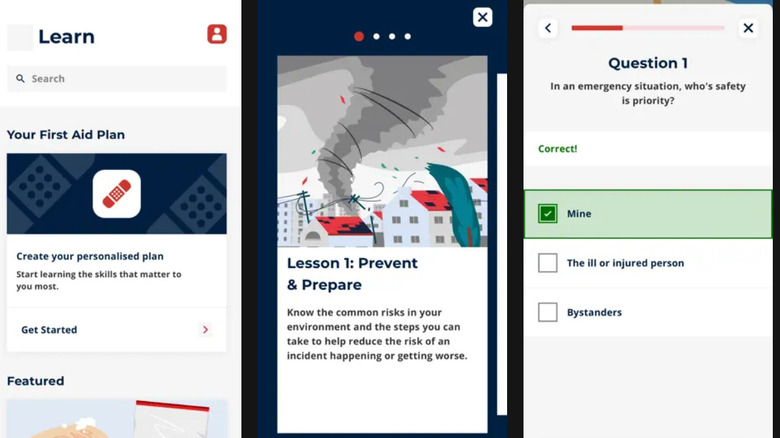
First Aid by the International Federation of Red Cross and Red Crescent is a life-saving app everyone should have. Best of all, it's available for free on both the App Store and Google Play. Emergency situations can occur anytime, and it's crucial to be able to access information quickly. The First Aid app helps you tackle the most common medical emergencies — such as choking, hypothermia, and fever — through short, step-by-step advice, written in plain language everyone can understand. There are even video guides, animations, and interactive quizzes you can take to learn what to do in certain emergencies.
Beyond medical emergencies, the app also offers safety and preparedness tips for various weather emergencies. Available in multiple languages, there's also an emergency call button always present, so you can contact emergency services at any time. You can use it even across borders, as the app integrates international emergency numbers such as 911, 999, 112, and others. The best part, however, is that the First Aid app comes with preloaded content, meaning you can access the emergency guides even in situations where you don't have an internet connection.
Briar
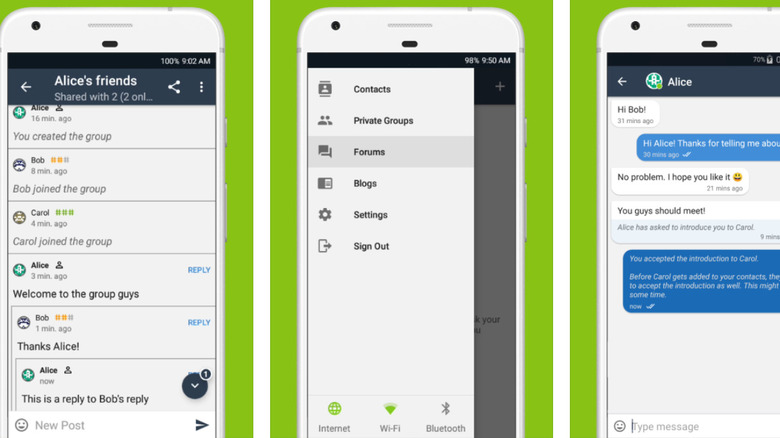
Briar is one of the most popular privacy-oriented and encrypted messenger apps used by journalists and activists around the world to convey sensitive information. However, it's worth noting that this messaging app is very restrictive when it comes to functions such as discoverability, video chat, or voice chat. Even taking screenshots within the app is impossible — but that's the entire point. It's not supposed to be used as a social media messaging app. Briar is designed as a secure communication tool for anyone who needs secrecy and is worried about surveillance and censorship. Nonetheless, Briar still supports features like group chats, forums, and blogs.
Unlike most mainstream messaging apps, Briar doesn't use a centralized server. Instead, it uses a direct, encrypted connection between users' devices. When online, the app uses the Tor network for user-to-user communication. If there's no internet access, the app can rely on Bluetooth and Wi-Fi. It can even sync the device's memory cards to keep the conversation off the network completely. That way, the information can continue flowing between users, even in the toughest crises or in remote locations. At the moment, Briar is only available for mobile download via Google Play. That said, its developers have also released a version that works with Windows, macOS, and Linux.
Kiwix
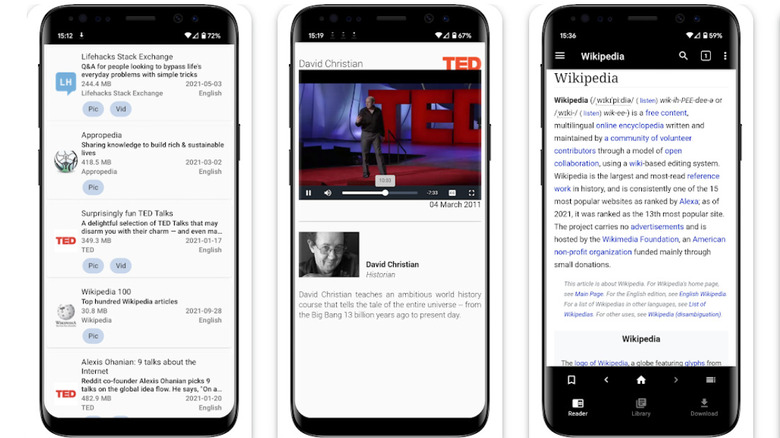
Kiwix is an app initially designed for offline Wikipedia use. However, it has since grown to include texts from Project Gutenberg, Stack Exchange sites, TED Talk conferences, and more. An open-source offline web browser available on both the App Store and Google Play, Kiwix is completely free, which means you can use it in areas without internet anytime, anywhere. It's especially useful if you ever find yourself in an emergency situation and need to look up essential survival information, like learning how to navigate without a compass or how to create simple tools with limited resources. Considering you can access a vast amount of critical information through Kiwix, you can even use it to repair your car if it breaks down in the middle of nowhere or follow a CPR guide to save someone's life.
As a knowledge repository, Kiwix allows you to build an off-grid knowledge library, making it a great tool for preppers, survivalists, and adventurers. You can even pair this app with a Raspberry Pi to create an offline data warehouse stocked with essential information you might need. The best part is that Kiwix is simple to use as it mimics web browsers. Better yet, it's also ad-free and it doesn't collect personal data.
iNaturalist
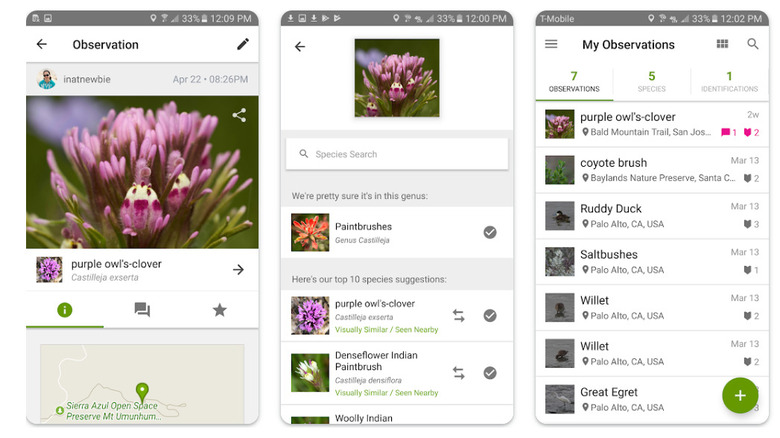
iNaturalist is a powerful and free app that helps you identify plants and flowers using your phone's camera. Simply take a photo of a plant, animal, fungi, or other organism, upload it to the app, and it will help you identify it. Created by the California Academy of Sciences alongside the National Geographic Society, it allows users to get help from real scientists and knowledgeable enthusiasts around the world. That said, the biggest asset that comes with this app is its community: People can suggest identifications and contribute to the global database. Available on the App Store and Google Play, iNaturalist also allows you to join different science projects — some focused on specific geographic areas, and others centered on particular species. By contributing your own observations, you can help scientists catalogue more organisms and advance real-world research.
In short, iNaturalist is a must-have if you ever find yourself in nature and need to identify poisonous or venomous species of both plants and animals. Additionally, you can even use the app to record and store your observations — including photos, date, time, and GPS location — while offline. However, you'll need internet access to actually upload and identify them. Nonetheless, although it doesn't fully work offline, it's still a great app to have on hand in places where you might only have a limited or intermittent connection.
Avenza Maps
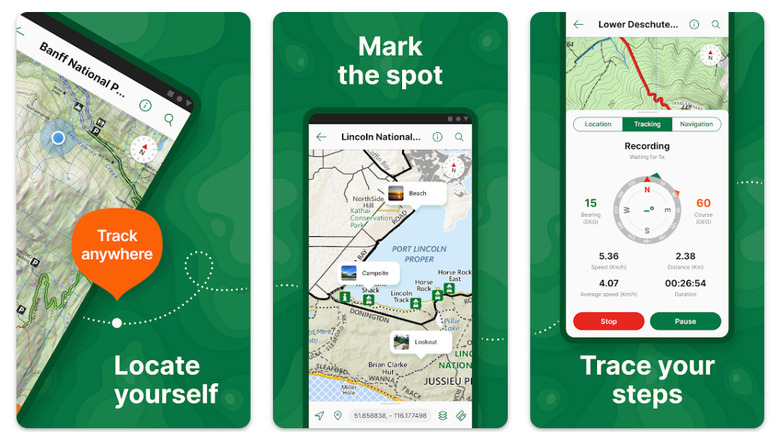
Avenza Maps is one of the best Google Maps alternatives designed for adventurers, professionals, and anyone who needs reliable navigation without internet access. You can use it to download detailed maps that range from topographic to recreational and specialized use cases. Once maps are stored locally, users can easily access them at any time. Most importantly, Avenza uses your phone's GPS to show your real-time location on the map — even if you're deep in a remote area without network connectivity.
But it's not just maps that you get with Avenza. Available to download for App Store and Google Play users, the app comes loaded with useful tools such as measuring distance, dropping pins on certain locations, recording GPS tracks, and attaching geotagged photos. This can greatly help you not only find your way, but also plan your next adventure or document it on the spot.
Although the basic version of the app is free, you can unlock some advantages if you pay for a subscription. For example, while the basic version only lets you upload up to three custom maps and use the pin tool, a subscription allows unlimited custom map uploads. Plus, you also receive access to additional professional-grade features, like shapefile support, advanced drawing and measuring tools, and data export and sharing options.
Methodology

In order to select the top five best survivalist apps for smartphones, we focused on diversity of function, widespread adoption, and proven reliability in real-world situations. Each of these apps serves a specific purpose, ranging from medical guidance to secure communication, information access, environmental awareness, and navigation. Together, these five apps address multiple challenges that could potentially arise when connectivity is limited. Along with usability, we also favored apps that have already demonstrated their value during emergencies, outdoor activities, or infrastructure disruptions where offline access is essential.