

This Cool New Car Could Change The Future Of EV Batteries Forever
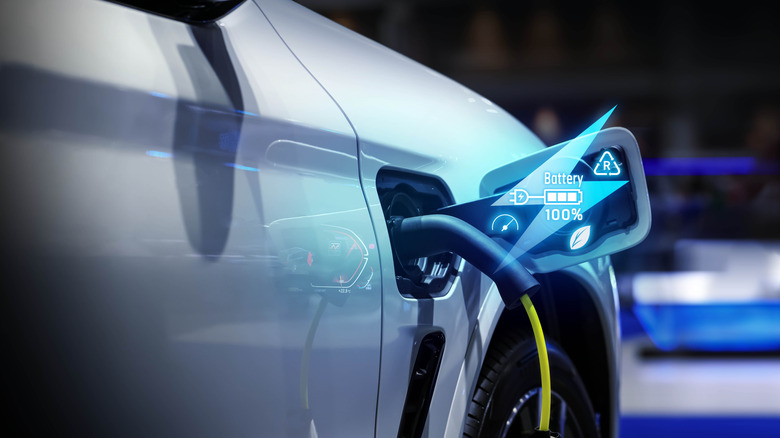
Batteries in electric vehicles (EVs) play a key role as they are the fuel that powers the motor to rotate the wheels and move from point A to B when you floor the accelerator. That's why many buyers pay attention to how far a given electric car can travel on a full charge, and EV manufacturers offer a warranty on the battery pack. But the battery packs used in modern EVs aren't perfect, even as manufacturers work their way to squeeze more range and reduce capacity loss over the course of the car's lifespan. At the core of the current EV revolution has been the use of lithium-ion batteries. However, a viable rival has just arrived on the scene in the form of sodium-ion batteries. While there's been talk in the industry about the use of sodium-ion batteries, the technology hasn't been used in any production passenger EV until recently.
An EV manufacturer in China by the name of Changan Automobile has just unveiled the Nevo A06, the company's first mass-produced car powered by a sodium-ion battery pack, instead of the universally used lithium-ion battery. The sodium-ion battery pack powering the Nevo A06 is from China's Contemporary Amperex Technology Co., Ltd. (CATL), the biggest EV battery manufacturer in the world. Since CATL supplies major automakers like Tesla and Volkswagen, the new sodium-ion battery could be a game-changer in the future of the EV market as we know it because it addresses one of the major weaknesses that plague the widely used lithium-ion batteries.
What makes sodium-ion batteries a game-changer
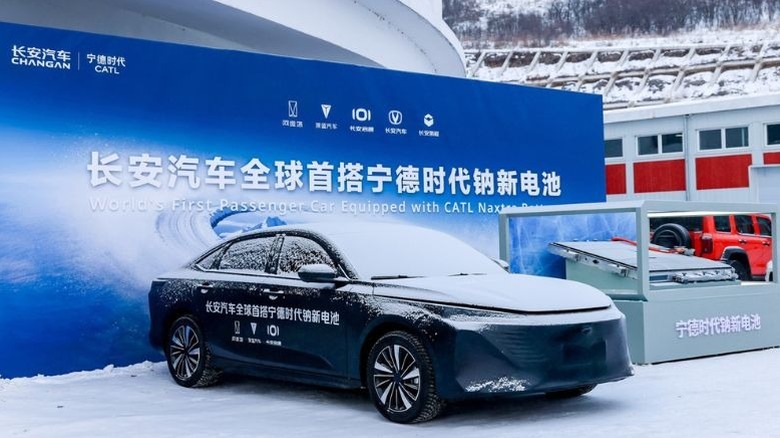
Current EVs use lithium-ion batteries that come in three flavors depending on the materials used for the positive electrode (the cathode): lithium-iron-phosphate (LFP), nickel-manganese-cobalt (NMC), and nickel-manganese-cobalt-aluminum (NMCA). Each flavor has its pros and cons, but the major setback across the board is that EV batteries drain faster in the winter. CATL's Naxtra sodium-ion battery pack aims to address this by delivering better performance in extremely cold conditions. According to CATL, the battery pack is able to deliver almost three times more power than that of an equivalent LFP battery at -22 degrees Fahrenheit and could still operate normally at -58 degrees Fahrenheit with "stable power delivery."
EVs lose a good amount of range in cold conditions, but the sodium-ion pack is said to have maintained over 90% of its capacity at -40 degrees Fahrenheit, an impossible feat to achieve for LFP batteries. In fact, according to Consumer Reports' winter testing, EV range starts to drop at 40 degrees Fahrenheit in current cars. Consumer Reports also found that you lose about 25 percent of range at 16 degrees when riding at 70 mph compared to driving at the same speed when the temperatures are in the mid-60s. That should tell you just how much sodium-ion batteries could be a game-changer, especially for those living in the snowbelt. It could also make snowbelt dwellers consider joining the EV bandwagon without worrying about performance in extreme cold.
A dual-battery future for the EV industry awaits
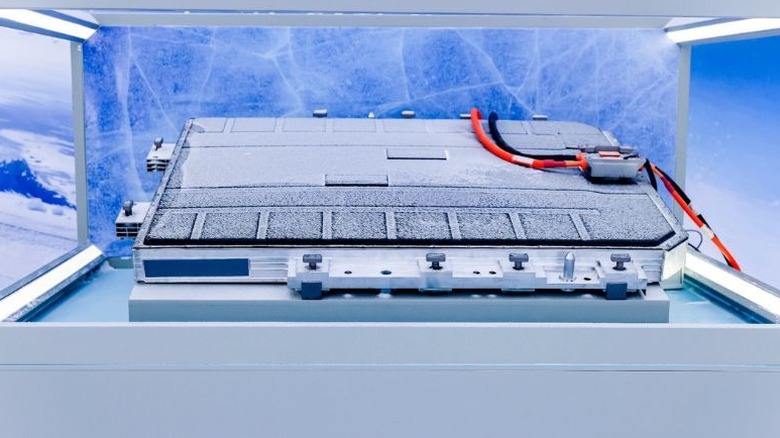
While the solid performance of sodium-ion batteries in extreme weather will be useful in cold seasons, this doesn't spell the end of the road for lithium-ion cells. CATL says this is only a major step in the industry toward a "dual-chemistry ecosystem," where the two battery technologies will "complement each other to meet diverse customer needs." The current version of CATL's Naxtra battery pack has a 45 kWh capacity with a range of over 249 miles (based on China's CLTC test cycle). However, CATL says the range is expected to reach between 310 and 372 miles in the future. But if you're an avid EV follower, you know that 249 miles (and even the projected 372 miles of range) isn't groundbreaking by any measure, as some existing EVs already offer north of 400 miles.
The 2026 Lucid Gravity, for instance, is an SUV with an EPA-estimated range of up to 450 miles on its Grand Touring trim. Sodium-ion batteries aren't seen as the ultimate replacement for lithium-ion, but for those in cold regions, they could be the answer to finally adopting EVs. As of this writing, there's no information on whether we will see sodium-ion battery EVs in the U.S., but Changan Automobile is looking to adopt the technology across its portfolio with CATL as the supplier after the Nevo A06 starts selling in the Chinese market in mid-2026.