

A Swarm Of 33 Earthquakes In 90 Minutes — Is San Francisco In Trouble?
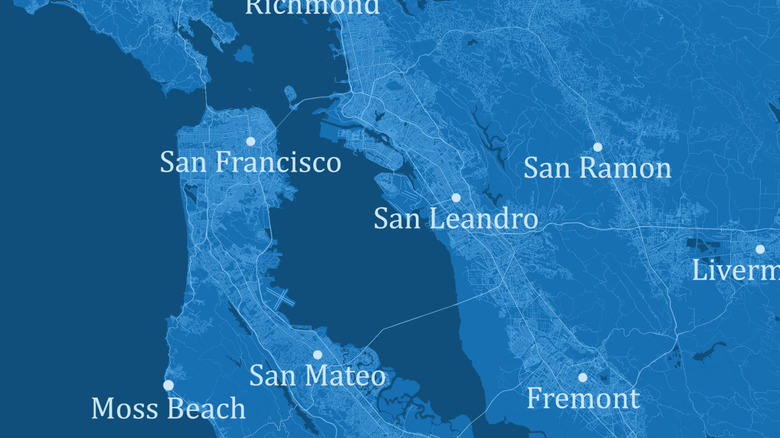
For residents of the San Francisco Bay Area, 2026 got off to a shaky start in the most literal sense imaginable. On the morning of February 2, between 6:27 and 8:00 local time, a series of no fewer than 33 earthquakes rocked the San Ramon Valley, 28 miles east of San Francisco. The United States Geological Survey recorded the strength of the tremors as ranging from magnitude 1.3 up to magnitude 4.2, strong enough to knock items off the shelves at several local businesses. Fortunately, nobody was hurt, and seismologists were quick to remind the public that such events aren't indicators of even bigger earthquakes brewing. However, for a region notorious for seismic activity, such a large number of earthquakes occurring in such a short time span was alarming to say the least.
San Francisco has a reputation as one of the most earthquake-prone cities in the world, a reputation it largely gained from two catastrophic events. On April 18, 1906, an earthquake and consequent fire destroyed roughly 500 blocks of the city and left an estimated 3,000 people dead. The quake remains one of the most infamous natural disasters in American history. Eighty-three years later, the Bay Area fell victim to the Loma Prieta earthquake, which killed 63 people and caused a portion of the Bay Bridge between San Francisco and Oakland to collapse. The region has been haunted by the specter of these losses, but this month's quakes need to be considered in their own right.
Earthquake swarms are unsettling, but not uncommon
When a series of earthquakes occurs in the same area in a very short time, like the 33 quakes felt by the San Ramon Valley in just 90 minutes, seismologists call it an "earthquake swarm." That's a scary-sounding term, but it's actually a normal occurrence around fault lines, something that the San Francisco Bay Area has a lot of. There is most famously the massive San Andreas Fault, which stretches up the California coast line, right past the peninsula on which the city of San Francisco stands. It was where the epicenters of the 1906 and 1989 earthquakes fell (not to mention the subject of an unintentionally-hilarious Dwayne Johnson movie).
That's not the only fault line in the area though, nor even the most active. To the east of the San Andreas Fault lie the Hayward and Calaveras fault lines, which both experience a higher percentage of seismic activity than the San Andreas. The San Ramon Valley lies just east of these fault lines and west of yet another one called the Greenville Fault. The valley is surrounded on all sides by fault lines, so it's no surprise that an earthquake swarm should occur there. However, this wasn't just a single event we're talking about.
The 33 earthquakes of February 2nd followed similar swarms that hit the region in November, December, and January. The latest batch was the strongest yet, and many residents are unsettled. However eerie the recurrences are though, we can't assume much from them.
There's no reliable way to forecast earthquakes
Anyone who's lived in the San Francisco Bay Area has heard murmurings about the "Big One," a catastrophic quake on the scale of 1906 that everyone in the region dreads. Each time a tremor is felt by the Bay, somebody is bound to wonder aloud if the Big One is finally here, and four straight months of earthquake swarms has people even more on edge than usual.
Seismologists are telling a less fretful tale though. The swarms hitting the San Ramon Valley aren't happening right on the major faults, but rather on much smaller fault lines between them. The swarms likely result from fluid from deep within the Earth trickling through the cracks, but these tiny fault lines can't produce earthquakes on the scale of 1906. It's highly unlikely that the San Ramon Valley could be the epicenter of a major quake, and as for the rest of the San Francisco Bay Area ... nobody can say.
There is simply no way to reliably predict earthquakes, not even a prolonged period of seismic activity like what the East Bay Area is going through at the time of this writing is an indication of future earthquake activity. The past provides a lesson in this; in 2015, scientists predicted a 99% chance of a magnitude 5.0 earthquake hitting Los Angeles within the next three years. That didn't happen, and a quake of that magnitude has yet to hit the city since. Uncertainty is scary, but it's the reality of living in a fault zone.