

The Furthest Galaxy From Earth Has Scientists Baffled
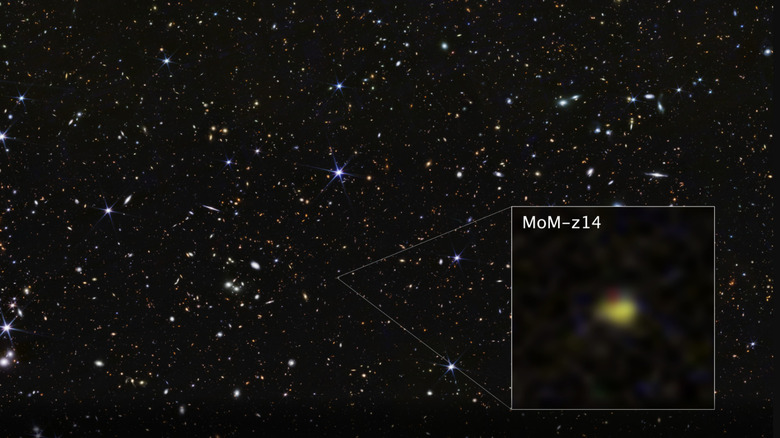
On Jan. 28, 2026, NASA announced that its James Webb Space Telescope had spotted its furthest detectable galaxy to date. The announcement marks the closest astronomers have come to studying the early origins of our universe, showing it as it appears just 280 million years after the Big Bang. The galaxy, dubbed MoM-z14, is surprisingly bright, challenging long held theories about the early formation of stars. In NASA's corresponding press release the study's lead scientist, Rohan Naidu of MIT, declared, "With Webb, we are able to see farther than humans ever have before, and it looks nothing like what we predicted, which is both challenging and exciting."
Dubbed a "cosmic miracle" by the study's authors, the galaxy possesses several anomalous chemicals that challenge notions of early star and galaxy formation. For instance, its nitrogen levels suggest that its massive stars formed faster than scientists had previously predicted, while its possession of primordial hydrogen gas refutes notions that the young universes possessed only neutral hydrogen.
Perhaps the most important implication of the findings is the notion that the gap between man's knowledge of the universe and the reality continues to grow. Luckily, the study also points to a growing possibility of discovery, as the findings vastly outpace what scientists thought possible prior to the James Webb Space Telescope, consistently seeing farther galaxies via infrared scope. With the launch of the Nancy Grace Roman Space Telescope headlining a series of changes coming to NASA, diving into the secrets of our universe's earliest days has never been more exciting. That is, unless the Trump administration's proposed budget cuts undercut said missions before they can get off the ground.
A look into the early days of the cosmos
According to the study, MoM-z14 is s "brighter, more compact, and more chemically enriched" than astronomers had thought possible for a galaxy of its period. Published in the scientific journal Open Journal of Astrophysics, the journal is the latest in a line of James Webb Space Telescope-generated breakthroughs in understanding our universe.
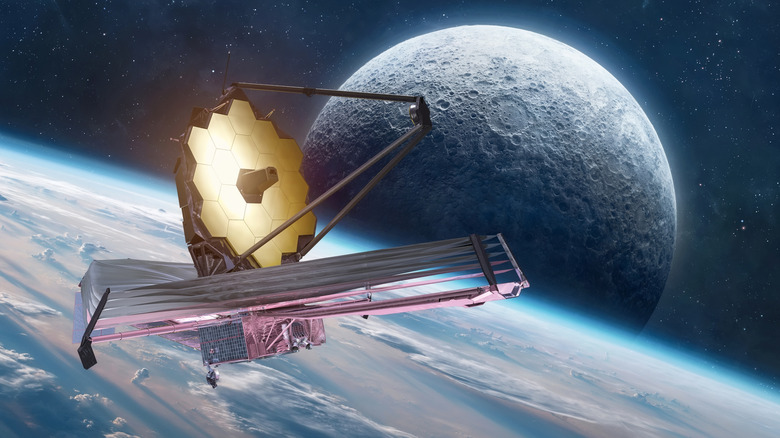
Determining how distant MoM-z14 is from Earth is a difficult task given its extreme distance. JWTS's Near Infrared Spectrograph, a instrument that determines how long light has been traveling due to the presence of its red wavelengths, determined that the "cosmological redshift" of the galaxy's light had been traveling for roughly 13.5 billion years, only 280 million years into the universe's existence. MoM-z14 is amongst a group of bright galaxies from these early years of the universe, which Webb has found to be 100 times more luminous than predicted.
According to the researchers, many of these stars are defined by what researchers dubbed "unusual nitrogen enrichment." These levels are surprising, as scientists believed that there was not enough time after the Big Bang to generate that much of the gas. One potential reason is that the high density of these early days of the universe resulted in supermassive stars capable of generating nitrogen at an extremely fast rate. Another quandary is the how the galaxy "cleared out" the primordial hydrogen that typically surrounds galaxies of this time period, similar to fog. In what scientists call a "reionization" or "clearing" period, the researchers believe that supermassive stars located within these galaxies like MoM-z14 might have produced enough energy to break through these dense gases . NASA credits the Webb telescope as being essential to work through these early, foggy periods, further underscoring the utility of advanced telescope technologies.
The future of NASA's space studies
MoM-z14 fits within a larger trend of NASA using advanced telescopes to peel back the curtain on these early stages of creation. Prior to the James Webb Space Telescope, the farthest of these bright galaxies ever discovered was roughly 400 million years after the Big Bang. Discovered by the Hubble Space Telescope, GN-z11, located in Ursa Minor, was shown 13.4 billion years in the past. The James Webb Space Telescope has since confirmed this distance, according to NASA.
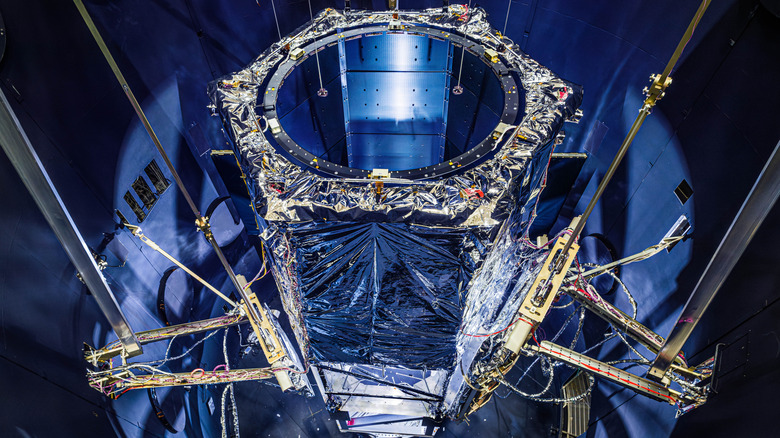
The James Webb Space Telescope is critical to uncovering the universe's secrets, and it has been instrumental in building man's understanding of star formation and the earliest days of the universe. For example, a January 2026 study redefines how astronomers understand one of the universe's largest galaxy clusters, JADES-ID1. Similar breakthroughs are expected of NASA's next great space telescope, the Nancy Grace Roman Space Telescope. Named after the famed American Astronomer, NASA finished construction of the telescope in January 2026. Slated to launch as soon as Fall 2026, the instrument will reportedly dive into some of the cosmos' most impenetrable mysteries, beginning with the study of dark matter and dark energy. According to NASA, the telescope will have a field 100 times larger than Hubble's, and will potentially capture images from billions of galaxies.
Unfortunately, the U.S. government has NASA within its budgetary crosshairs, painting a bleak picture of NASA's future. Luckily, in January 2026, Congress rejected an attempt to cut NASA's budget by $6 billion, saving the NGRST and its potentially groundbreaking work, for now.