

This Theoretical Spaceship Is Longer Than Most Cities Could And Transport Humans For Centuries
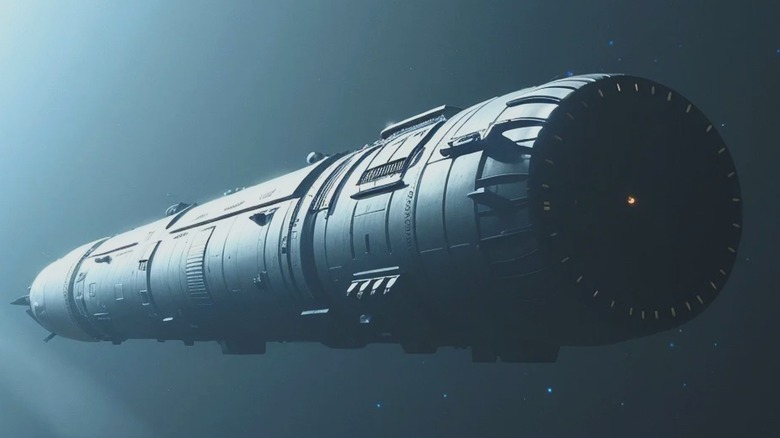
Mankind has imagined traveling to the stars (and what awaits us there) for as long as we can remember. However, the closest star system is Alpha Centauri, approximately 4.24 light-years away. If we plan on visiting, we'd need a ship like the Chrysalis, a theoretical generation ship helmed by Giacomo Infelise and his team of engineers and architects. If produced, the Chrysalis would stretch a massive 36 miles in length. By comparison, Manhattan Island is only 13.4 miles long.
Now, you're probably wondering why the Chrysalis would need to dwarf most cities. The crew of the USS Enterprise (NCC-1701D) from "Star Trek: The Next Generation" only needs a vessel that is 641 meters long, which isn't even half a mile. Well that's because they have faster-than-light travel technology (which might be possible according to some studies) and can drop by established outposts to stock up on supplies. The Chrysalis, meanwhile, is designed for the long haul, so it needs enough space to produce and recycle enough food, water, oxygen, gravity, and fuel to last thousands of humans for approximately 400 years.
While the Chrysalis project provides numerous details about the ship's design, it makes several assumptions, such as how the Chrysalis will generate energy for propulsion and other systems. The team behind the documents believes a "Direct Fusion Drive" that runs on helium-3 and deuterium will be best, but right now that's just an educated guess since nobody has a reactor that can sustain such a ship. And given recent trade wars, that dream might not come to fruition for a while.
The Chrysalis is more than a ship; it's a civilization

The concept of a generation ship isn't new. In fact, you've probably seen some in your favorite sci-fi shows and movies, but that isn't what makes the Chrysalis so special. The design documents go into an absurd amount of detail on the ship's architecture and how all the systems are interconnected, including their redundancies. The plans also detail how the vessel would generate and distribute gravity throughout itself, as well as where the ship would be constructed.
As the Chrysalis would house thousands of people for hundreds of years, the design plan takes into account all the necessities of civilization and integrates them into the design. At 36 miles long, the Chrysalis will have plenty of room for schools, hospitals, and libraries, as well as farmlands and forests, all filled with insects, livestock, and other necessities. However, cities are more than just buildings and resources; they need stability.
The Chrysalis project goes into detail about how the ship would self-govern and avoid a societal collapse. According to the project brief, this would start in an Antarctic station designed to weed out anyone who can't stand the rest of their life cut off from the rest of the world and culminate in a community-based family unit to preserve "technical and cultural continuity." Oh, and an AI would help make governing decisions.
It's a one-way trip, one way or another
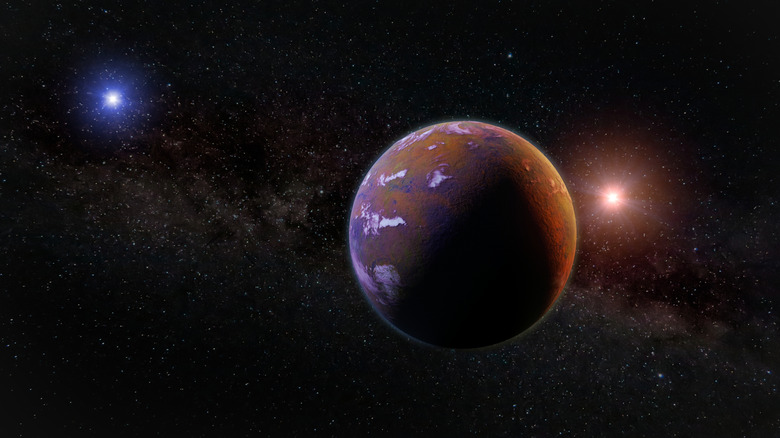
Once the Chrysalis reaches the Alpha Centauri system, passengers will land on the Earth-like planet Proxima Centauri b. But once there, what then? Sure, if Proxima Centauri b is a verdant planet with a large ocean teeming with life, then mission successful, but what if living on Proxima Centauri b is impossible? The crew might have a ship, but not necessarily a way back. The Chrysalis would have taken a beating to reach Alpha Centauri, and even if the ship had energy to spare, the technology would be breaking down. And that's to say nothing of the societal impact of staying 400 years within the confines of the Chrysalis. According to the project brief, society, government, and the economy would be in a bad spot after several centuries. Not unraveling, but definitely at an all-time low for the Chrysalis' inhabitants.
Currently, all plans surrounding the Chrysalis are purely theoretical. Could a ship last 400 years and maintain a population several-thousand strong? Will the passengers not succumb to space madness and unwittingly sabotage the vessel partway into the journey? Is Proxima Centauri b even habitable? For all of the work that went into the project, the answer for each is a great big "maybe." Still, the Chrysalis might be one of our best bets to establish an extra-solar civilization.