

Nvidia GPUs: Here's Who Makes Them And Where They're Manufactured
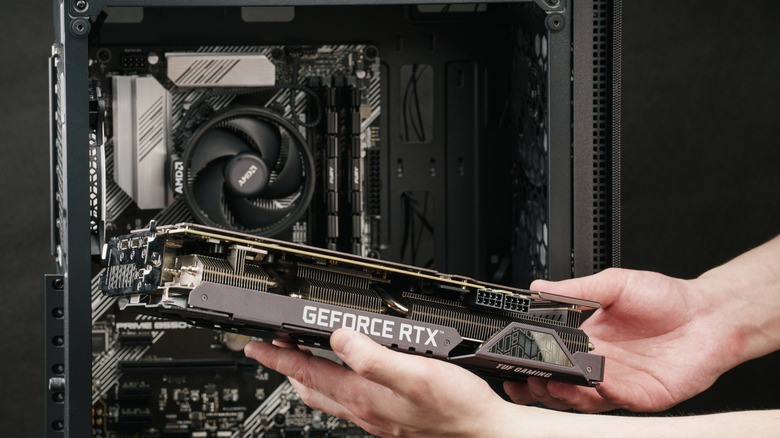
Nvidia has transformed from a PC gamer's favorite into one of the most valuable and influential tech giants in the world, and its rise hasn't slowed down since its rapid ascent in 2022. The company's explosive growth mirrors the surge in artificial intelligence, a market that has depended heavily on high-performance GPUs. Nvidia was uniquely positioned for this moment thanks to its graphics cards already being recognized as industry leaders for the commercial space, and its AI-powered technologies, such as DLSS upscaling and advanced tensor processing, gave it a significant leg up as demand for AI hardware boomed. But with success has come increased scrutiny. Nvidia's latest best-valued graphics card has been notoriously difficult to find in stock or at MSRP.
While Nvidia designs its chips and architecture, it doesn't fabricate or assemble its own hardware. Instead, GPU production involves a global network of manufacturing partners, such as Taiwan Semiconductor Manufacturing Company (TSMC) and Samsung, as well as multiple third-party assemblers responsible for everything from water fabrication to custom PCBs, cooling systems, and firmware. This multi-step process spans several countries and specialized facilities, each playing a crucial role in producing the graphics cards that power today's AI boom.
Where are Nvidia GPUs made?
Nvidia GPUs are primarily made in South Korea and Taiwan. Modern graphics cards begin their life inside massive semiconductor fabrication facilities. These are highly specialized and ultra-expensive factories known popularly as "fabs." Remember that Nvidia doesn't operate its own fabs; instead, it relies on industry partners to manufacture its GPUs. The most important of these partners is TSMC, the world's leading chipmaker and the producer behind many of Nvidia's most advanced GPUs. Nvidia also collaborates with Samsung and SK Hynix in South Korea to develop specialized processors and memory components, underscoring the global nature of GPU manufacturing.
After the wafers are produced, they're tested, sliced into individual GPU dies, and shipped to add-in board partners (AIBs), companies such as ASUS, MSI, Gigabyte, EVGA, and others. These AIB partners transform bare chips into the finished graphics cards you see on store shelves by adding high-speed video memory, custom PCBs, power-delivery components, and cooling systems. They also handle the famed gamer aesthetic elements: RGB lighting, branding, factory overclock features, and packaging.
Nvidia is bringing more production to North America
For decades, most semiconductor manufacturing has been concentrated in Asia, but the United States is now making a major push to rebuild its domestic chip-making capabilities. The federal government, under both the Biden and Trump administrations, has emphasized reducing America's reliance on overseas fabs like TSMC. The CHIPS and Science Act has played a central role in this effort, directing billions of dollars in federal investment toward new fabrication plants, research initiatives, and supply-chain incentives to strengthen U.S. semiconductor production.
Even as political leaders debate the specifics, both parties have signaled strong support for expanding American semiconductor manufacturing to improve national security, stabilize the tech supply chain, and ensure companies like Nvidia, AMD, and Apple aren't wholly dependent on foreign foundries.
As a result, several major chipmakers and manufacturing partners have announced new fabs and assembly facilities in states such as Arizona, Ohio, and Texas, marking what very well may be the beginning of a long-term shift towards more resilient, diversified GPU and CPU production in the United States.