

Comet C/2025 K1 (ATLAS) Has Split Into Three Pieces
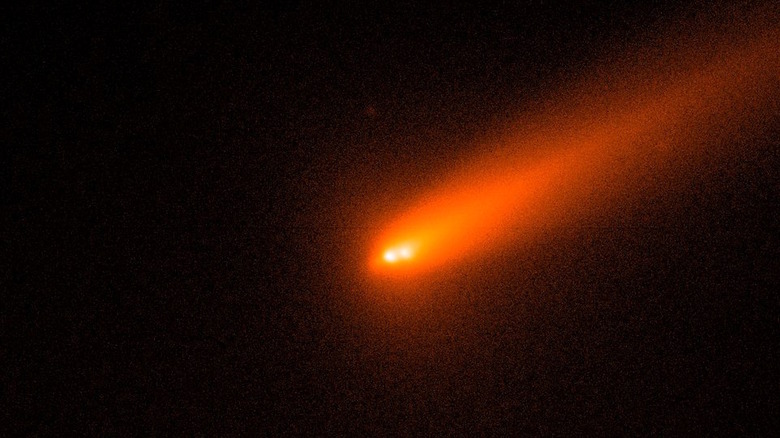
Italian astronomers captured rare footage of Comet C/2025 K1 ATLAS tearing itself apart in real-time. The comet's October 8 solar pass vaporized subsurface ice, creating gas pressure that cracked the nucleus from the inside. This leads to an outcome even stranger than 3/I ATLAS's acceleration mystery. While the structural damage was done in October, the comet didn't visibly fragment until a month later when astronomers caught the breakup in progress. Using the 1.82m Copernicus telescope located in the Asiago Observatory, they recorded the comet's break up on November 11-12.
A release from the Italian Institute of National Astrophysics (translated) says that the pieces of the comet are around 1,250 miles (2,000 km) away from each other. That's roughly the distance from Chicago to Miami, except these fragments are chunks of 4.6-billion-year-old ice hurtling through space at thousands of miles per hour.
The comet was discovered in May 2025 and steadily brightened as it approached the sun, but never became visible to the naked eye, unlike other comets. Astronomers suspected the close October pass would stress the comet's structure, making the November observations a priority for tracking potential changes. Astronomers captured the breakup evolving over 24 hours, showing how the fragments continued separating after the initial split.
A 4.5-billion-year-old time capsule
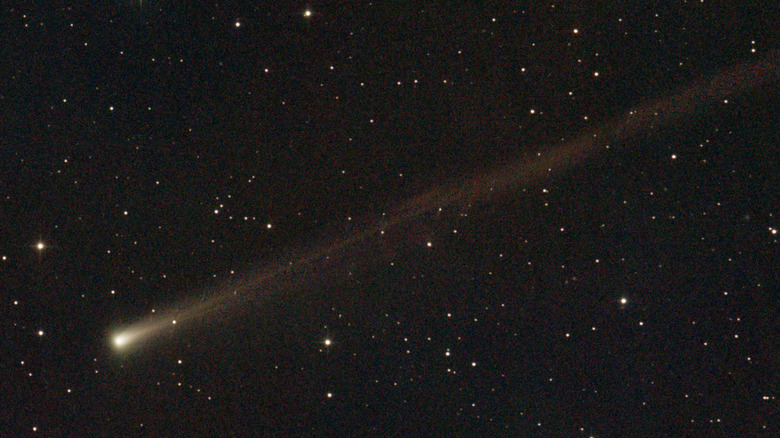
This comet is thought to have originated in the Kuiper Belt, a region of icy bodies beyond Neptune's orbit. While we don't know the comet's actual age, scientists believe it's roughly as old as the solar system itself — around 4.6 billion years. That ancient origin is what makes the breakup scientifically valuable. Getting information about the exterior of a comet, especially one this old, is useful, but it's even more important to get information about what's inside it. Comet surfaces get bombarded by solar radiation and cosmic rays for billions of years, altering their chemical composition.
Scientists have long studied how the solar system formed from its original ingredients. The breakup exposed interior material that's never been touched by solar radiation, giving researchers direct access to pristine samples from the solar system's formation. Analyzing the composition of freshly exposed material reveals what elements and compounds existed in the solar nebula. That's the cloud of gas and dust that eventually collapsed to form the sun, planets, and everything else orbiting today.
Researchers rarely get this kind of access since most comets either stay intact or fragment too far from Earth to study in detail. Italian astronomers happened to catch this one at the right distance with clear enough skies to capture the exposed interior material. Despite its breakup, this one, like other comets, is not a threat to life on our planet.
Capturing the split in real-time
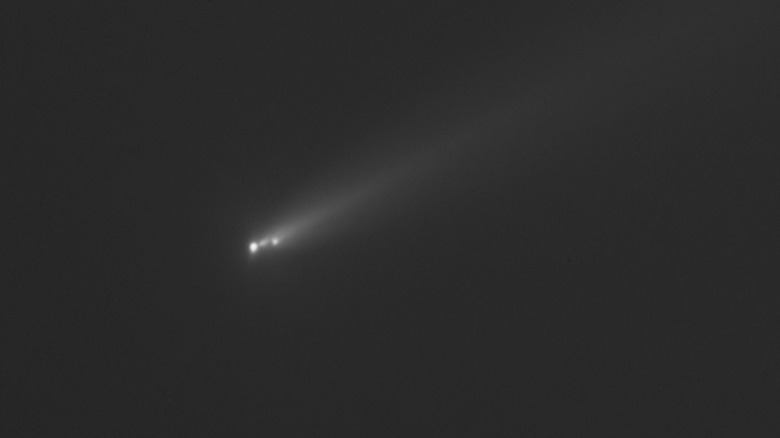
Italian astronomers at Asiago Observatory were tracking C/2025 K1 after its October solar pass when they caught it fragmenting on November 11-12. What they expected to be routine monitoring turned into documentation of a rare breakup event.
The telescope imagery shows two large, bright fragments and one smaller, dimmer piece trailing behind. Gianluca Masi of the Virtual Telescope Project captured additional observations on November 12-13, documenting how the fragments continued separating. Clear skies with minimal atmospheric turbulence allowed them to capture fine detail on an object millions of miles away.
Comet breakups rarely happen in places they can be observed, either due to it happening too fast, or too far away to be seen with a high-resolution telescope. Multi-night observations allow researchers to study how the fragmentation progressed, not just see the final state. The 24-hour observation window revealed the fragments were actively drifting further apart, with the debris field continuing to expand as the fragments drifted apart. Spectroscopic analysis of the exposed interior material will reveal the comet's chemical composition, providing direct evidence of what existed in the early solar system.