

The Best Place To Put Your Wi-Fi Router
Your Wi-Fi router placement could make or break your connection with the rest of your devices in your home. If you live in a multi-story home, and unless you've carefully crafted a good mesh network or installed a Wi-Fi range extender, your router could be the reason why your network connectivity is dropping. Usually, unless your house is small, a router can't cover all areas in your home at once.
You have to consider not only the size of your home, but also about the objects placed in it and the walls nearby. Wi-Fi signals coming from your router could easily be obstructed depending on the layout of your home. Instead of buying a better router to improve signal strength, identify where the dead zones are in your home, and that'll help with improving coverage. Correcting a misplaced router could be the magic fix to stabilizing your connection, and it is also the easiest solution to do.
Choose an open central location for your Wi-Fi Router placement
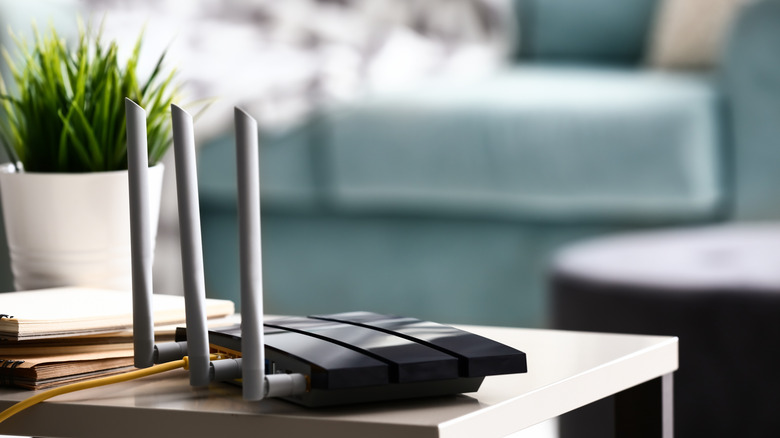
The best place to set up your Wi-Fi router is in an open, central area of your home. Doing so helps broadcast the radio waves at equal distances. When placing the Wi-Fi router in an open area, you also reduce the chance that impermeable objects will block any of these signals. That's why putting your router near thick walls, inside drawers, and cabinets is a huge no-no. It's also recommended to place the router on elevated surfaces so nothing gets in the way, like floors and furniture, and to ensure it doesn't get dusty (dust particles accumulate around carpets and floors).
Putting your router in the basement can also degrade the signal. Basements are often built with dense materials: Think of concrete and how difficult it would be for any electromagnetic wave to penetrate those walls. It is more likely to get absorbed and converted into heat. These factors can obstruct or absorb the signal, and they are also at the lowest part of your home, meaning the Wi-Fi signal is no longer centralized; the upper floors of your home are likely much weaker, further increasing the chance of it becoming a dead zone. Dead zones are the reason why you have slow speeds or dropped connections.
Consider other electronic devices and potential interference
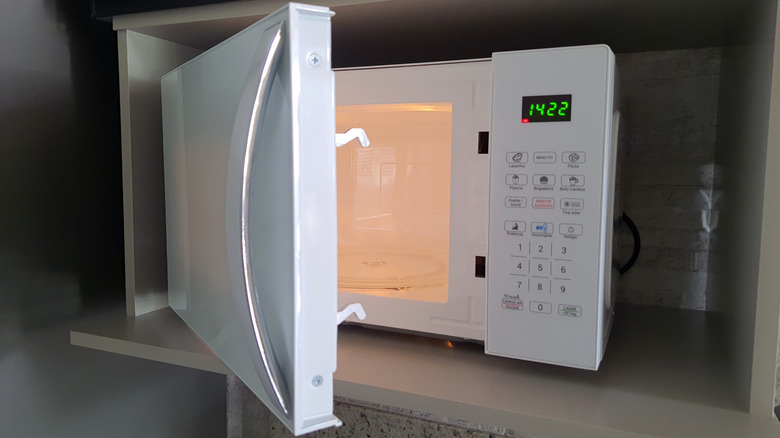
The physical placement of your router isn't the only reason why the signal can drop. Sometimes, interference from other electronics, such as microwaves, can weaken the signal because a low-end or old Wi-Fi router will operate in the 2.4 GHz frequency band. Most modern day routers will support 2.4 GHz, 5 GHz, and 6 GHz connections. If your router supports 5 GHz/6 GHz (via a dual-band or tri-band setup), it can help reduce interference, since microwaves operate outside that range. Just note that 5 GHz and 6 GHz will have a shorter range and weaker penetration than the 2.4 GHz band, but in return, they offer faster speeds.
The long-term solution would be to move your router/pair it with a wired connection, or upgrade your router. Most new routers don't operate exclusively on 2.4 GHz anymore, so this type of interference shouldn't be common. Though if it does occur, just be mindful of what can happen when you use the microwave or use other devices that operate on a similar frequency to your router. Microwaves aren't the only source of EMI (electromagnetic interference); you can experience it with various Bluetooth devices, such as speakers and wireless headphones, as well as fluorescent and LED lighting.