

How Much Power Can A USB Port Actually Deliver?
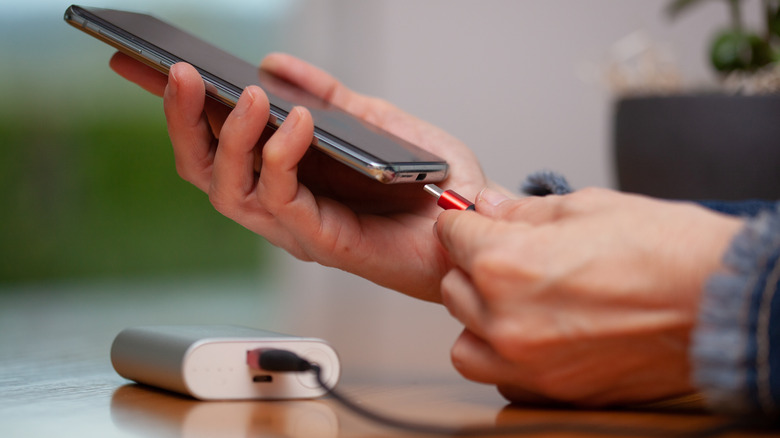
The Universal Serial Bus (USB) is a widely compatible connection standard for modern gadgets, including laptops and computers, as well as mobile devices, printers, and various peripherals. But one major feature that sets USB ports apart is the connector's version or generation. Older USB ports, like USB 2.0, tend to be slower and deliver less power than newer generations, like USB 3.2 Gen 2. That's why when you plug your device into a certain type of USB port, it charges slowly, or data transfer isn't available. For that reason, it matters which USB port you use on your computer and on other devices, including power adapters used for charging. But how much power can actually be achieved through USB?
The current highest achievable power output for consumer-grade USB is 240 watts through USB PD 3.1 over USB-C. The "PD" stands for power delivery, a charging protocol introduced with the widespread availability of USB-C connectors. It's essentially the next generation of USB, enabling faster and more reliable charging for high-power devices like modern phones and computers.
From there, speeds are slower. Maximum output is 100 watts via USB-C 3.0, 15 watts via standard USB-C, and 4.5 watts via USB 3.0. It's even lower for older standards, with USB 2.0 and USB 1.0 delivering 2.5 watts or less. Plugging a new fast-charging-capable smartphone into an older USB port or with non-compatible USB cables may result in slower charging overall, and potentially not enough to keep up with the drain. iPhone 15 and most newer devices, for example, require USB-C Power Delivery for charging capable of 7.5-watts or more.
Slow charging versus fast charging over USB

It's not just the USB ports in modern devices that are relevant. The output and power capacities also matter for power adapters, the chargers you plug into an outlet to charge your phone or tablet. The average power consumption for phone chargers is about 5 watts, while fast chargers use up to 20 watts or more. It really just depends on the adapter and whether it supports the PD protocol or not. The iPhone 17, 17 Pro, and 17 Pro Max all support up to 40-watt fast charging, while Samsung's Galaxy S25+ and S25 Ultra can charge at up to 45 watts with the right cable and adapter.
The PD protocol also sets portable power banks and charging systems apart, too. For example, some of the best USB-C power banks support fast charging thanks to their upgraded technology. In most modern vehicles with USB ports, you'll need an additional power adapter to enable fast-charging support. Overall, the takeaway is that the USB port, cable, and connector protocol matter for fast and slow charging. If you're using older ports or an adapter with low power output, your device is going to charge more slowly.