

Who Invented Nuclear Power? Here's Why That's A Complicated Question
The origins of nuclear power are complicated because it wasn't discovered by a single person. Nuclear power is a product of many scientists and engineers who worked across generations and borders. Nuclear energy emerged slowly through theory, trial and error, and persistence. Each separate contribution to the big puzzle of nuclear power arrived from a different country, a different political system, and for different purposes.
What we now call "nuclear power" is not one invention. It's a chain of discoveries that gradually revealed how energy is stored inside the atom, and how it could be released and controlled. But the first controlled nuclear fission reaction wasn't about electricity production. It was conducted as part of the infamous Manhattan Project and tied directly to World War II. From then on, humanity's ambition to control this newly discovered resource took a much darker turn. War and politics shaped the course of science, and the first atomic bombs were created. Nuclear energy also powers American aircraft carriers and submarines. However, without military use and research, we may have never learned how to harness nuclear power and put it to civilian use.
The origins of nuclear power
It's impossible to point a finger at one historic figure and say, "this is the person who invented nuclear power." Nuclear energy wasn't a product of one single flash of genius, or a single "aha!" moment. It's the result of decades of scientific discoveries made by dozens of individuals across many countries. Some even argue that it all started with ancient Greek philosophers who guessed that the smallest, invisible unit of matter called atoms existed. But it was the scientists of the 19th and 20th centuries who first discovered the nature of atoms. The atoms of certain elements are unstable, and they would release energy when going through the process of radioactive decay.
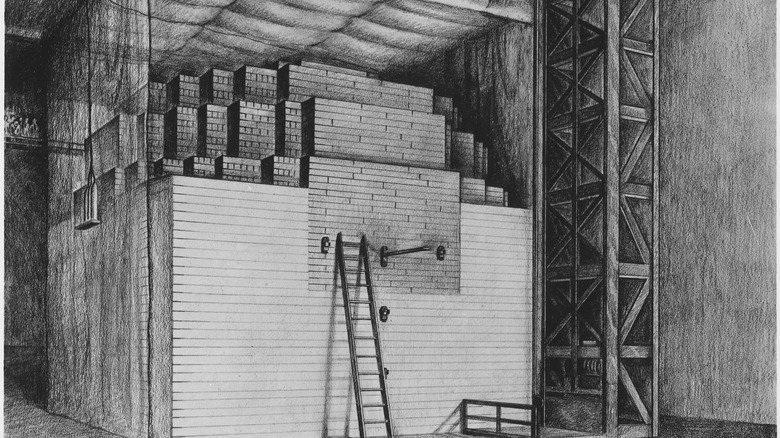
At the end of the 1930s came the discovery of nuclear fission. Scientists discovered that the nucleus of an atom could split and release a massive amount of energy. It was a major milestone, but not enough to achieve the quest for limitless energy. However, fission alone didn't produce usable energy that could be harvested and transformed into electricity. That's because the concept of chain reaction hadn't been confirmed yet. The first controlled chain reaction was achieved in 1942 by the Nobel Prize winner Enrico Fermi. This Italian-American physicist is now often called the "Father of the Nuclear Age."
Fermi's first reactor, known as the "Chicago Pile-1", was purely experimental. It produced barely any power, and it required no cooling. Converting fission heat into a reliable electricity power source meant solving many scientific and engineering problems. Reactor design, uranium enrichment, reactor cooling, and isotope separation were the steps that needed to be addressed. And it wasn't a task for just one person. Experts in metallurgy, physics, chemistry, and mechanical engineering all worked together to create the first stable nuclear reactor capable of producing electricity.
War and politics dictated nuclear power
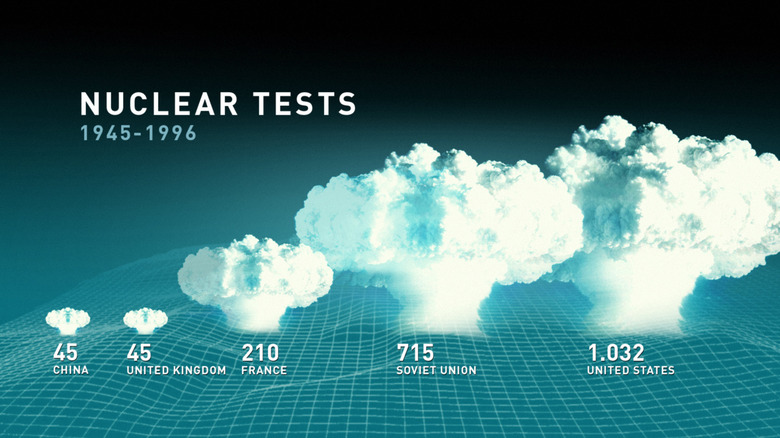
Throughout history, war has often been a catalyst for scientific discoveries and the rapid development and application of new technologies. Nuclear power wasn't an exception. The urgent military needs of World War II and massive government funding transformed nuclear fission into a weapon. A secret U.S. effort, known as the Manhattan Project, brought together thousands of scientists, engineers, and industrial workers to create the first atomic bomb. After all, during the war, most work on nuclear technology was devoted to weaponization, not energy production.
Once the war ended, political ambitions turned that same nuclear technology in a different direction. The destructive power demonstrated by the bombs over Hiroshima and Nagasaki in 1945 made it clear that atomic energy could potentially be harvested to benefit humanity. It was no longer just an instrument of war, but a source of seemingly endless power. In the U.S., that shift from war to peace was formalized under the newly established United States Atomic Energy Commission. This commission took over the development of nuclear power from military hands. Under its guidance, the nuclear project started developing new reactors, oriented towards electricity production.
Today, we're witnessing peaceful and civilian use of nuclear power, for the most part. We still see nuclear-powered missiles and nuclear weapon arsenals. Without the extreme pressure of wartime, fear of enemies, and the race for global dominance, reactor science would have probably developed a lot slower. In that sense, nuclear power owes its existence to geopolitics and conflict, and that legacy still echoes in modern debates about safety and control of nuclear energy.