

This Free App Protects Your Photos From Facial Recognition
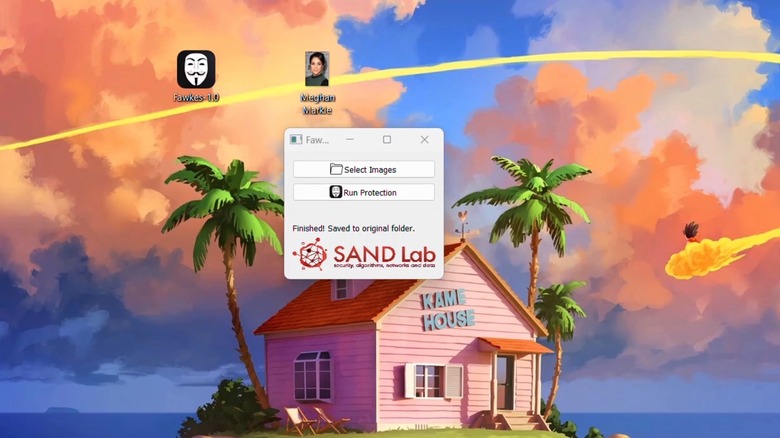
If you're worried that advanced AI-powered facial recognition systems will allow third parties to easily identify you by using publicly accessible photos of yourself, you can use a free app called Fawkes to cloak your appearance. Available as a free download, it was created by researchers at the University of Chicago's Sand Labs who launched the first version in August 2020. Fawkes is still available several years later, supporting Windows, Mac, and Linux.
The app was created at a time when services like Clearview AI presented a major privacy problem. The facial recognition system had collected over three billion photos of people by scraping the internet and social media. As Sand Labs explained, Clearview built facial recognition models for millions of people without obtaining permission. Fawkes allows users to hide in plain sight by making it harder for facial recognition apps to match the Fawkes-camouflaged photos to the images in their databases.
Fawkes was released years before the emergence of generative AI products like ChatGPT and Gemini, which feature advanced image generation and analysis capabilities. The program was last updated in May 2022, several months before ChatGPT went viral and kick-started the current AI revolution. As of early 2026, AI image generation models can create realistic images. Tools like Google's Nano Banana Pro can edit real photos of a person and create AI images based on an uploaded image. Chatbot apps like Copilot and Gemini can also understand image content. Some AI tools can see video and live feeds. In this context, some may think Fawkes can be even more useful than when it was first released. However, it's unclear whether the app is as effective against modern AI tools that may be able to track you without seeing your face.
How Fawkes works
The video above shows Fawkes in action on a Windows 11 machine from the moment you download the app to using it. On that note, ensure you get the correct app from the Sand Labs website. Be sure to select the correct version for your needs, whether it's Windows or macOS. You can also install Windows, Mac, and Linux binaries from the same source, which offer support for additional parameters.
The Windows app in the demo above has a simple interface that lets you select an image or set of photos you want to cloak. After that, you'll run the protection system by pressing a button. What actually happens in the background is fairly simple. Fawkes adds almost invisible pixels to an image to "poison" it, as the researchers explained in their 2020 release. "Fawkes takes your personal images and makes tiny, pixel-level changes that are invisible to the human eye, in a process we call image cloaking," they explained. The video demo above shows that while the changes are almost imperceptible, they are visible when comparing the cloaked image to the original. The following video, made by the Fawkes developers, explains in more detail how the app cloaks images.
You can use the cloaked images on the web once Fawkes produces them. You can set them as profile images on social apps and share them with friends. In other words, you can use the photos as you'd normally do with images you'd take on your phone to share online. However, when a facial recognition system tries to identify you by comparing the cloaked images to the photos of you it may have been trained on, it won't recognize you.
The downside to using Fawkes to protect your privacy
When Emily Wenger and Shawn Shan released Fawkes, they said the app had been tested "extensively," proving "effective in a variety of environments and [...] 100% effective against state-of-the-art facial recognition models (Microsoft Azure Face API, Amazon Rekognition, and Face++)." However, in early 2021, the researchers reported evidence of adversarial training against Fawkes in Microsoft Azure, which they promptly patched.
By April 2021, the app had been downloaded more than 500,000 times, proving that people were interested in protecting their privacy. Over 840,000 downloads were registered by early May 2022. The researchers have not updated the figure since then. That said, the app is available for download in early 2026.
There are two issues with using Fawkes right now. First, it's unclear whether other AI companies have learned to circumvent its cloaking protections. Users worried about more modern AI products can perform a simple test. You can cloak a photo with Fawkes and then upload the resulting image and the original to a chatbot like ChatGPT or Gemini. Then, ask the AI if the photos show the same person. If the AI model sees two distinct people, it means Fawkes can still protect your identity from that specific AI tool. You'd have to repeat the test with each AI product you're unsure about.
Secondly, using Fawkes for social media content will make sharing images online more difficult, removing the spontaneity of such events. You'll need to download images on your computer, cloak them with Fawkes, and only then share them online. This may be impractical for some scenarios that demand sharing an image online as soon as it is taken. Unfortunately, there's no mobile version of Fawkes to install on your iPhone or Android device.