

Modern SSDs Are Great, But Intel's Discontinued Alternative Could Have Been The Future
We may receive a commission on purchases made from links.
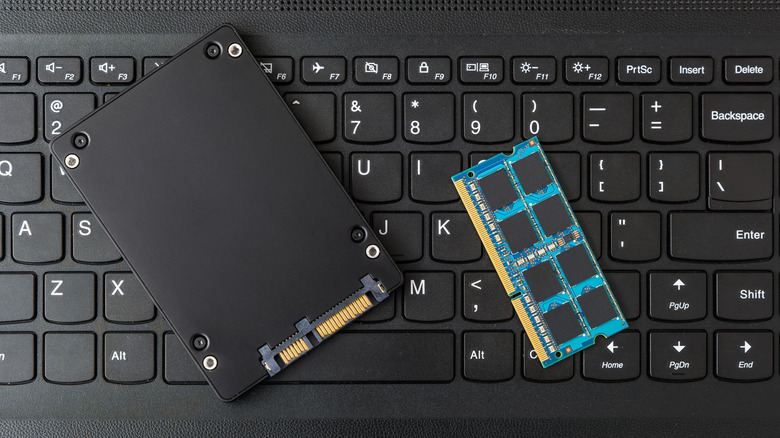
Solid-state drives offer much faster read and write speeds over their traditional hard drive counterparts. However, they're often limited in scope and capacity. If you want lots of storage space, you'd normally go with a hard drive and take the performance hit. If speed is paramount, you opt for an SSD. But what if there was a middle ground with a storage option that was both fast and large in size? That was precisely the idea behind Intel's Optane Memory, a discontinued alternative that could have been the future of storage technologies.
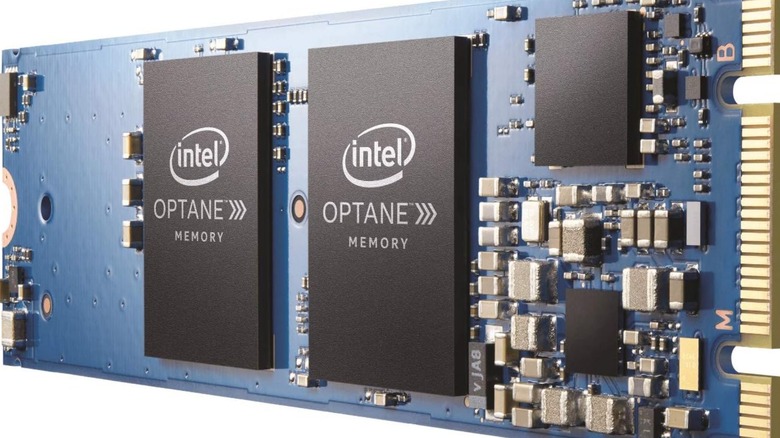
Optane was designed to work in tandem with the Random Access Memory (RAM) and the hard drive in your system, by essentially acting as a go-between. It was slower than RAM, but still faster than NAND or flash memory storage, offering significant benefits. It stores frequently used items, offering faster storage and task access like RAM, while keeping larger caches like hard drives accessible. It is also non-volatile, so storage contents aren't purged upon power-down or reset, and utilizes a unique technology Intel and Micron call 3D XPoint.
As Intel describes it, Optane is "a system acceleration solution installed between the processor and slower storage devices" that allows "the computer to store commonly used data and programs closer to the processor." In turn, the system has quick access to that information, which improves "overall system responsiveness." In the end, Intel could not bring the costs of Optane technology down enough to justify its sale, and it has since abandoned the project. Moreover, alternatives cropped up like the DDR5 standard, Micron's LPCAMM2 laptop modules, and compute express link (CXL) technology, which are faster, cheaper, and more open.
How would Intel Optane technology have changed storage experiences?
RAM is a super-fast, temporary solution for storing data while running applications. When you're running an app, a game, or doing tasks on your computer, the active data is stored in a portion of the RAM until the app is closed. The faster read and write speeds boost performance, which is why it's always better to have more RAM when buying a laptop or PC. Meanwhile, long-term storage, like files or documents you're working on, is stored on the hard drive, mainly because it offers more space, but also because it's non-volatile.
The drawback is that traditional hard drives are slower, and while today's NAND, flash storage, and SSD solutions are much faster, they're still slow compared to RAM. Although all computer memory works together, essentially, every time the system has to switch between RAM and drive storage, it can create a bottleneck, or what we perceive as lag or slow loading times.
Intel's Optane would speed up that process by acting as the middleman. It would retain data long-term, learning your usage habits and patterns, keeping your most used content primed and ready. This would allow the computer to access the data faster, as it does with short-term RAM, but for the most important system files and digital content, like apps you use frequently. It wasn't a drive per se, more like an extra, ultra-speedy cache that your computer could utilize. SSDs aren't necessarily more reliable than traditional hard drives, but they are faster. Much faster. Intel's Optane tech could have made slower hard drives feel as fast as an SSD.