

Can Apple CarPlay Actually Make Your Car Safer? Here's What Studies Say
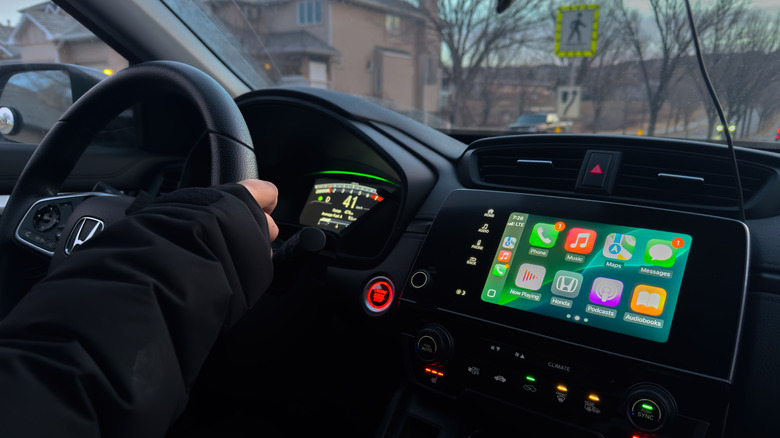
Smartphone distractions can be dangerous while driving. That's why both Apple and Google have come up with features for iPhone and Android to manage communication (texting and calling), navigation, and entertainment (music, radio, and podcasts) while behind the wheel. Researchers have examined the impact of these technologies on drivers, with one 2018 study finding that Apple CarPlay and Android Auto can be less distracting than the default infotainment systems in some cars. However, a different paper in 2020 concluded that using CarPlay and Android Auto may be more dangerous than driving intoxicated, even if they are safer than using native infotainment systems.
The AAA Foundation for Traffic Safety teamed up with University of Utah researchers to compare the three technologies, releasing their results in the summer of 2018. The scientists concluded that drivers using CarPlay and Android Auto were visually and mentally distracted for 15 fewer seconds than default systems when setting up navigation. According to the Foundation, taking your eyes off the road for more than two seconds to perform a different action doubles the likelihood of a crash occurring. Consequences for inattentiveness can be dire, as distractions while driving accounted for 3,500 deaths and over 390,000 injuries a year as of June 2018.
The study involved recruiting 64 drivers between the ages of 21 and 36, all of which had clean driving records. Researchers put the participants behind the wheel of five cars made in 2017 and 2018, all of which supported Apple CarPlay, Android Auto, and a native system. The experiments measured the visual and cognitive demand levels of the various infotainment activities a driver would perform on over a low-traffic stretch of road measuring two miles with a speed limit of 25 mph. Researchers designed their scale so that "low" cognitive demand was classified as similar to listening to the radio, while "very high" was like trying to balance your checkbook while driving.
How researchers measured CarPlay distractions
To measure time spent looking at something other than the road (visual distractions), and time spent performing an infotainment action (cognitive workload), the researchers used a Detection Response Task (DRT) standard. The DRT system featured two elements: a small vibrating device on the collarbone of the driver, and a light on the windshield that changed color. Each time one of the two stimuli occurred, the driver had to press a small button as quickly as possible. The driver also had to keep operating the vehicle while managing the same tasks on the infotainment system, including calling, texting, handling audio entertainment, and using navigation.
The study found that both CarPlay and Android Auto generated an overall "moderate" level of demand. In comparison, native infotainment systems were rated at "very high". For example, dialing a call was 24% faster, the equivalent of about 5 seconds, on CarPlay versus the native infotainment option. Entering a navigation destination was 15 seconds quicker (31%) on both CarPlay and Android Auto. The researchers did not find meaningful overall differences between CarPlay and Android Auto, though there were some: CarPlay, for example, caused less demand for texting, while Android Auto was better at navigation.
The researchers pointed out that while Apple CarPlay and Android Auto placed only a moderate demand burden on drivers, they still resulted in increased distraction. In other words, no car infotainment system is perfectly safe for drivers, but CarPlay and Android Auto were lauded for being significantly safer when compared to native systems. The researchers urged better cooperation between smartphone vendors and car makers to work together to improve the safety of these technologies.
Is Apple CarPlay safer than alcohol?
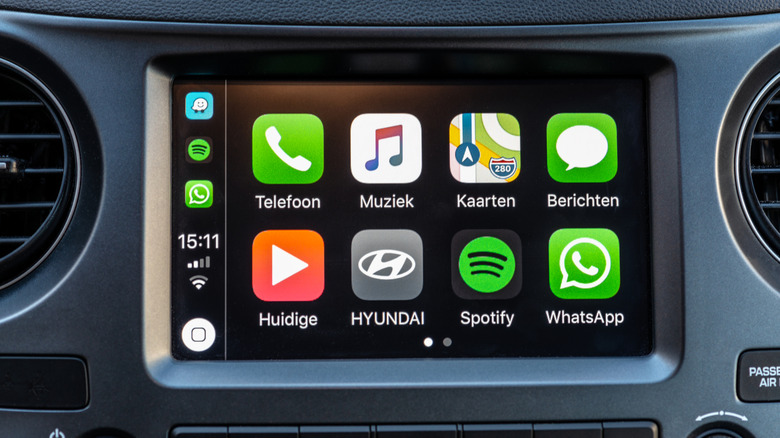
In 2020, the UK's Transport Research Laboratory released a study on behalf of IAM RoadSmart to determine the distraction levels caused by Apple CarPlay and Android Auto. Surprisingly, the researchers found that both systems caused more distraction than alcohol or cannabis use after conducting simulated testing. The participants completed three 20-minute drives for each system. One drive involved no interaction with CarPlay or Android Auto. Then, the drivers interacted with the systems via voice, and then finally through touch. The latter was the most distracting, slowing reaction times by 57% (CarPlay) and 53% (Android Auto). Voice interaction slowed responses by 36% (CarPlay) and 30% (Android Auto). Alcohol and cannabis slowed reaction time by 12% and 21% respectively. Interestingly, a hands-free phone experience caused a 27% slower response, representing a smaller reduction than CarPlay and Android Auto use but still more than alcohol and cannabis.
The researchers found that participants using CarPlay and Android Auto showed "a reduction in average speed, increase in deviation of headway [following distance], and larger deviation of lane position for most tasks," especially for touch interaction. When using the display, the participants took their eyes off the road for longer than the NHTSA guidelines. Using voice to control Apple CarPlay and Android Auto allowed drivers to stay within these recommendations. The participants also underestimated the time they looked away from the road. Managing audio, like Spotify music, delayed reaction to a stimulus on the road significantly for both platforms.
The research referenced the AAA Foundation study from 2018, but the new findings prompted IAM RoadSmart to raise concerns about all infotainment systems, urging the industry and governments to develop standards that would minimize distractions. As for drivers, IAM RoadSmart advised them to set up infotainment tasks before beginning the drive.