

China's Future Fighter Jets Might Power Themselves Using 6G Radar Energy
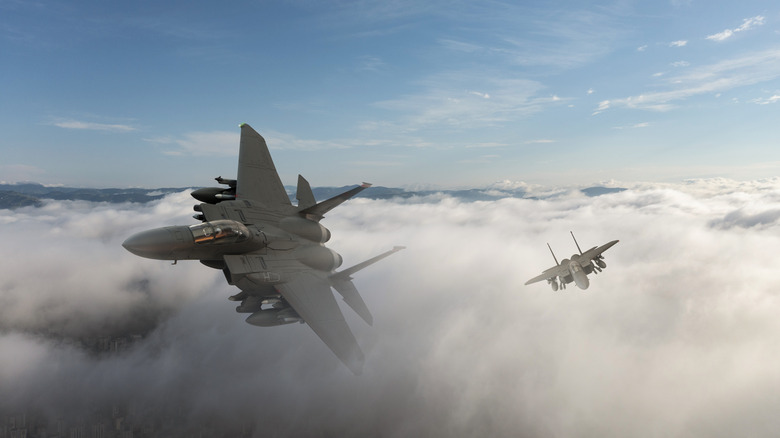
Chinese scientists may have found a way to turn one of the biggest weaknesses of fighter jets into a strength. For years, radar has remained one of the biggest fears that military aircraft have to worry about. These beams of invisible radio signals scan the sky, looking for anything that they can reflect off of. And while militaries do have stealth aircraft that are harder for radar to detect, none are truly undetectable yet. Instead, they simply make themselves appear smaller on the radar by pushing most of the radar signals away, thus making it harder for the enemy radar tower to pick them up.
However, scientists in China are looking at this problem from another angle. According to some reports, they may be able to harness the radar signals themselves to power new fighter jet technology, rather than just bouncing them off the jet's exterior. The idea appears to be to use advanced "smart surfaces" in aircraft that allow their systems to draw power from the radar signals they detect.
It is important to note that all of this is still just theoretical at this point, according to those behind a new study. But if the scientists are able to make a breakthrough, we could one day see fighter jets that utilize the technology, among other devices, such as satellites.
Figuring out how to absorb and control radar waves
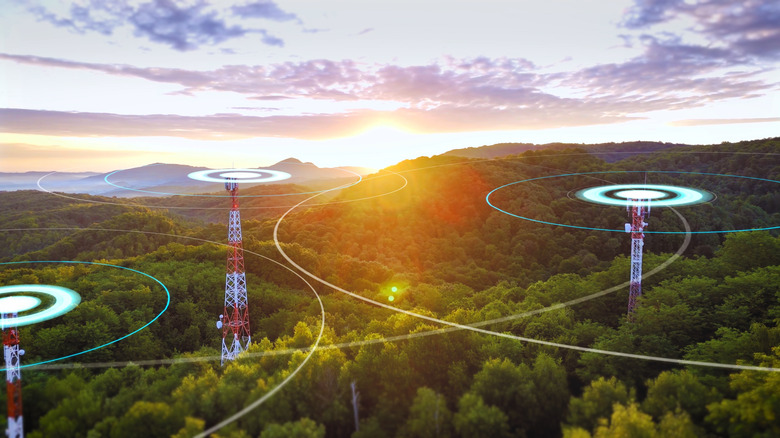
The way that radar works is that towers or other structures send out pulses of radio signals that then pass through the air all around the signal's point of origin. From there, these signals, or waves, are picked up and reflected by objects such as metallic aircraft. The radar structures then detect any signals that are reflected back, allowing it to determine where objects are, how fast they might be moving, and more.
The core of the new theoretical design is based on a concept of technology that scientists have dubbed Reconfigurable Intelligent Surface, or RIS. Using this idea, the scientists aim to create an engineered surface composed of hundreds or thousands of small elements programmed to manipulate the radio waves they pick up. This would allow the system to not only pick up the radar signals but also to focus and redirect them into electromagnetic waves.
Instead of just dissipating the signals as extra heat, though, the researchers in this new study believe they might be able to convert them into electrical power. In the model featured in the study, the tech would absorb some of the radar signals, send them to an internal circuit that harvests the energy, and then distribute it where needed. This would utilize a new concept that the researchers have described as a RIS-assisted communication system that relies on 6G — a future network system that has seen some wild claims about it over the years, including some that it might use human bodies for power and that it will be over 9,000 times faster than 5G.
Using 6G to its advantage

The reason that 6G appears to be such a foundational part of this new advancement is tied to how many feel about the upcoming network technology. As we move steadily closer to the "internet of things," 6G is expected by many to bring the digital world and the physical world even closer — perhaps even blurring the lines entirely. And with a larger RIS-assisted communication system, scientists might even be able to take the tech beyond fighter jets and use it for ground-to-air communications.
Further, because RIS also offers sensing capabilities, it might prove an additional boon for the fighter jets that incorporate it. While most of the research centers on the overall ways RIS and 6G might work together to create a smoother operating network, it seems there is still an extreme focus on how it might be usable within the military. Something we've seen heavily emphasized in China's ongoing tech developments, including its AI robotic designs — we've already seen China testing robots built for combat, including rifle-toting robo dogs.
Of course, we have to actually see the distribution of 6G as a network, which could take a while. 5G only began rolling out more widely back in 2022, and while 6G has likely been under research since before then, the kind of network advances that scientists are touting will take a lot to pull off.