

This Apple TV Series About The Space Race Is Already A Modern Sci-Fi Classic
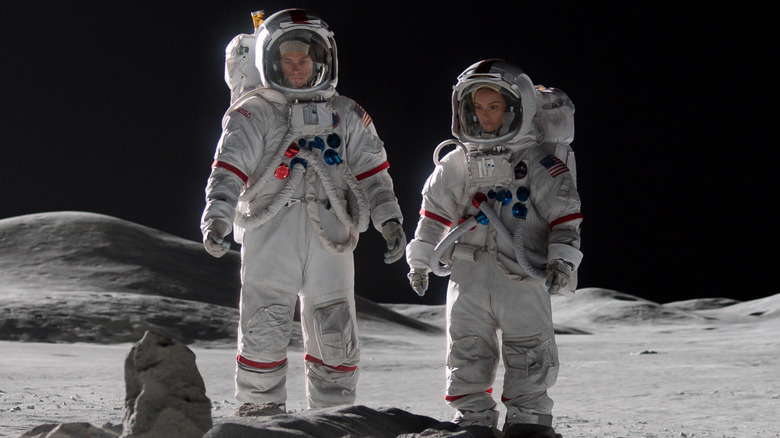
"For All Mankind" is an alternate history tv show that will change the way you see the space race. This Emmy-nominated drama from creator Ronald D. Moore of Star Trek and Battlestar Galactica fame, takes one pivotal moment in 1969 and changes it. Instead of the USA, the Soviet Union lands the first human on the Moon. This alternate moment in history is what the show builds on. "For All Mankind" is a character-rich universe where ambition, conflict, and human resilience propel the story forward across decades.
This premise certainly strikes a chord with both the audience and critics. With four seasons now streaming on Apple TV+, the series scored an impressive 92% on Rotten Tomatoes. Two seasons were even rated 100% Certified Fresh. Part of the series' success is due to how it blends historical realism and imaginative reinvention. It uses real timelines and political tensions as a launching pad for compelling drama. Yet it never feels like a mere alternate past.
The stakes are familiar, the characters are alive, and the possibilities are endlessly compelling. The show manages to deliver complex personal character arcs as well as humanity's expansion into space. The good news is, Apple TV+ officially renewed "For All Mankind" for a fifth season and announced a spinoff series called Star City. This spinoff is set to explore the same universe but from the Soviet perspective.
For All Mankind asks powerful questions
"For All Mankind", which reinforces the sci-fi excellence of Apple TV+, asks a simple, yet powerful question. What if the global space race never ended? This sci-fi drama begins in 1969, when Apollo 11 landed the first humans on the Moon. But that's not what happens in the show. Instead of Neil Armstrong, it was the Russian cosmonaut Alexei Leonov who walked on the Moon for the first time. The political and technological landscape of the 20th century in this series differs significantly from the real world.
But NASA doesn't give up. This was just a setback, and the race continues, but now it is to establish a permanent lunar base. The show leaps a decade into the future for every new season. That's what gives the impression of a sustained space race, and dramatizes how space exploration reshapes the future of humanity. Early episodes of "For All Mankind" explore the immediate fallout of America's loss in the Moon race and how NASA pushes to stay relevant throughout the 1970s.
Later seasons tell the story of how prolonged lunar exploration influences political and social life on Earth. The new objective is Mars. By the 2000s, space becomes an arena for settlement, commerce, and resource gathering. The international rivalry continues, and ambition continues to define national pride. In this very different timeline, technology advances more rapidly than in our real world. The real space race sparked rapid advances in energy, transportation, materials, computing, and electronics. This begs the question of what would have happened had the race never ended. What technology would now be at our disposal?
What a prolonged space race would mean

"For All Mankind" is a reminder that Apple TV+ sci-fi shows keep raising the bar. It's a thought exercise on human ambition and what drives us forward. The series claims that the competition and curiosity of a prolonged space race would have pushed humanity towards more inclusive social change. In this timeline, the Soviet Union's early inclusion of female cosmonauts on the Moon forces NASA to recruit and train women astronauts years ahead of our real history. Thus, the show reshapes the culture of the space program.
In this way, the narrative naturally raises questions of inclusion, merit, and who gets to be a part of humanity's greatest endeavor. That said, characters from diverse backgrounds, such as engineers with immigrant roots, enrich the story and show how a sustained quest for the stars would intersect with social struggles on Earth. Racial inequality, immigration, LGBTQ rights, and the fight for recognition and respect are just some of the themes that grow out of the story's premise.
They're not superimposed, instead they rise because the alternate history reshapes society itself. NASA and other institutions are forced to adapt if they want to stay relevant in this geopolitical contest. "For All Mankind" also manages to balance the ambition of humanity with realism. Although it depicts technologies and achievements ahead of our own timeline, the show's attention to technical plausibility keeps it grounded. The use of archival footage and period-accurate design successfully blurs the lines between the real and the imagined.