

Razer Revealed Its New AI Companion, Leaving Us With A Few Big Questions
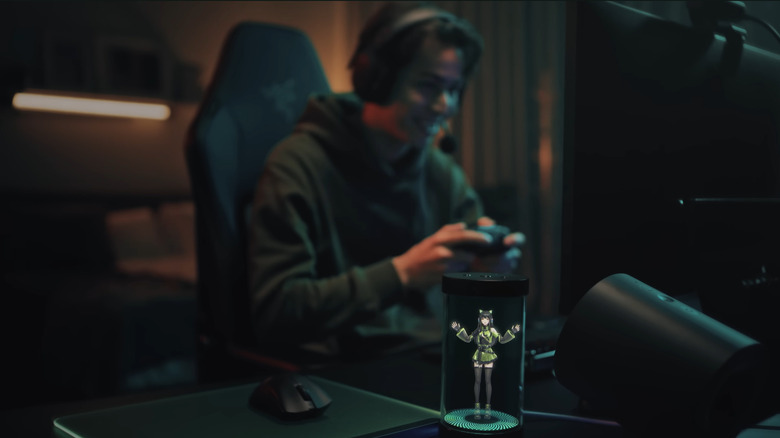
Razer, the American-Singaporean gaming company responsible for everything from controllers and laptops to gaming chairs, has built on its recent introduction of AI esports coaches with its new 3D companion initiative, dubbed Project AVA. Debuted at the 2026 Consumer Electronics Show in Las Vegas, Project AVA is something akin to an Alexa smart speaker with a smile, bringing typical LLM capabilities to a moving 3D character kept on your deskside. Powered by xAI's Grok engine, Project AVA uses an HD camera and Dual Far-field Array mics to inject its chatbot into users' daily routines, from schedule planning and sleep tracking to wardrobe selection. Of course, there is also a gaming component, in which AVA both coaches and cheers its users' in-game exploits.
If a 5.5-inch AI character that watches you sleep, dress, and game makes you uneasy, you're not alone. The comments on the company's announcement video, for instance, are a deluge of negative feedback, with responses ranging from sarcastic mockery to critiques of the unrelenting rise of AI. But the questions prompted by Razer's companion product extend far beyond Project AVA and strike at the heart of the AI debate, ranging from privacy concerns to the potential effects on users' mental health.
Such critiques are particularly urgent as tech giants increasingly invest in the budding market, sparking widespread debate over content controls, age restrictions, and corporate responsibility following a series of lawsuits alleging that AI companions manipulated vulnerable users, allegedly prompting some to commit suicide. And although some regulators have already set their sights on companion software, the introduction of Project AVA's 3D hologram may point to a paradigm where AI companions are developing faster than lawmakers can address them.
A new AI companion from Razer
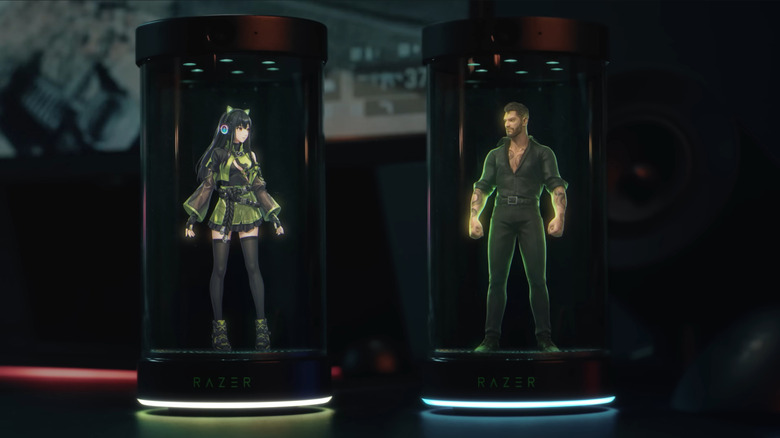
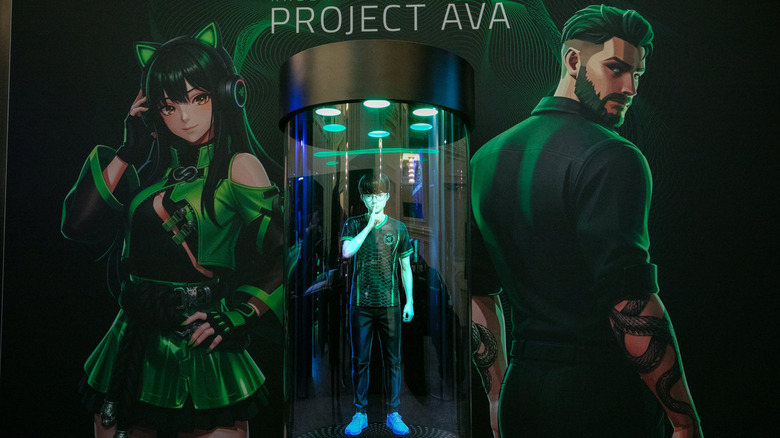
In Project AVA, Razer delivers a companion that brings LLM capabilities to the gaming set. Developed alongside Animation Inc., a firm specializing in building 3D AI characters, AVA currently offers five desktop companions equipped with facial expressions, eye tracking, and high-fidelity motion. They include three in-house characters — AVA, an energy orb that keeps users "always on point;" Kira, a cosplaying gamer girl; Zane, a bearded street tough covered in Razer-themed snake tattoos; and two celebrity animations. Those celebrity figures include an avatar based on Korean League of Legends star Faker, and Sao, a binder-clutching office girl who mimics Saori Araki, a J-pop star turned influencer who Razer partnered with on social media after she went viral for her "iconic office pose" last year.
According to Razer, these characters carry out a variety of functions, serving as daily routine planners, work assistants, and gaming wingmen. Utilizing the Project AVA hardware's HD camera and microphone, the 5.5-inch avatars can help customers select outfits, manage calendars, track sleep patters, translate foreign languages, and conduct creative brainstorms. Connecting AVA to a Windows PC via its USB-C port enables PC Vision Mode, which allows the hologram to analyze content on users computer screens, enabling everything from data synthesis to in-game advice and encouragement.
Slated for the second half of 2026, American customers can reserve an AVA companion with a $20 deposit via the company's website. Global release dates and pricing have not been announced. Although currently powered by xAI's Grok model, Razer built AVA with an open architecture, potentially allowing users to opt for different LLMs. Future iterations could enable customers to add custom-built avatars, bringing a personal touch to their new "Friend for Life."
Tinker, Tailor, Gamer, Spy
Razer's introduction of a 24/7, holographic AI companion adds a new element to industry-wide concerns. Thus far, companion applications have been criticized for exacerbating a growing loneliness epidemic, with observers noting that LLMs foster dependency, degrade social capabilities, and heighten social isolation. A series of lawsuits have highlighted the dangers of AI-relationships, accusing OpenAI, Meta, Character.AI, Google, and X of manipulating vulnerable users and producing inappropriate content. Although Project AVA isn't the first physical platform, it is the highest-profile one, potentially signaling the next phase of a market expected to grow by $500 billion over the next decade.
Razer, for its part, has downplayed these concerns, with CEO Min Liang Tang telling Bloomberg that its companions are "not trying to foster a relationship." However, the company's use of outsourced algorithms like Grok, which has been criticized for its sexualization of women and minors, may raise eyebrows. Furthermore, these claims dismiss the emotional, intellectual, or social dependency AI companion algorithms often encourage to foster engagement. And while Razer might not have set out to create a desktop girlfriend or boyfriend, its marketing campaign, with its tagline "Friend for Life," does little to assuage these concerns.
Considering the all-encompassing nature of AVA's functionalities, some of which require round-the-clock visual and audio surveillance so it "learns about you," users must be able to control the collection, storage, and usage of their data. This is especially relevant given Grok's documented history of repurposing user content without consent. To date, Razer has been relatively mum on both the privacy safeguards and information-sharing policies of Project AVA. However, the privacy protections listed on the company's website are arguably lax, further underscoring questions related to whether potential privacy violations are worth AVA's gaming advice and other features.