

Why Do Electrical Plug Outlets Have Different Sized Holes?
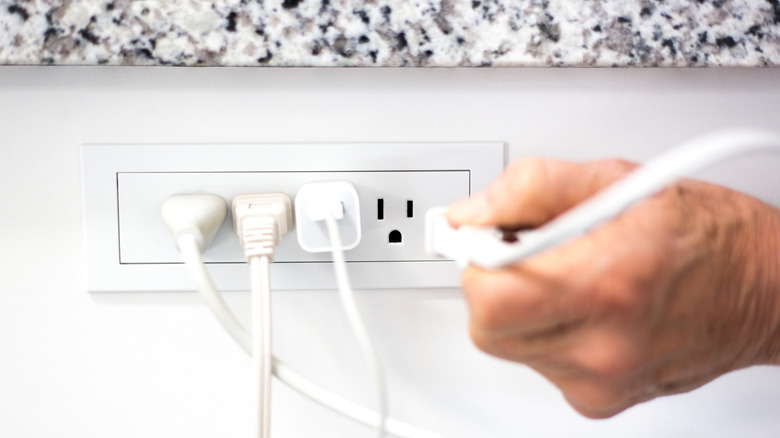
If you've ever looked closely at an electrical plug, you've likely noticed that the ends of the prongs have little holes in them. While this is a leftover design element from early electrical systems, modern plugs have another quirk you may have spotted: The prongs themselves come in different sizes on many of today's electrical devices. Lots of devices, such as phones, laptops, and especially appliances, use these uneven prongs as a safety feature. However, this also comes as a small annoyance when trying to plug them into a power source, since they can only be connected in one way — but this design choice is about reducing hazards.
This asymmetry exists to discourage improper use, since if you try to connect a modern plug backwards, a newer power outlet won't accept it. In the past, older plugs were fully reversible, but they also could let electricity flow through internal components even when a device was turned off. So, to reduce the risk of shocks and other hazards caused by that, this different size feature became more popular as a safety standard for many devices.
Known as polarization, this design uses plug prongs with different sizes to help control how electricity flows into a device when it is plugged in, making it safer to use without the need to do anything extra. While it may be an inconvenience for many users, especially if the power outlet is placed in an odd place, it greatly improves safety in your home.
Electrical plug prongs are different sizes to ensure polarization
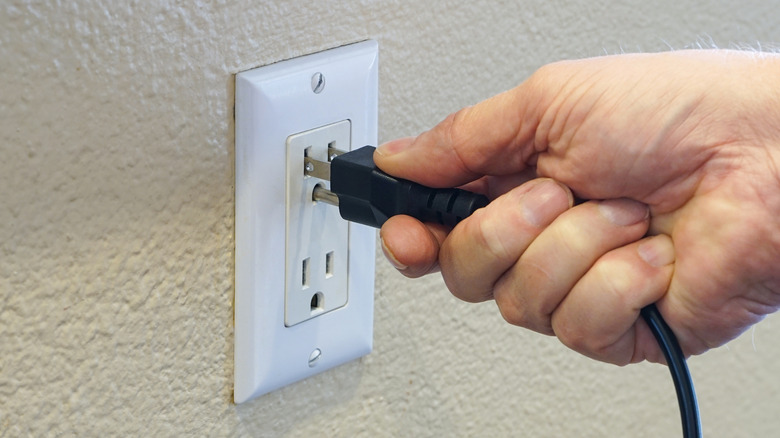
If you inspect the plug on a modern appliance, it's very likely that you'll see that the electrical plug prongs are different in size. However, this choice is not made only to annoy you when you are trying to connect them, but as a safety measure that ensures that polarization works properly and guides electricity safely. This means that the narrow slot is connected to the hot wire, which is the side with dangerous voltage from the breaker panel.
The wider slot is connected to the neutral wire, which completes the circuit by providing a return path for the current. So, the asymmetrical design is there to essentially force you to connect the plug correctly, which ensures that when you flip the switch to "off," power is cut on the intended side of the circuit before it reaches internal components. This helps prevent parts of the device from remaining energized when it appears to be turned off, something that may occur in reversible plugs.
Additionally, this scenario with reversible plug prongs can create some hidden hazards for the user. For example, without the protection provided by a polarized plug, the threaded metal collar of a light socket can become energized if the plug is not inserted correctly in some cases. So, when changing a lightbulb, a user may accidentally touch that metal casing and receive a shock, which is why forcing the hot wire to align with the switch properly cuts off the threat before it can cause harm.