

You're Not A Jack Nicholson Fan If You Haven't Seen His '70s Crime Thriller Streaming For Free
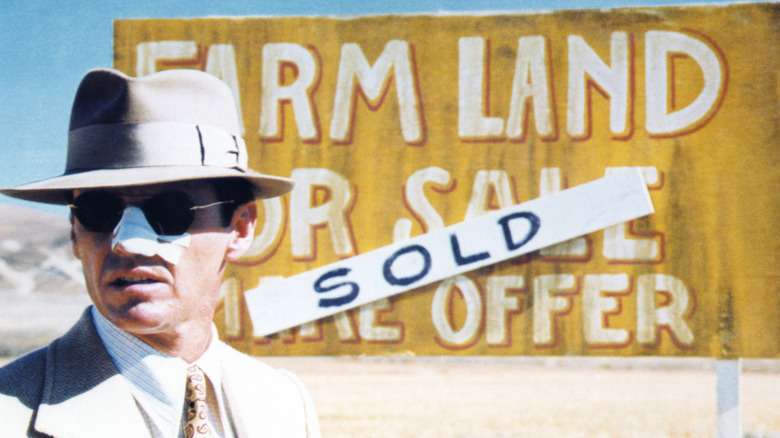
Few films have captured Hollywood's collective imagination as strongly as Roman Polanski's "Chinatown." Starring Jack Nicholson, Faye Dunaway, and John Huston, the lauded 1974 noir is a chillingly honest exploration of the demons lurking beneath the City of Angels. Applying a Hitchcockian twist to the ever-addictive crime drama genre, Polanski's "Chinatown" paints a lurid portrait of a city whose corrupted underbelly lies not in dark alleyways, but behind closed boardroom doors.
Set against Depression-era Los Angeles' desperate fight for water security, "Chinatown" is a searing meditation on the city's malignant past, applying a critical lens to its struggle for land and resources, and the hope, despair, and destruction it wrought. A 1970s film about 1937, the prescient screenplay presages many of L.A.'s modern struggles, foreshadowing everything from wealth stratification and homelessness to the inherent social isolation of a scar-bound megacity. Half a century later, the film can even be understood as a stark warning against the havoc of American oil diplomacy.
An instant classic that has since been hailed as one of the best films ever made, "Chinatown" was nominated for 11 Oscars, winning best original screenplay for Robert Towne's acclaimed script. Featuring what many believe to be its star's most enduring performance, Nicholson's Oscar-nominated depiction of detective J.J. Gittes alone warrants "Chinatown's" place in the National Film Registry's 100 Essential Films list. Available to stream for free on Pluto TV, Polanski's masterpiece remains as visually stirring, emotionally disturbing, and intellectually provocative as it was upon its release.
Why Jack Nicholson's Jake Gittes is noir's perfect detective
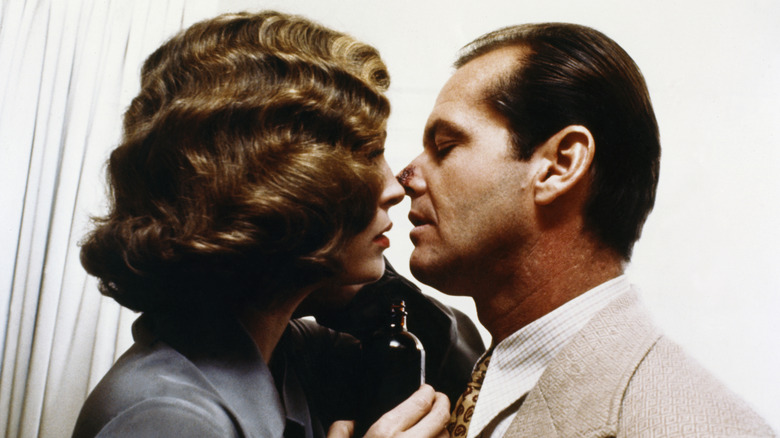
"Chinatown's" opening is seemingly mundane: A woman asks private eye Jake Gittes (Nicholson) to tail her philandering husband, who happens to be the Department of Water and Power's chief engineer, Hollis Mulwray. But when Gittes finds his client to be a fraud and Mulwray's lifeless body at the bottom of a reservoir, he's pulled into a dark labyrinth of family secrets, political back dealings, and sexual intrigue. Eventually unraveling into nothing short of a Kafkaesque nightmare, Gittes finds himself in the center of a conspiracy that strikes at the heart of L.A.'s 20th century transformation.
Nicholson executes and subverts tropes with equal dexterity, oscillating between biting wit and subdued stoicism. Displacing the genre's stereotypical bravado with loneliness, Nicholson's performance contrasts with the wild brashness of his other roles, like in Rob Reiner's "A Few Good Men" and Stanley Kubrick's "The Shining." Often, Jerry Goldsmith's haunting score, dripping with existential dread, is the only window behind Gittes' façade. The wayward detective conjures a common emotion for today's Angelinos as he drives from one disaster to the next. Passing beautiful homes, ramshackle apartments, and empty riverbeds, Gittes is consumed by a nearly inarticulable mystery: How did the city get here?
For Gittes, the case is ultimately more about formulating the correct question than finding an answer. Predictably, he finds his closest approximation in the story's femme fatale. Played by Faye Dunaway, who earned an Oscar nomination for the role, the real Evelyn Mulwray is Polanski's double-faced Los Angeles incarnate. Victim, lover, and suspect, she embodies the core question of how a city of overwhelming wealth and promise can be the source of such despair.
The slow-burn tragedy that makes 'Chinatown' hit so hard
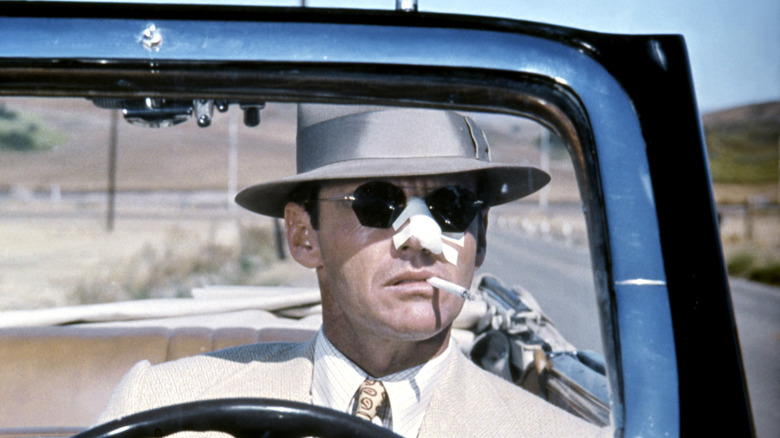
"Chinatown's" answer is pulled from the real-world water wars that spurred Los Angeles' 20th century population boom. The film's central mystery unravels on two interlocking tracks, where family drama and criminal intrigue expose wealth's incestuous nature and the sordid consequences of a city built by greedy plutocrats. Every frame is meticulously crafted to foreshadow Towne's thesis, from its blanched color palette that screams drought everywhere outside aristocratic gardens to a score foretelling the lonesomeness of the big city to come. A masterwork of tone and plotting, the mystery at the heart of "Chinatown" isn't the death of a bureaucrat, but of a city.
Watching "Chinatown" feels like smoking a kerosene-soaked cigarette atop a pile of dynamite. The definition of a slow burn, the film crescendos to a devastating climax that finds its truth in the contrast of its unnecessariness and inevitability. Following the explosive conclusion, Gittes stands in for the viewers as he voices the only question remaining to those confronted with the true nature of evil: Why? The answer, confidently sung by one of the film's antagonists and eerily echoing the manifest destiny of presidents, industrialists, and tech bros alike, is simple: "The future, Mr. Gittes! The future."
Fifty years after its debut, the shocking twist and deadly fallout remain both the pinnacle of noir moviemaking and the saddest L.A. love letter ever written. All told, "Chinatown" is Los Angeles' prevailing creation myth, painting a bleak picture of Tinseltown's original sin in the melancholic azure of its dwindling water reserves. And just like the tale of Eve and her apple, "Chinatown's" warning against unrestrained greed continues to go unheeded.