

Apple Is Quietly Working On These Three New AI Wearable Devices

A new report from Bloomberg confirms that Apple is actively developing three brand new AI-powered hardware products. The products include smart glasses, a pinnable pendant that can be attached to a user's shirt, and AirPods with bolstered AI functionality.
It's worth noting that we've seen rumblings regarding these products before. Indeed, rumors of Apple developing a pair of smart glasses are nearly 10 years old at this point. And while Apple regularly works on futuristic products that never see the light of day, Bloomberg's track record is sufficiently reliable that there's a good chance we'll see Apple boldly embrace the wearable AI space in the coming months.
According to the report, all three of Apple's rumored wearable devices will need to be tethered to an iPhone to run. Note that this is in stark contrast to products like the Humane Ai Pin, which was able to operate without a tethered smartphone.
Apple's rumored smart glasses

Apple's smart glasses are being designed to compete with Meta's own smart glasses, which debuted at Meta Connect in September of last year. As you'd expect from a pair of smart glasses, they will be able to take photos and record video. They will also "make phone calls, access Siri, take actions based on surroundings," and play music. Of course, if they have to be tethered to an iPhone in order to work, it's hard to see the benefit of using such a device to play music or make phone calls.
Arguably, the primary use case for such a device would be to take first-person photos and videos and then use AI to leverage that data. The report notes that the glasses are being positioned as "an all-day AI companion capable of understanding what a user is seeing and doing in real time. Wearers could look at an object and ask what it is and get assistance with everyday tasks."
When it comes to navigation, Apple's smart glasses may make getting around town more natural. Instead of trying to orient yourself to a destination on a virtual map, the smart glasses might be able to process the location of nearby landmarks and buildings in real time. In such a scenario, imagine directions that tell you to "take a left at the green skyscraper coming up on your right" instead of "take a left in 100 feet."
As for which frames Apple is going to use, the report claims that the company will use its own frames as opposed to partnering with established brands. Apple's frames are said to be high-end and will have a more premium look and feel than what Meta has produced.
Next-gen AirPods may feature a camera
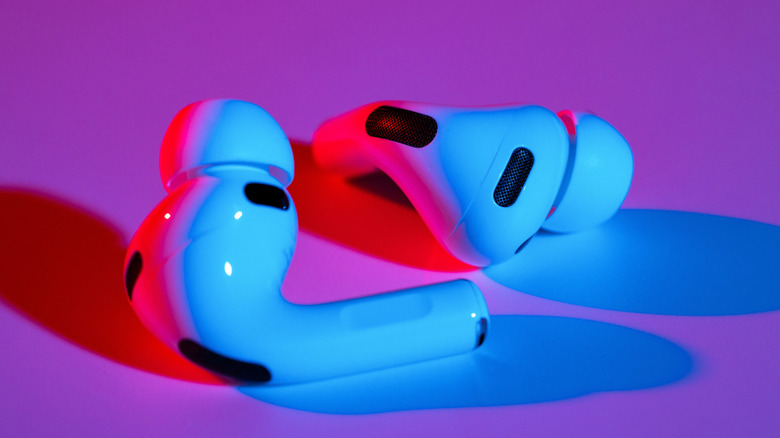
Also in the works is a pair of AirPods with a built-in camera and enhanced AI functionality. The report doesn't go into significant detail about this particular device, but previous reports have relayed that it will likely leverage a built-in camera to allow the device to gather relevant information about the user's surroundings.
The ultimate goal is to allow users to process information, with the help of AI, without having to take their phone out for basic tasks. Imagine, for example, being on vacation and asking for information about a monument you're looking at. Your new AirPods might be able to use a built-in camera to ascertain what the monument is, and then relay that information directly to you via spoken word through your AirPods.
It will be interesting to see how Apple's implementation actually works in practice, because it's not as if reaching for one's iPhone is all that time-consuming or cumbersome. This is another instance in which the necessity of the product isn't immediately apparent.
Apple is also working on an AI wearable pendant

The most curious item currently being developed by Apple is a pinnable AI pendant. It's interesting that Apple is developing such a product because a similar AI wearable — the Humane Ai Pin — was a colossal failure. Apple's implementation will reportedly include an "always-on camera for the smartphone that also includes a microphone for Siri input."
The device would only gather information and wouldn't project anything outward, in contrast to the Humane device. Most of the processing would occur off-device on the iPhone. The pendant itself might be designed such that it can be worn in two ways. In one scenario, users might wear it on their clothing via a clip. In another scenario, Apple envisions that some users might want to wear it around their neck attached to a necklace.
The pendant is in active development, but Bloomberg relays that it is the least likely of the three aforementioned products to actually ship to consumers. Given that these three devices all seem to serve similar purposes, it's difficult to imagine all of them seeing the light of day.