

The Oldest Movie To Realistically Depict Space Travel Is Almost 100 Years Old
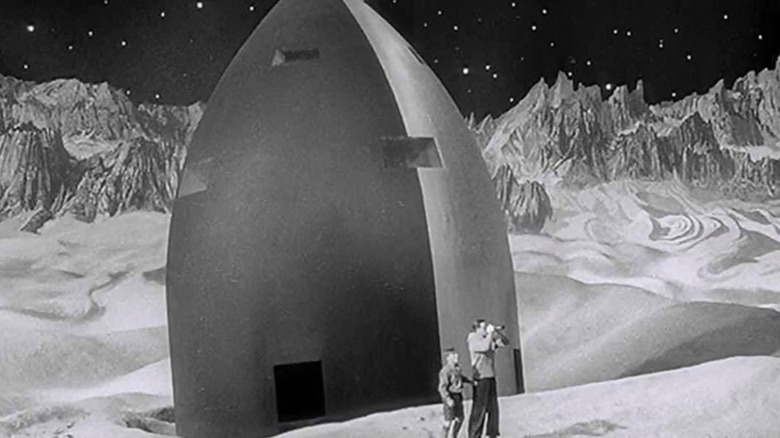
Science fiction has an uncanny history of foretelling scientific advancement, predicting technological breakthroughs, ranging from tablets to holograms, and even defining the public's understanding of complex scientific phenomenon. Since its earliest iterations, a fierce debate has raged amongst cinephiles and scientists alike over the extent of the genre's scientific influence. Most notably is sci-fi's influence over the public's understanding of complex scientific concepts. Perhaps nowhere is this more relevant than the realm of space travel, in which films like "Woman in the Moon" (1929) by legendary Austrian director Fritz Lang have proven incredibly prescient, serving as the first popular representation of everything from rocket countdowns and lunar orbits to the politics surrounding modern space races.
Since Georges Méliès' "A Trip To The Moon" debuted in 1902, audiences have delighted in cinema's differing portrayals of space travel, with directorial legends like George Lucas, Christopher Nolan, and Stanley Kubrick shooting for the stars. But perhaps no movie has had as great an effect on space travel, and the public's understanding of it, than Lang's silent epic. Today, "Woman in the Moon" is credited as the first film to depict space travel as a realistic scientific endeavor. Released in 1929 , two years after Lang's revolutionary epic "Metropolis" cemented him atop the international cinema scene, "Woman in the Moon" was crafted by a team of scientists to be as realistic as possible; a fact which some observers credit for the film's banning by Nazi Germany in WWII. As much a spy thriller and romantic melodrama as it is an odyssey through outer space, "Woman in the Moon" continues to stand out as a technical marvel that, nearly 100 years after its debut, holds up as one of the most scientifically accurate sci-fi films of its era.
To the moon
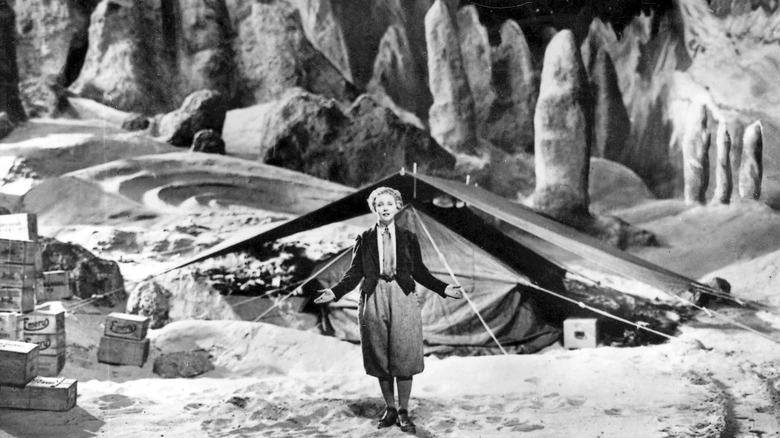
Following the resounding success of his previous film "Spies" (1928), Fritz Lang made his final venture into sci-fi. An epic adaptation of his wife-turned-screenwriting-partner Thea von Harbou's novel, "Woman in the Moon" is ostensibly divided into two parts. The first plays as a conventional spy thriller, following opposing groups of industrialists and scientists as cheat their way through the preliminary stages of a burgeoning space race. The second follows this ragtag team of astrophysicists and conmen as they brave the final frontier. Along the way, the nearly three-hour epic charts a dramatic love triangle between scientist Wolf Helius and his assistants. Ending with a desolation typical of Lang, it is a thrilling and poignant portrayal of the lusts for power and its dire consequences.
What really makes the film standout to modern viewers, however, is its scientific prescience. To ensure accuracy, Lang became one of the first directors to employ a team of scientists, soliciting the help of rocket scientist Hermann Oberth, who'd later be instrumental in developing Nazi Germany's V-2 rocket program, and influential science writer Willy Ley. Together, they created a story that foretold modern space flight, becoming the first film to depict zero-gravity, multi-stage rockets, figure-8 lunar landing trajectories, and g-force-laden liftoffs. It even popularized our conception of rocket launches, complete with detailed checklists and momentous countdowns. As Lang told Peter Bogdanovic in a 1965 interview published in his book "Who The Devil Made It," the countdown was born out of "dire necessity" to build narrative suspense (via TCM). Unfortunately, the film's realism runs out once the rocket lands upon the moon, depicting a breathable atmosphere, Earth-like gravity, and a surface rife with riches. However, the fantastical ending doesn't diminish the fact that many of the defining images of space flight were born on a German screen.
A lunar legacy
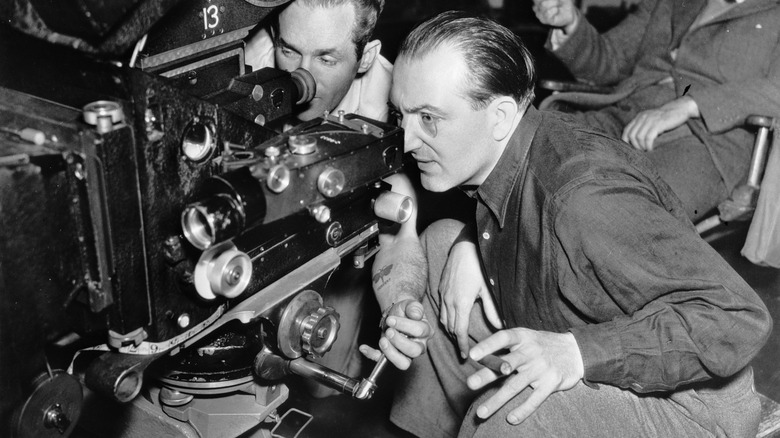
Upon release, "Woman in the Moon" found commercial success despite mixed critical reception. Premiered alongside a failed rocket launch funded by Fritz Lang himself, the film was hailed as technically brazen and visually audacious. Nearly 100 years later, the film is still lauded for its groundbreaking use of special effects, orchestrated by revolutionary animator Oskar Fischinger. Historians, meanwhile, have credited "Woman in the Moon" for predicting both the hysterical mobs of Nazi Germany and the Cold War's rocket mania. Modern viewers, conversely, will likely recognize a privatized space race in which the world's greatest scientific achievements are cooped by scheming tycoons in search of untold riches and stolen glory.
Over the course of his 40-year career, Lang has delivered some of the most important films in movie history, ranging from the aforementioned sci-fi classic "Metropolis" to noir staples "M" and "You Only Live Once." Considering the influence of "Woman in the Moon" on everything from WWII-era rocketry to the moon landing to Thomas Pynchon's "Gravity's Rainbow," one could argue that the director's final silent film is his most indelible. In fact, the film was so accurate in its depiction of rocket flight, that the Nazis banned it in 1937 for fear it would divulge too much about its budding rocket programs. Although, admittedly, Lang's Jewish heritage and status as a Nazi-critic are also likely factors. In either sense, the subsequent banning of "Woman in the Moon" led the film to be largely destroyed. Later, when interest in the influential space drama resurfaced, fans could only watch a shortened version until Friedrich Wilhelm Murnau Stiftung fully restored the sci-fi epic in 2000. As it stands, viewers can stream "Woman in the Moon" for free on cheap streaming alternatives like Kanopy and Tubi or purchase a digital restoration from Kino Lorber.