

How Wooden Satellites Can Prevent A Nightmare Pollution Problem
Space is the final frontier. Much of humanity's greatest scientific and engineering efforts have been put forward to try to get mankind further and further into space. However, the journey there has been fraught with issues like a growing space junk problem and even the possibility of what kind of damage being in space might do to the human brain and body. However, a new potential problem has come up in recent years, and that's just how much our endeavors to explore space and put satellites into orbit might be hurting the planet.
Many are concerned about how large satellite systems like Starlink might be hurting the ozone layer. The simplest solution might be to just stop sending satellites into space, but researchers have come up with another idea that could not only help curb possible climate harm, but also allow us to continue working with satellites in space. That solution is wooden satellites.
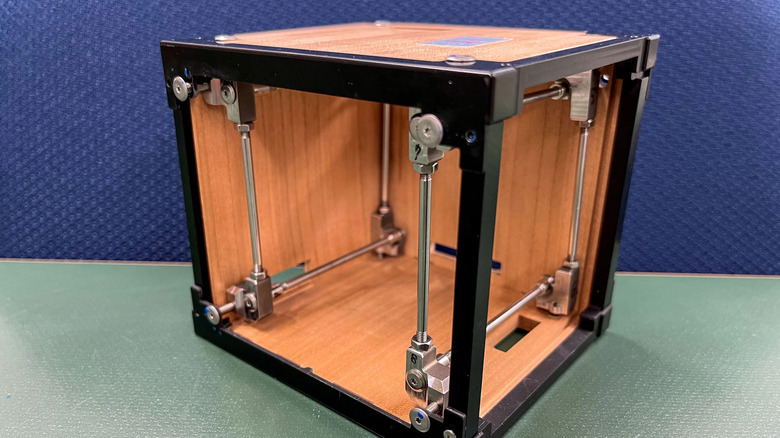
Now, this isn't the first time we've seen the idea of wood-based satellites cross the headlines. Back in 2023, the Japan Aerospace Exploration Agency, or JAXA, proposed an idea to build a satellite made entirely of wood. The reasoning here was so that once it finished its job in orbit, it could return to Earth, burning up completely upon re-entry without delivering any harmful chemicals into the atmosphere. It seemed like a silly idea, but in the last month of 2024, it actually became a reality, with JAXA launching the first wooden satellite — LignoSat — into orbit.
Why wooden satellites, though?

The main reason why JAXA is testing the capability of wooden satellites all has to do with what happens during re-entry into Earth's atmosphere. See, most satellites are made out of metal or other components that are designed to burn up during re-entry. However, metal often breaks down into other chemicals when it burns up. We most recently saw this when researchers measured the air pollution left behind by a SpaceX rocket upon re-entry. The cloud of pollution left behind by the rocket as its components began to break down due to the heat has only helped push researchers toward finding more sustainable ways to put objects into space.
And wooden satellites could be the answer to many of those concerns. That's because satellites like LignoSat contain far less metal than traditional satellites. Instead, they are made up of wooden panels held together using a blind miter dovetail joint, common in Japanese woodworking. This means less chance for metal alloys to burn up in the atmosphere, and less chance they might cause harm to the atmosphere as a result. There are still some concerns that the resulting soot — as well as the chemicals released by the electronics in the satellite as they burn up — could lead to an unexpected chemical reaction, though more research will be needed to understand those risks properly.
There's also the fact that wooden satellites could result in less space junk falling from the sky, thus lowering the chance that any pieces of satellites might crash into populated places and potentially hurt someone.