

Why Your Phone Is The Perfect Way To See The 'Planetary Parade'
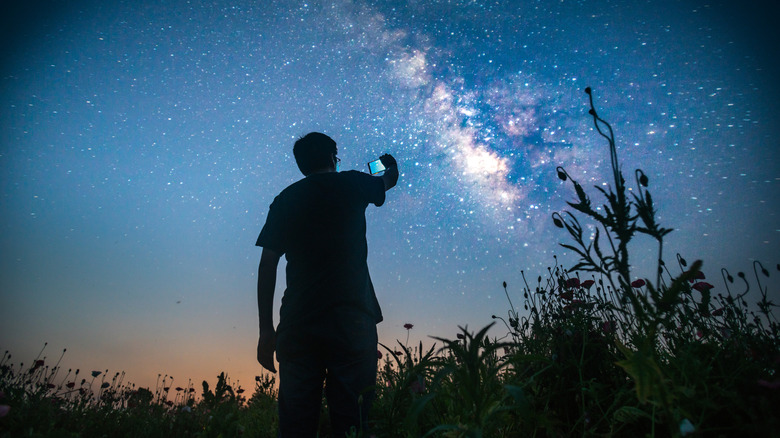
Humanity has been gazing at the stars for millennia, trying to decipher their mysteries. Their periodic changes in the night sky have been tracked throughout the generations, looking to understand what the bright lights are, and what they might mean to humanity's existence, if any such connection can be drawn. Thousands of years later, civilization has a much deeper understanding of space — so much so that NASA is already planning multiple Artemis missions bound for the moon. That doesn't make the night sky any less mesmerizing, as celestial events still manage to captivate people worldwide.
One such event is the upcoming "Planetary Parade," which will be visible right after sunset on February 28. If you're a fan of watching the night sky to discover the planets in our solar system, you may be in for a very special event, as six planets will be in the night sky, four of which will be visible with the naked eye. But you don't have to worry about complex equipment when hunting down a spot to see the next Planetary Parade, because your iPhone or Android device will be the perfect way to see the upcoming event for two reasons: Planet discovery apps and photography.
If you know how to use your phone's camera and adjust the settings (using night mode, knowing how to turn off auto focus), then you'll be able to snap a nice picture of the event. After all, these six planets – Jupiter, Uranus, Saturn, Neptune, Mercury, and Venus — will be parading through the sky in the coming days, appearing from east to west, as they make their predictable journey around the sun.
How to watch the Planetary Parade
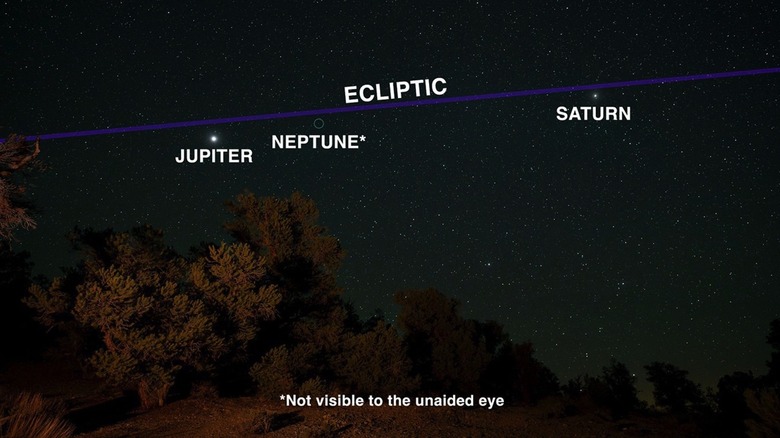
"Planet parade" isn't an official term for astronomers. They may use "planetary alignment" to describe various celestial sightings of multiple planets, but planetary parade is a fitting description. Planetary alignments are events where multiple planets appear in the night sky, showing up as a line or arc in the sky called the ecliptic. All the planets in our solar system circle the Sun in almost the same plane, including Earth. "We see the racetrack of the planets from the perspective of one of the racers ourselves," per NASA. Once you locate one or more planets in the Planetary Parade, it should be easy to find the others by drawing imaginary lines and arcs in the night sky, as seen in NASA's example above.
To see February 28's alignment, you will want to prepare accordingly. First, you should ensure that you're out in an open setting within 30 minutes of sunset in your area. You'll also want to avoid seeing the Planetary Parade from a town with lots of lights and tall buildings. Trees and mountains that may block some of the horizon are also not recommended. According to StarWalk, Mercury and Venus will be placed very low in the western sky. Saturn and Neptune will have a similar position, but they should be slightly higher on the ecliptic. Uranus and Jupiter will be visible high in the sky, with the latter placed in the in the east‑southeast region.
StarWalk also points out that the February 2026 Planetary Parade stands out because seeing the planets is easier to watch thanks to the evening visibility window. Other similar alignments may happen in the morning.
Why using a phone can enhance your experience

Of the six planets, four should be visible with the naked eye (Venus, Jupiter, Saturn, and Mercury). Uranus and Neptune will require optics, so that's where your gear comes in. Binoculars and telescopes would give you a better look at the six planets, but a phone has something these gadgets don't: Apps. You can install an application like Star Walk 2 Plus, which is available as a free download. Use the Planet Walk feature, point the phone to the sky, and you'll find the six planets.
As a challenge, you can try to spot Jupiter and Venus first, which are the brightest. Also, they're at the opposite ends of the ecliptic, with everything else placed in between them. But you'll want to act fast, as Mercury and Venus will be the first to set. This explains the limited window to see the planets parade across the sky. After you've spotted the planets, with or without app assistance, you may want to capture photos and videos.
Shooting the night sky with a high-end phone shouldn't be a problem, as long as you're in a dark setting and adjust the parameters. You may want a tripod for stabilization, or anything else that can keep the phone still. You'll then want to lock the focus and set a long exposure to ensure the phone can capture good photos of the sky. Some phones may have camera modes dedicated to astrophotography. If you haven't done this before, you may want to try it before the big night. On the other hand, if you miss the February 28 sighting, or the weather is bad, you can return on the following nights to try to capture this special Planetary Parade.