

Kansas Is Shooting This Lake With Water - Here's Why
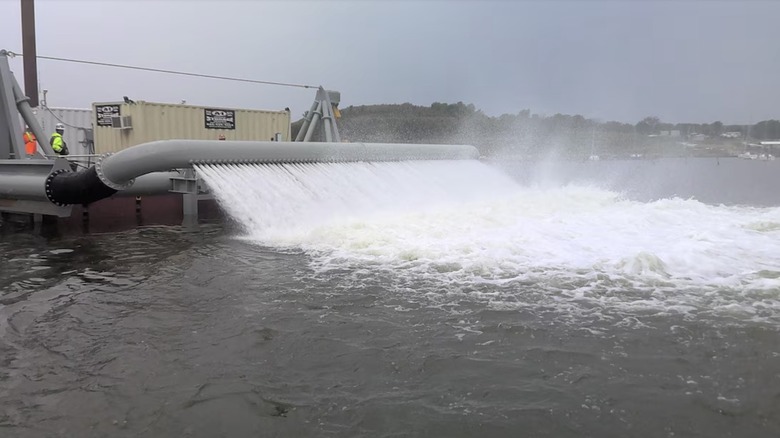
As the name might imply, Kansas' Tuttle Creek Lake — which is actually a man-made reservoir whose construction was authorized by the Flood Control Act of 1938 — consists primarily of, well, lots of water. That hasn't stopped the U.S. Army Corps of Engineers (USACE) from working on a project that involves essentially shooting water back into the lake from a specially equipped barge. Naturally, this might trigger some confusion.
A USACE report indicates that, in collaboration with the Kansas Water Office, the corps is studying whether a method called Water Injection Dredging (WID) can address a sedimentation problem that's caused the reservoir to essentially shrink over the years. If it works, it could represent an environmentally-friendly way to maximize the usefulness of a critical resource without depleting it.
Best of all, the WID method isn't very resource-intensive itself. It actually uses the reservoir's own water to potentially restore its overall water supply over time.
A unique dredging method could fight sediment with water
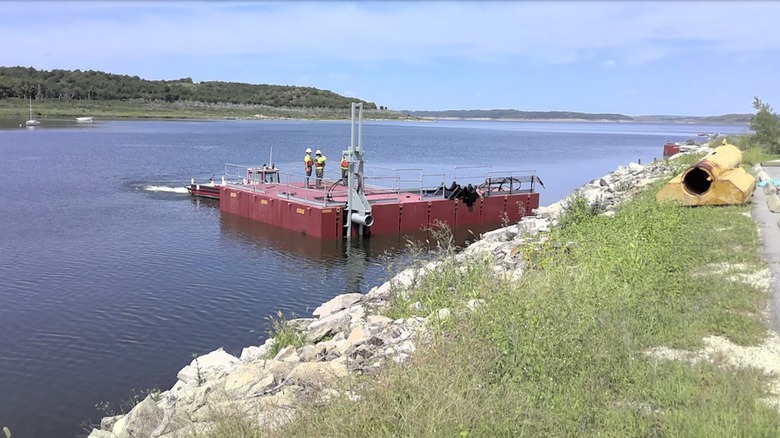
Tuttle Creek Lake currently serves as a water supply source and flood control measure for nearly half of all Kansas residents. It also supports various water-based recreational activities. Unfortunately, over the course of decades, approximately 438 million cubic yards of sediment have settled throughout the reservoir, severely limiting its overall surface area. It's estimated that, unless someone intervenes, in about 50 years, Tuttle Creek Lake could be about 75% sediment; leaving only a quarter of the original capacity available for use.
WID may offer a solution. The process involves equipping a barge with a jet bar that takes water drawn from the reservoir and essentially shoots the water back into the lake. In theory, the water jets will lift the sediment from the surface, allowing gravity to carry the sediment downstream and out of the reservoir.
USACE and the Kansas Water Office plan on studying the effects at a primary dredging location within four miles of the reservoir's dam, where they will employ the WID method to dredge both the lake's floodplain and its channel. They'll also perform testing at a secondary location further from the dam, where only the channel will be dredged. USACE indicates it will perform environmental monitoring of the reservoir and nearby bodies of water (such as the Big Blue River and Kansas River) to assess any environmental impact of the project.
Injecting a lake with its own water could preserve a natural resource
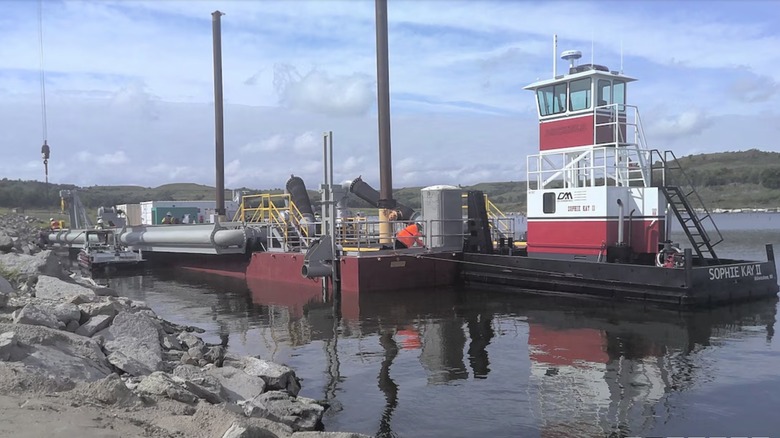
If all goes according to plan, USACE and the Kansas Water Office will begin the Tuttle Creek Lake WID testing with an initial testing period running from September 17 to September 27, 2026. The test is meant to be the first of three testing periods. Depending on the results, the project may serve as a "proof of concept" of sorts for future projects at other reservoirs and lakes.
Sure, when some scientists and governments are actually seeking to control the weather, a unique reservoir sedimentation solution might not immediately appear to be a thrilling technological development. However, it's worth considering the implications of a project like this. With changes to the balance of the global water cycle resulting in potential water shortages, any safe and effective method that may optimize our existing water sources is worth developing. Along with innovations like "farming fog," WID may help us make the most of a vital natural resource.