

This New Way To Produce Battery-Grade Lithium Kills Two Birds With One Stone
The pursuit to find new ways to create batteries more efficiently may have uncovered a way to deal with forever chemicals, which are considered some of the most persistent environmental pollutants on the planet. These dangerous chemicals have become so prevalent that they have even been found to be in 99% of bottled water. For the most part, scientists have been looking for ways to destroy these chemicals, as they don't appear to naturally breakdown over time, which is why they are called "forever chemicals." However, one research team seems to have come up with a different idea, and instead found a way to use forever chemicals to extract lithium, giving us yet another way to gather one of the important components needed to create lithium-ion batteries.
Forever chemicals are more scientifically known as perfluoroalkyl and polyfluoroalkyl substances, or PFAS. They are essentially a group of manmade chemicals that have been used in various consumer products since the 1950s thanks to their extreme resistance to heat, water, and grease. While some of the most common types have been phased out over the years, they still remain resilient and within the environment, and have even been linked to cancer. Which is why we've seen so much work from scientists to try to find ways to remove them — like bacteria that eats forever chemicals.
Based on this new research, though, which uses the forever chemicals to draw lithium out of high-salinity brine pools, there could be a way to not only clean up the forever chemicals in the environment, but also a way to help us gather more lithium, too.
How the process works
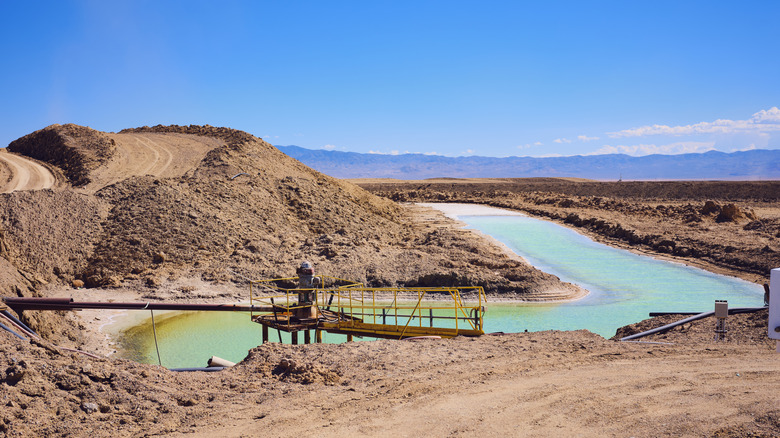
The extraction process works by taking the PFAS and adding it to a high-salinity brine that has multiple salts mixed in. The idea here is to take the lithium that is found within the salts and the fluorine that is locked inside of the PFAS molecules, and free both of them so that they can be combined together to create lithium fluoride. To accomplish this, the researchers took the mixture, added everything together, and then applied electrothermal heating to it. This allowed them to rapidly heat the mixture to more than 1,000 degrees Celsius (~1800 degrees Fahrenheit). After it reached a certain point, they then immediately cooled it down.
By utilizing the extreme conditions, they were able to free the fluoride from the PFAS by breaking down the bonds. It was then able to react with the metal cations — which are positively charged ions formed after a metal atom loses one of its valence electrons. Once everything had settled, the researchers say they were left with a mixture of several different salts including the lithium fluoride and magnesium fluoride. Additionally, the mixture contained a nontoxic waste component, which was created when the fluorine broke free of the PFAS material.
While promising, the researchers were far from done. As outlined in their paper in Nature Water, they then went on to test how useful the lithium fluoride would be if incorporated into a lithium-ion battery and found that the battery design that utilized the extracted material displayed increased performance as well as stability compared to others.
A somewhat limited win
While being able to create lithium from PFAS is promising, there is an important note to account for here. Yes, the batteries with the lithium from the brine were more stable, however, the process of extracting the lithium from the brine is not as useful for cleaning up PFAS in the environment as it may sound. That's because the entire process relies on extracting the forever chemicals from field-collected firefighting foam using granular activated carbon (GAC). The GAC basically absorbs the PFAS from the foam, allowing the scientists to retain it in what they call PFAS-laden GAC. This is what is responsible for creating the nontoxic waste component that we mentioned earlier.
It is also important to understand that the researchers involved in this process also completed a "wash step" to help remove impurities from the mixture. They accomplished this by essentially boiling the mixture until they could distill the lithium fluoride. Because it changed the lithium into a stream of liquid, and the other salts remained solids thanks to their higher boiling points, the researchers say they were able to gather 82% of the lithium in their concoction with a roughly 99% purity.
Further, the researchers note that they compared this new process to other brine extraction methods, and found that their method used less water and energy, which means it contributed less to climate change than the current two most used methods for extracting lithium from a brine. And because it only takes minutes to complete, it could also help lower costs across the board. Not quite the smoking gun for removing PFAS from the environment completely, but it does at least offer a promising way to deal with some types of PFAS-laden waste.