

Caltech's New Tiny 3D Metallic Parts Could Change How Space Equipment Is Made
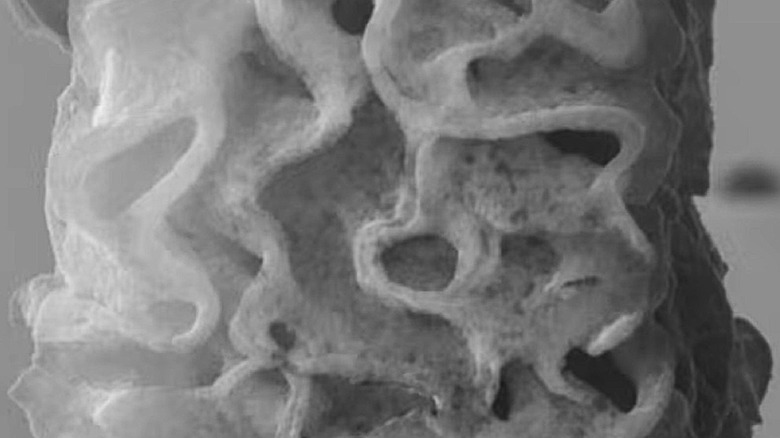
A team of scientists at the California Institute of Technology, or Caltech, have discovered a way to engineer three-dimensional pieces of metal using nanoscale dimensions. What makes this feat unique is that these really small parts are impressively strong and durable despite having a structure that contains pores, grain boundaries, and impurities. These traits would be considered flaws or defects on other materials, but here it helps provide sheer strength that would be ideal for a wide range of applications including in the medical field, computing, and even space equipment.
The technique used to make the material is called femtosecond project two-photon lithography, or FP-TPL, which shapes a light-sensitive liquid into a hydrogel using a femtosecond laser. Then, the hydrogel is fused with metallic salts, composed of copper nitrate or nickel nitrate, before being heated twice a special furnace. Heating the composite in the furnace burns off excess material and shrinks the entire structure achieving the nanoscale dimensions, reducing volume by as much as 90%.
The reason why this would be beneficial for space equipment is because of the material's size and strength. NASA is working on similar nanotechnologies that are significantly lighter and more durable than conventional materials. Imagine if this were used to develop or reinforce NASA's breakthrough 3D-printable super alloy or even NASA's chainmail-like space fabrics.
Tiny parts with immense strength

The material created is vastly superior to its larger, conventional version because everything works differently at the nanoscale. Even with the aforementioned flaws, it's up to 50 times stronger, so components don't necessarily have to be discarded because of perceived defects. And when Caltech's researchers implemented the same microstructural details into models, they were able to accurately predict the strengths of the nanomaterial. Julia R. Greer, the executive officer for applied physics and materials science at Caltech, co-authored of the original paper, and she said: "We put exactly the microstructure we uncovered into the models. It's not an inference. It's not representative. It's the actual microstructure that we made."
That also shows we have a way to correctly model the properties of nano-architected materials, which could significantly improve our understanding and development of future resources, especially for unique projects like space equipment. This development, along with other uses of nanotechnology, shows that the future of nanotech is promising. Not only is nanotechnology being used in ongoing research to reverse Alzheimer's disease, but we could see it improve our everyday lives following a breakthrough in LED tech involving nanoparticles for light-based electronics.