

5 Major Brands You Might Not Realize Are Owned By Microsoft
Microsoft was founded in 1975 by Bill Gates and Paul Allen to develop software for an early personal computer known as the Altair 8800. Decades later, Microsoft has grown to become one of the biggest technology companies in the world. Additionally, it ranks among the top companies in general based on market capitalization, with the company primarily known for its Windows operating system, first released in 1985, and its Office suite of applications used for work by professionals. However, the company does more than just software, and it has diversified its business by spreading its reach into more sectors.
The company's main expansion strategy into more areas in the tech industry has primarily been through acquisitions of different brands. For example, Microsoft acquired Nokia in 2013 for $7.2 billion and, to date, it has made over 200 acquisitions dating as far back as 1994. Through acquisitions, Microsoft has been able to expand its reach as a tech giant, making not just software products but also hardware, and offering different services, such as cloud computing. Due to this acquisition strategy, Microsoft now owns a variety of major brands that you might not even realize fall under its portfolio.
GitHub
GitHub is a platform that is used by software developers to store their code, keep track of changes they make, and collaborate with other members. Founded in 2007 by Chris Wanstrath, Scott Chacon, P. J. Hyett, and Tom Preston-Werner, the platform is one of the most widely used by developers. Some estimates suggest that it is used by over 90 percent of Fortune 100 companies. Microsoft acquired GitHub in 2018 for $7.5 billion, which ranks as one of the company's largest acquisitions to date. Since joining the Microsoft umbrella, the brand's popularity and usage have only continued to grow.
The platform first crossed the 100 million users mark in 2023, adding 50 million users in just three years. And as per GitHub's recent report, it has a user base of over 180 million developers, having added 36 million of them in a single year, an average of more than one developer every second. The site also revealed in the report that it hosts over 630 million projects and achieved a record-breaking figure of 100 million commits in a single month in August 2025.
LinkedIn is another major brand that you probably didn't know is owned by Microsoft. LinkedIn's site doesn't help make this clear either, since it doesn't have any clear label that might give you a hint. As you probably already know, LinkedIn is a go-to site for professionals to network, a place where you can showcase your skills and connect with other individuals within your line of work. Additionally, the site is a valuable tool for job seekers as various companies post their jobs on it and recruiters use it to find potential candidates. With over a billion users on the platform, many people in the workforce have a profile on LinkedIn, and, as such, it's a valuable tool for professionals.
Like GitHub, Microsoft didn't create LinkedIn; it acquired it. LinkedIn was founded in 2002 and officially launched in 2003. It gained just 4,500 users after the first month of operation, and had amassed 225 million users in 2013, roughly 10 years after launch. Microsoft officially made the acquisition in 2016 in a deal valued at $26.2 billion with the intention of growing the site and integrating it with the company's software, such as its popular Office suite. When the company acquired LinkedIn, it was Microsoft's largest acquisition to date.
Activision Blizzard
If you're a gamer, you know Microsoft has its tentacles in the video game industry through its consoles, such as the latest Xbox Series X and S, and its Xbox Game Pass subscription service. However, it might surprise you to know that Microsoft also owns Activision Blizzard, a major gaming publisher that is behind popular franchises such as "Call of Duty," "World of Warcraft," "Overwatch," "Diablo," and "Candy Crush." Microsoft acquired Activision Blizzard in 2023 for $68.7 billion, which helped it climb the charts to become the third-largest gaming company in the world. Interestingly, Activision Blizzard was formed through a merger of two video game studios, Activision and Vivendi Games, in 2008.
However, the name Activision goes as far back as 1979 when the company was founded. Activision Blizzard is a well-known video game publisher that makes games for different platforms, such as PCs, consoles, and even mobile devices. Similar to how Microsoft has various divisions within the larger organization, Activision Blizzard's business also has different arms like King Digital Entertainment, the studio behind the popular Candy Crush Saga mobile game. So the next time you play some games on the Xbox, chances are that it might be a title that is owned by Microsoft.
ZeniMax Media
This is yet another video game publisher that is owned by Microsoft. It was founded in 1999, and its main business is the creation of video games that can be played on different platforms, including PC, consoles, and mobile phones. While ZeniMax has produced some of the biggest gaming franchises, you might not be familiar with the company on its own. In reality, ZeniMax is the parent company of Bethesda Softworks, the studio behind recognized titles like "Fallout," "Doom," "Quake," "The Elder Scrolls," and "Starfield."
ZeniMax was acquired in 2021 for $7.5 billion, which saw Microsoft's portfolio of creative studios grow from 15 to 23 and helped expand the number of games available on its Xbox Game Pass gaming subscription service. Microsoft's acquisition of ZeniMax Media helped to strengthen its position in the video game industry. But more importantly, it helped Microsoft take on its long-time gaming arch-nemesis, Sony, which, like the American tech giant, makes and sells video game consoles and also owns a portfolio of video game studios.
SwiftKey
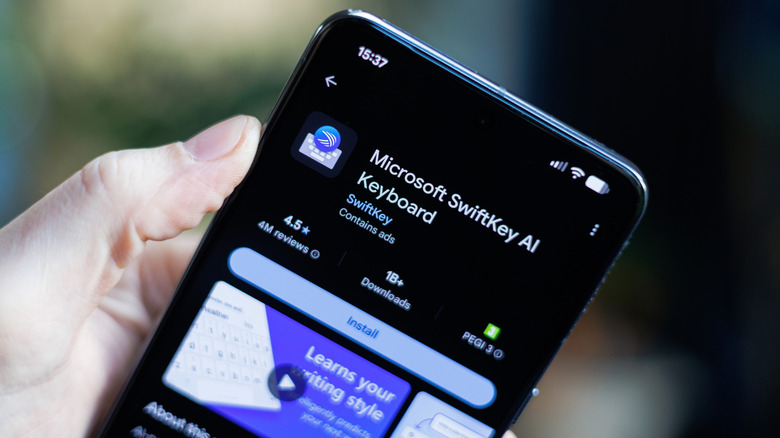
All the brands we've discussed so far are huge companies that run various activities. However, SwiftKey is just a keyboard app that became popular through its predictive capabilities that automatically anticipate what you would say next and offer suggestions to help you type faster. The SwiftKey keyboard app was originally founded by Jon Reynolds and Dr. Ben Medlock in 2008 and officially launched in 2010. It gained traction when it first hit the app stores, amassing over 100,000 downloads in the first week, and that momentum didn't stop, which caught Microsoft's attention.
That led Microsoft to acquire the app in 2016 for $250 million. As of this writing, the app has over a billion downloads in Google's Play Store alone and supports different languages, such as German, Arabic, Russian, English, and Portuguese. The app is free, but its Play Store listing suggests it contains some ads. While the app's name in Google's Play Store and Apple's App Store includes the term "Microsoft," it's published under a different developer name.