

Volcano Eruption Predictions Will Never Be The Same After New Signal Discovery
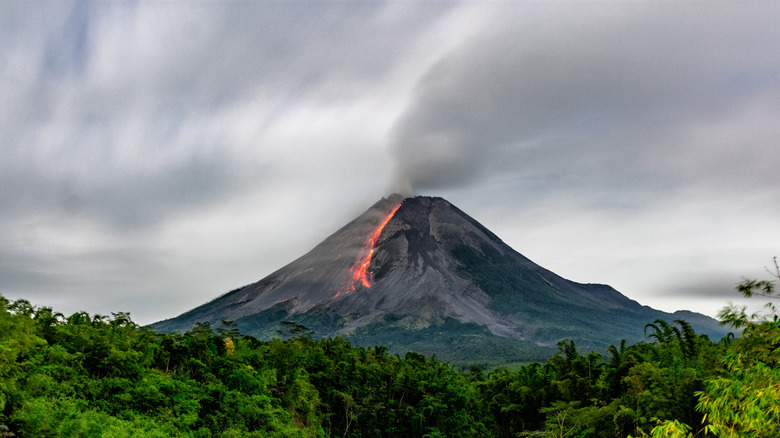
Predicting volcanic eruptions before they occur is valuable for obvious reasons. The earlier scientists detect signs of an imminent eruption, the more time people will have to evacuate potentially affected areas. Unfortunately, as volcanologist Einat Lev explains, key limitations and restrictions make early volcanic eruption prediction difficult. Participating in Columbia University's Columbia Climate School "You Asked" series, Lev states that the technology necessary to predict eruptions is available. However, it's not easy to install all the sensors and equipment necessary to facilitate early prediction at major volcanoes across the globe. Luckily, scientists appear to have discovered a new signal indicating subterranean "fracture openings" that could precede an eruption.
Per a study recently published in the journal Nature Communications, a team of engineers and researchers with members from the Institut de Physique du Globe de Paris (IPGP) and the GFZ Helmholtz Centre for Geosciences has developed a method for detecting eruptions that could change how scientists, authorities, and citizens monitor these disasters before they happen. The researchers behind the project refer to the technique as the "Jerk." They explain that they arrived at this name because the observed signals aren't based on changes in ground elevation, rather they are "directly related to the dynamics of the source that generates more horizontal displacement." In other words, they're measuring the sideways jerking of the ground.
New volcanic eruption detection method identifies signs of magma movement
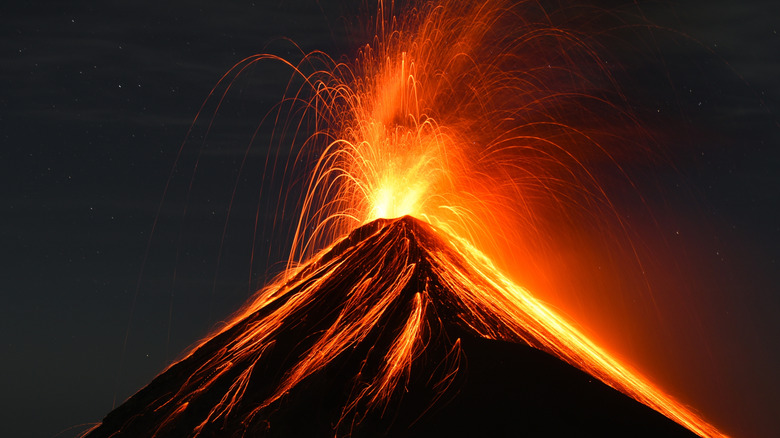
The study in Nature Communications explains that previous methods for predicting volcanic eruptions required analyzing diverse sets of data to identify statistical relationships that could indicate when eruptions may occur. The Jerk method is different. It uses sensors to detect signals indicating the kind of underground magma movement that precedes an eruption.
Early research suggests the new method offers various critical benefits that could theoretically save lives if implemented on a large scale. The Jerk system was initially installed at IPGP's Piton de la Fournaise volcanological observatory in April 2014. While in operation, it predicted 92% of the recorded eruptions that occurred at the site over the course of about a decade. Although the system sometimes provided only minutes of warning, it also generated alerts as much as 8.5 hours before an eruption occurred.
Even when the system wasn't entirely accurate, it wasn't necessarily because it erroneously detected false warning signs. About 14% of the alarms the system raised didn't correspond with actual eruptions. Despite this, researchers found that the kinds of magma movement that could mean an eruption is imminent did occur when the system generated these alerts. The magma movement simply didn't lead to actual eruptions in these cases.
Research team hopes to implement new volcanic eruption detection method at additional sites
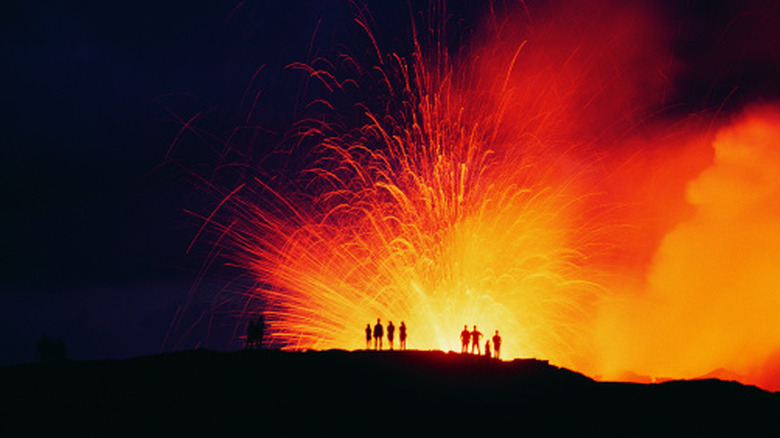
Perhaps the most significant advantage the Jerk method offers (aside from its apparent accuracy) is the fact that its equipment needs are relatively minimal. This addresses one of the core barriers that's prevented volcanologists from successfully predicting major eruptions in the past. Now that the Jerk method has yielded enough data to show just how useful it could be, the research team behind the technique wants to begin testing it out at other sites.
Widespread adoption of the method — which, again, could translate to many lives being saved — might not be far off. Of course, it's also important for scientists to continue studying the reasons eruptions may occur in the first place. Greater exploration into these questions may also help researchers better understand why dormant volcanoes become active again. The more we understand about what precedes an eruption, the more we can do to protect those who live in potentially affected areas.