

The Random Camera Shop Discovery That Inspired Star Wars' Lightsaber Design

We may receive a commission on purchases made from links.
The lightsaber is one of the most iconic weapons in cinematic history. Wielded by noble Jedi and sinister Sith alike, the fictional energy sword has appeared across the "Star Wars" universe in many forms: from Luke Skywalker's instantly-recognizable blue battle lightsaber to Kylo Ren's seriously cool red crossguard lightsaber. But the inspiration for the first iterations of this famous weapon came from a rather unusual source.
Ahead of production on the first "Star Wars" film — later renamed "Star Wars: Episode IV – A New Hope" — writer and director George Lucas worked with concept artist Ralph McQuarrie to translate his ideas for the Jedi's "laser sword" into solid design concepts. However, it was up to set decorator Roger Christian to turn these designs into real props for the film. Unexpectedly, it was a visit to a secondhand camera shop in London, England that provided him with the necessary inspiration he needed to bring Lucas' vision to life.
Where did Star Wars' lightsaber design come from?
In an interview for Titan's book "Star Wars Insider: Icons of the Galaxy," Roger Christian spoke about finding the materials for the first lightsaber in Brunnings, a photography shop in Holborn, London — roughly an hour-long car journey from Elstree Studios, where "Star Wars" was filmed. Christian asked the shop's manager, David French, if he had any old or damaged equipment he could buy for a movie he was working on.
"He pointed me to boxes of equipment that had obviously lain untouched for years," Christian recalled. "I started rummaging through them and found old lenses and rangefinders, pulling out anything I thought might be useful. I then discovered one old box under the others, covered in dust, that had obviously not been opened in years."
In the box, he found just what he needed: seven or eight antique Graflex 3 Cell camera flashes – silver, tube-like objects with red buttons set into the handles. "They actually looked like Ralph McQuarrie's paintings of the lightsaber," Christian continued, comparing the moment to "finding the Holy Grail." Christian was taken aback, recalling that "Even the red firing button seemed perfectly designed for a lightsaber handle. I held one in my hand; it was the right weight and size. I had found the treasure that was eluding me, and I knew exactly what to do with it as I headed straight back to Elstree Studios."
How an old camera flash became a lightsaber
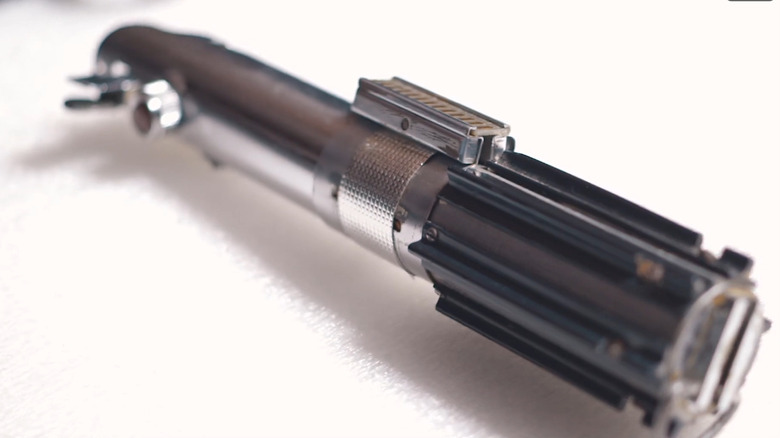
Upon returning to Elstree Studios, Roger Christian added parts from an old Texas Instruments calculator to the contraption and applied black PVC T-Track strips to the hilt. "I superglued the plastic strip onto the Graflex, and there, before my eyes, was Luke's lightsaber," Christian recalled in "Star Wars Insider: Icons of the Galaxy." "I placed a strip of chrome tape around the shaft to hide the Graflex name, and then added a small D-ring so it could hang from a belt. The elegant weapon was finally ready to make its on-screen debut in Obi-Wan Kenobi's hut!"
Today, Graflex happily embraces its part in the creation of cinema's most iconic weapon. The company now exclusively sells products that match "the design, detail, inspiration of the original 1977 movie," including Graflex 3 Cell Flashes, polymer sabers, and grip kits — allowing avid "Star Wars" fans to create their own authentic homemade lightsabers inspired by Christian's method.