

NASA Just Discovered A Massive Field Of 'Dragon Scales' On Mars
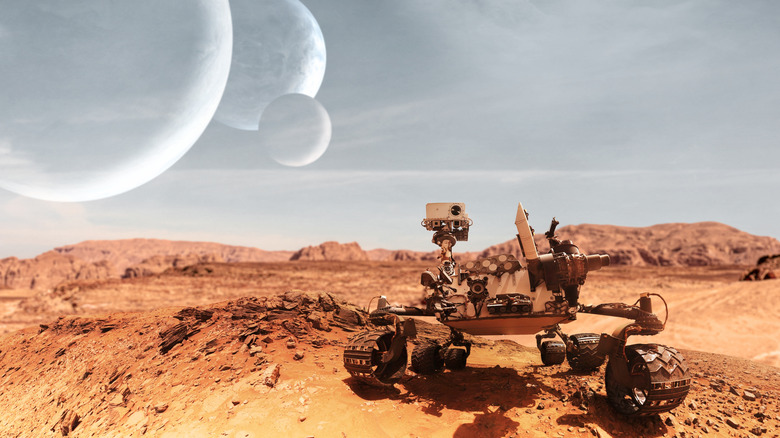
There be dragons on Mars. In some recent snaps taken by NASA's Curiosity rover, dozens of polygon-shaped rocks have appeared, and they look remarkably similar to fossilized reptile scales or, more aptly, dragon scales. Alas, the peculiar rocks are not from a fantastical origin hailing from the winged backs of fire-breathing wyverns, but instead, more likely, due to ancient water patterns. Discovered in a Martian impact crater not far from the planet's equator, the scale-like rocks stretch "for meters and meters." NASA's researchers are surprised to find them, perhaps like everyone else, but not for the same reasons.
According to a NASA blog post, the agency has encountered the same polygon-patterned rocks before, but what makes this particular patch special is that it's "dramatically abundant," stretching across a much larger area of the planet's surface than anything previously encountered. They're visible as raw images on NASA's site as Sol 4859. Researchers have a working hypothesis for why the rocks form in this way, but they're collecting more "images and chemical data" to better distinguish how the unique honeycomb textures formed.
Currently, it's believed they are related to the drying of wet mud or ice crystals below the surface, and were exposed by "nature's drill," the craters on the Martian surface. Curiosity has discovered evidence of ancient water on Mars in the past, through ripples in rock surfaces and other shapes that have formed, not unlike the scale-like rocks. New research also points to the possibility that Mars was always primarily a desert planet, which clues NASA in to what happened to the water that did exist on the red planet.
NASA's Mars rovers have discovered weird rock formations for years
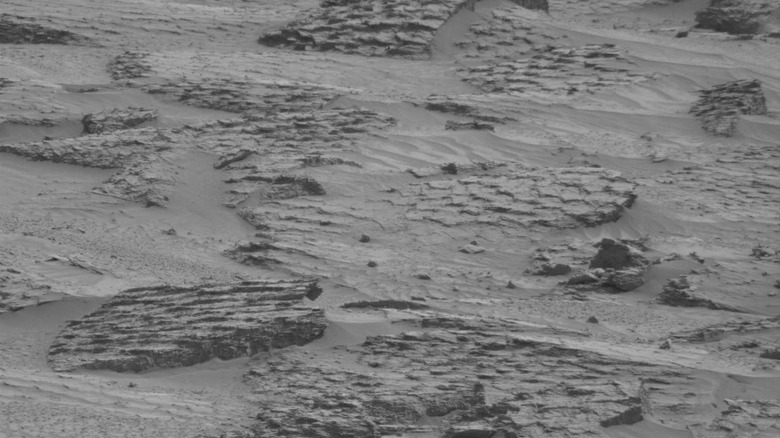
Obviously, the honeycomb-shaped rocks from the recent discovery have nothing to do with ancient dragons, but they are unique. They are also informative, showing signs of what may have transpired on and under the red planet's surface. NASA's Perseverance rover also discovered some strange stuff, like the rock it found with no idea where it came from — named Skull Hill. Another rock, referred to as Phippsaksla, might even be alien to the planet.
The star-studded rover of the day, Curiosity, may also have discovered a valid water source on Mars that agencies can use for future missions if it pans out. All that to say, NASA's rovers are doing some great work, helping to get to the bottom of the Martian history humans have pondered over for so long. The current goal is to discover if there's "an even bigger treasure trove of complex chemistry below the surface." The scale-like hexagonal rock formations suggest there is, but as NASA explains, there are "a lot of ifs" in the equation. Curiosity's further exploration of the Antofagasta crater, where the rocks were discovered, could potentially tell the agency a lot more. NASA should know more soon, maybe even within the next couple of weeks, it projects.