

Scientists Have One Big Question After Reconstructing A 3.7 Million-Year-Old Face
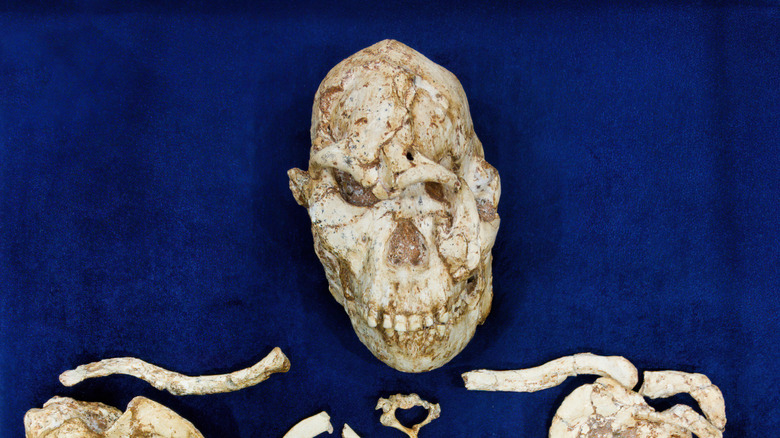
"Little Foot" isn't just a beloved character from "The Land Before Time," it's also the name given to the fossil of a human ancestor found in a South African cave in 1994. Although critical features, like the fossil's face, could provide insights into our shared evolutionary history, for decades, those insights remained elusive. Innovative digital reconstruction tech has changed that. Now, some researchers are questioning whether the fossil may represent a previously undiscovered species.
In a study published in Comptes Rendus Palevol, researchers have shared the results of the five-year digital reconstruction process. Their findings don't just offer a unique glimpse into what a pre-human ancestor like Little Foot would have looked like, they may also provide evidence of the existence of a previously unknown human ancestor. Although one sample isn't enough to confirm that Little Foot is the fossil of a "new" species, this research broadens our understanding of where we come from while also shedding light on just how little we know about our ancestors.
Reconstructing a 3.7 million-year-old fossil's face answers some questions and raises others

Little Foot has always been an important specimen due to the fact that it's long been the closest thing we have to a complete Australopithecus skeleton. Australopithecus was an early hominin genus that lived in Africa over 2 million years ago. Although Little Foot's skeleton is more complete than other Australopithecus fossils, generating a clear image of what its face looked like has proved difficult, as the skull sustained major damage after being buried for an estimated 3.67 million years.
A research team has now used digital technology to rearrange the specimen's skull bones, creating a picture of its overall face shape. As a pre-human ancestor, naturally, Little Foot's mug displays some key differences from that of today's humans. For instance, the orbital region around the eye sockets is significantly larger than our own. However, this detail has raised an interesting question for researchers.
Most of Little Foot's skeleton was discovered in the Sterkfontein Caves of South Africa. When the research team compared its digital reconstructions of its face to other Australopithecus fossils, they found it bore a surprising resemblance to those found in eastern African fossils. Per a CNN report, some also argue that these disparities may mean Little Foot is actually an example of a previously unidentified human ancestor.
Scientists plan to continue reconstructing Little Foot's skull

Dr. Jesse Martin recently co-authored a study arguing there's reason to believe Little Foot might be the fossil of a species other than Australopithecus. Martin suggests that methods used to determine the age of the Little Foot fossil haven't offered a definitive answer to the question of how old it is. If researchers have the age of the fossil wrong, this could throw into question whether its species has been properly identified.
The full reconstruction of Little Foot's skull isn't complete. The current digital reconstruction focused primarily on the face. The team behind the research plans to continue, hoping to reconstruct other portions of the skull (particularly the cranium). What they learn might provide more information about overall evolution of the human brain. This future research may also offer more insight regarding the species the fossil belongs to, and whether that species represents a new discovery. Having a clearer sense of what we evolved from could even help us better understand what we might evolve into.