

Google Stopped Its Campaign To Build America's Next-Gen Drone Swarms - Here's What We Know

According to a report at Bloomberg, Google has dropped out of a contest to provide the Pentagon with AI resources to power autonomous drone swarms by voice. This is after the company had advanced beyond the first round of the contest, alongside other AI firms like xAI, Palantir, and OpenAI. According to Bloomberg, the outlet reviewed a number of records indicating that the decision followed an internal ethics review, though Google's official line was that it came as the result of insufficient "resourcing."
A Google spokesperson also told the news agency that the search giant decided to bow out so that it could focus on "initiatives where our models are most effective." The contest is the combined brainchild of the Special Operations Command's Defense Autonomous Warfare Group and the Defense Innovation Unit (DIU), a government organization tasked with increasing the adoption of commercial technology for the purposes of national security and defense.
The drone technology involved
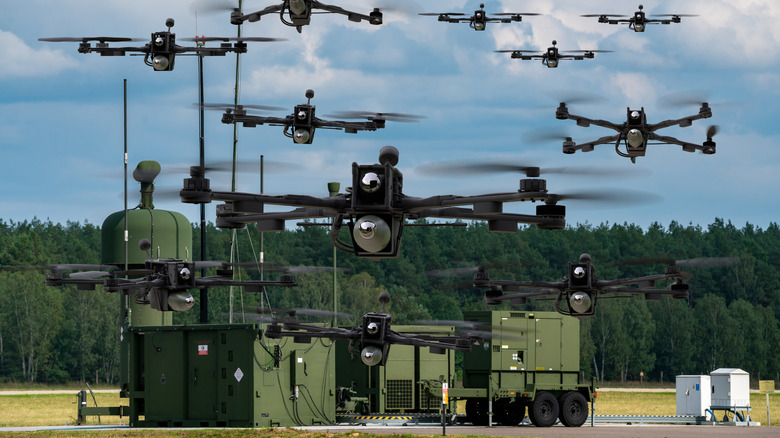
While Google and the other contestants haven't provided precise details about the scope of their entries, reporting about the contest at Breaking Defense provides some indication of the Pentagon's aims. The military is seeking what it calls drone swarm "orchestrator" software, the goal being to surpass current control limits, which restrict an operator to guiding a single drone. The project hopes to develop a user-friendly interface that would allow a controller to maneuver an entire fleet of water, ground, and air vehicles simultaneously, with up to $100 million dollars on offer for the winning contributor(s).
The brief also emphasizes the importance of plain language commands. DIU hopes to design a drone swarm control mechanism that eschews complex menus and that doesn't require familiarity with programming. The ideal system will allow drones to operate in challenging conditions, where connectivity and cloud access are limited, what the military refers to as an "edge environment." Drones must be able to follow common, sophisticated military commands, such as "hold position, conserve battery, and wait for further tasking unless a threat crosses Line Bravo."
The broader context: AI and the Pentagon
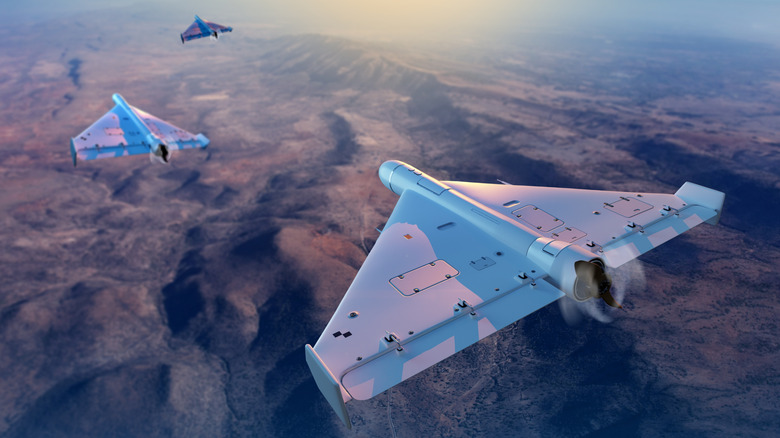
While Google has officially withdrawn from this specific drone technology contest, it has signed an open-ended, $200 million contract with the Pentagon to provide AI models for any "lawful governmental purpose," according to The New York Times. This, despite an open letter from more than 600 of Google's employees in the AI and cloud computing divisions that urges the Alphabet Inc.-owned company to avoid providing AI assistance for classified military operations.
A similar employee-led protest in 2018 caused Google to cancel a bid for a $10B Pentagon contract for cloud computing tech. The tech firm has contributed to several other government agency-led projects, however, like when a Google-funded NASA AI drone raced a human pilot. The Pentagon has also encountered difficulty with other Silicon Valley firms, drawing criticism when it integrated Elon Musk's Grok AI days after the technology was slammed for generating nonconsensual explicit images.
It later clashed with Anthropic, a company it had partnered with to secure Claude AI models on classified networks with the aim of advancing "nuclear deterrence, energy security, and materials science" initiatives, according to a statement from Anthropic. When the company refused to remove guardrails that would prevent its AI from being used in autonomous weapons or for domestic surveillance, the Pentagon countered by declaring Anthropic a "supply chain risk" and terminating its contract. In response, Anthropic has filed suit against the Pentagon and continues to pursue contracts with other federal departments.