

Why Do Rockets Perform A Rolling Motion After Launch?
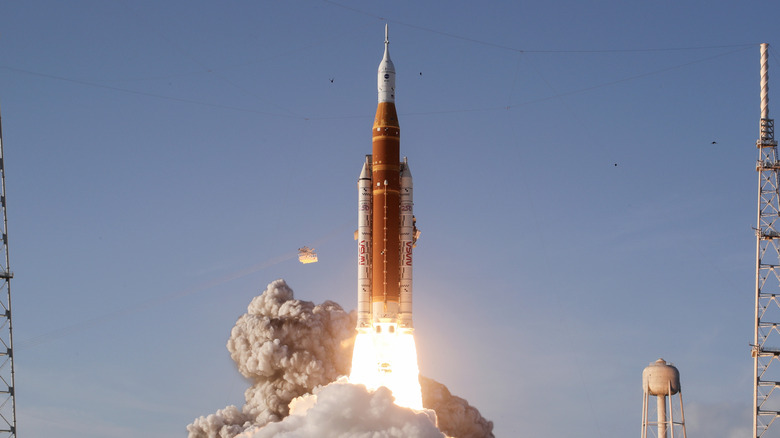
Launching rockets into space is no easy task. Engineers and scientists need to ensure the vessels have enough thrust and fuel to escape Earth's gravity. To achieve this feat, rockets launch at curved trajectories to take advantage of the Earth's gravitational pull. Rolling is another trick rockets use to stay on course.
A rolling motion, alternatively known as a roll program, stems from the rotational movements all flying vessels, including rockets and airplanes, use to navigate. Every movement involves curving one of three axes, and these movements are known as the roll, yaw, and pitch. In airplane terms, a roll occurs when the lift in one wing is higher than the other and makes the plane, well, roll. The rear horizontal tail rudder controls the pitch and uses it to adjust elevation. Meanwhile, the vertical rudder controls the yaw, turning the plane horizontally. While rockets lack wings and rudders, their roll, yaw, and pitch still determine their trajectories, which is where the rolling motion comes into play.
Rockets perform a slow, controlled roll while in flight because it technically removes the roll from the navigation equation. If and when pilots need to change the horizontal angle of their trajectory relative to north (the azimuth), they only need to worry about the rocket's pitch after rolling. This also saves on fuel, as having to make any mid-flight corrections would use more.
How do rockets perform a roll maneuver?
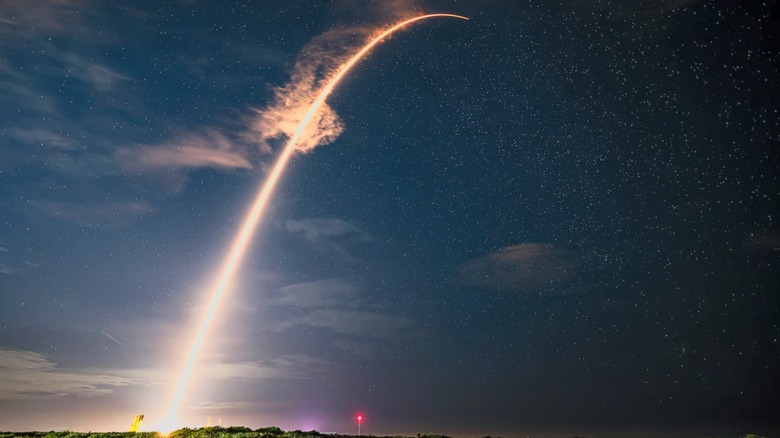
As previously stated, pilots can control the roll, yaw, and pitch of an airplane with its wings and rudders. However, rockets don't have any of these components. So, how do astronauts start a rocket rolling to begin with? How can they control pitch to change azimuth? It all comes down to fins and thrusters.
One way rockets generate and control roll movement is through auxiliary thrusters. These boosters are placed on the sides of the rocket and don't face the same direction. Because their thrusts aren't parallel (sometimes they even oppose one another), the net force of the auxiliary engines produces a roll. More advanced rockets secure engines to gimbals, which are pivoted support mechanisms that let attached objects rotate around an axis. You often see gimbals used to stabilize cameras — the DJI RS 4 Mini is one such gimbal. When rocket engines are gimbaled, they can rotate on their own to produce a roll.
Many rockets also have specialized rear fins that are hinged to "deflect" relative to the natural airflow, which produces their own lift. Since this lift is perpendicular to the rocket's trajectory, it makes the fins, and thus the rocket, roll. To maximize this passive roll movement, all rear rocket fins are deflected in the same direction. While advances in stabilization technology have diminished the importance of these fins, they were a critical part of early rocket designs.