

The US Navy's Project Overmatch Sounds Massive: Here's What It Does
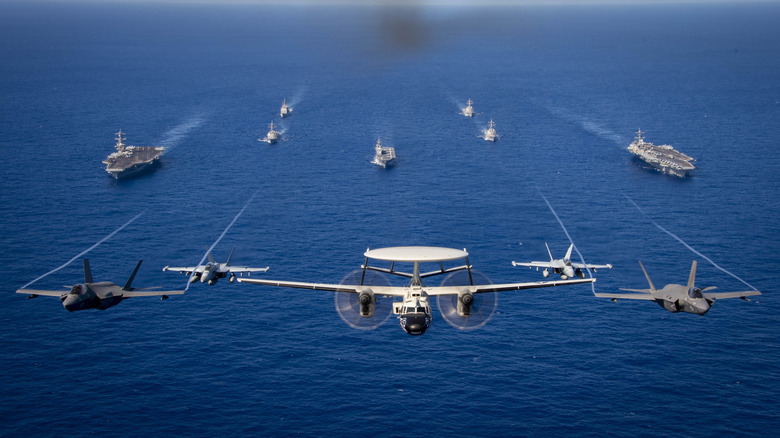
The Navy is six years into a large-scale digital intelligence project called "Overmatch," designed to aggregate key information from several Navy assets at sea, in the air, and even on land, to form a holistic picture of the battlefield. The project started in 2020 and was kept under tight wraps for nearly two years before it became public, according to Defense News.
The project is part of a Department of Defense project called the Joint All-Domain Command and Control, or JADC2, which encompasses all branches of the U.S. military. It's designed to form a global picture of joint operations, while also providing a mechanism for regular system upgrades — meaning that the Navy is moving toward a future where the software on its ships and submarines can be updated, just like Tesla remotely pushes software updates to its cars. The project also aims to gather detailed intelligence of its enemies, using the sensors on ships, submarines, aircraft, or satellites to create a detailed overview of adversary movements in order to exploit weaknesses.
Project Overmatch will unify intelligence from four other key allies — namely, Australia, Canada, New Zealand, and the United Kingdom — as part of the Five Eyes global intelligence community. In order to expand the footprint and detail of information gathered by the Navy and other Department of Defense (War) branches, the project aims to integrate with military assets and data sources of these allies. Together, they can provide more effective situational awareness and strike capabilities during multinational operations. The recent RIMPAC 2026 military exercise tested these integrations at scale, and was a crucial step toward fielding the technology in a real-world scenario. While the project is already six years into its development, it is far from being rolled out successfully, with spending being allocated through fiscal 2029.
How the Navy shares data securely

One of the most important aspects of Project Overmatch is to create the required infrastructure to integrate support intelligence at this scale. Information obtained through a 2025 NDIA Overmatch Brief details some of the elements of the data structures and intelligence gathering mechanisms. The Naval Operational Architecture (NOA) will form the basis of these systems by facilitating networks, data architecture, tools, and analytics. While work forges ahead on the NOA, the data has to come from somewhere, and the mechanisms of generating and sharing it are varied based on location.
Modern Navy ships and aircraft use radar and advanced still or video-based imaging to detect enemy targets. Radar-based information can provide a target's range and speed, and imaging technology can assist with the identification of a target and its origin. All of these methods of detection will be shared to a central cloud-based data warehouse to be used to form an overarching view of a battle environment. The key to using that data correctly is by ensuring that it's standardized to align to newly designed data models.
A variety of hardware and software tools are being deployed on ships to facilitate the standardization that Project Overmatch requires. Images obtained from ship or aircraft-based sensors need to be transformed into specific formats, files need to be labeled in certain ways, and data needs to be sent in specific structures and formats to be accepted by the data model. AI models have even been deployed as part of edge computing, where data is processed where it originates to help facilitate this standardization and add an initial layer of intelligence before being shared.
This is how wars will be fought using AI
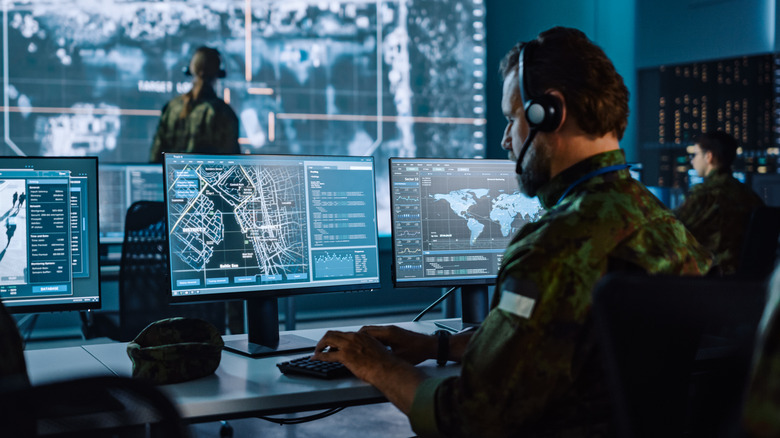
The cornerstone of Project Overmatch and the JADC2 effort is to enable decision-making using artificial intelligence (AI), signaling the start of a new age in digital warfare. By aggregating the data gathered by all of its ships and aircraft, the Navy and its allies will provide a real-time status of enemy positions and activities that can be used by AI-powered learning models to analyze enemy assets and behaviors on a global scale. These systems can then quickly identify weaknesses that could be exposed to inflict the maximum amount of damage on enemy forces in any military operation.
Not only can AI be harnessed to surface these insights in near real-time, it can also identify the best-placed ship or aircraft to carry out a strike on a target. The U.S. and its allies must remain at the bleeding edge of this technology in order to maintain a strategic advantage over its adversaries. China is already reported to be working on similar technology. According to the 2022 annual China Military Power Report, China has been developing its own version of Multi-Domain Precision Warfare.
This will create an interesting new layer of counterintelligence strategies between the East and West. In a world where AI is used to expose crucial vulnerabilities and offer optimized fire solutions, nations will need to develop ways of conducting counter-AI operations to ensure success in future conflicts.