

Those White Trails Behind Planes Aren't Actually Chemicals
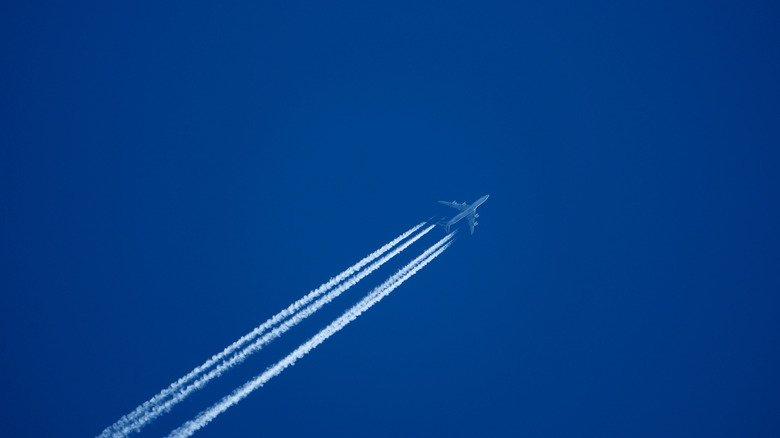
There is an ongoing theory that the white cloud-like lines left behind by high-flying aircraft are actually trails of chemicals being released into the sky for some nefarious means. The theory first gained wider spread popularity in 2002, when journalist William Thomas wrote that trails from jets in the past used to disappear; however, they now remained visible for much longer. As part of the theory, Thomas posited that the trails were actually the military spraying chemicals into the sky. In short, that's not true, though the conversation has persisted regardless.
Over the years, we've even seen the theory popping up in the government, with Louisiana Rep. Kimberly Landry Coates urging for a new law to ban the practice in 2025. We've also seen researchers looking for ways to get rid of airplane contrails to help the environment, lending more credibility to the thought that they are terrible somehow. Others, still, believe they could be some secret project to slow global warming; after all, we've seen a number of potential plans to combat climate change over the years, even including one idea involving the dimming of the sun. However, based on everything that is known about contrails, none of these beliefs line up with the science.
What contrails are and how they form
According to the Federal Aviation Administration (FAA), contrails are formed when airplanes fly at high altitudes and the air pressure and temperature is cold enough to form crystals of ice around the particles and gasses released by aircraft engines. This happens because the exhaust coming out of the aircraft's engines is often as hot as 600 degrees Fahrenheit. When it reacts with the surrounding air of the atmosphere, which can be close to negative 70 degrees Fahrenheit, the water vapor around the particles released in the exhaust form tiny ice crystals similarly to how clouds form in the sky.
While contrails can form at any time throughout the year, the FAA says they tend to be more prevalent when there is a lot of humidity in the air and it is cold. They can also appear as different shapes and even different colors, depending on how the sun hits them and how the aircraft is flying, such as in a straight line or in a more circular holding pattern.
While contrails are mostly formed through natural processes interacting with the gasses left off from the engines of aircraft, it is important to note that there are technically some chemicals being released into the air. Aircraft exhaust contains similar levels of pollutants to automobile exhaust, which the FAA notes is roughly 71% carbon dioxide and 28% water vapor. There are also minute traces of soot and other gasses, such as sulfur. However, there is believed to be less than one percent of these components within the exhaust trail.
Natural processes interacting with exhaust
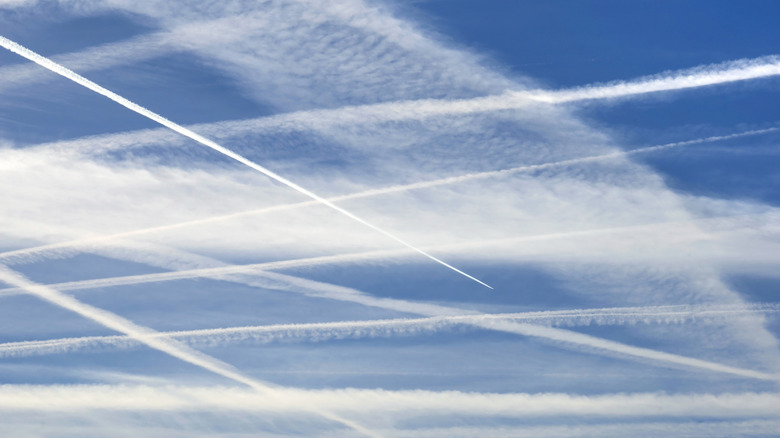
Additionally, the FAA says that it and the EPA have not found any evidence of "deliberate actions" being taken to release dangerous chemicals into the air from the backs of aircraft. Of course, that doesn't mean people aren't going to still believe in the theory, especially since some aircraft are used to delivery pesticides and other intentional dispersion agents such as fire suppressants. There is also the fact that the U.S. has carried out secret bioweapon tests before, including a test in 1950s San Francisco.
As humanity continues to fight global warming, and concerns surrounding our failed attempts to take control of climate change continue to be at the forefront of scientific minds, understanding the full weight of these kind of phenomenon is important. Thankfully, though, the science says we don't need to worry about contrails, at least not when it comes to the potential that they might be some kind of chemical warfare being unleashed upon us.