

Liquid Vs. Solid Fuel Rockets: What's The Difference?
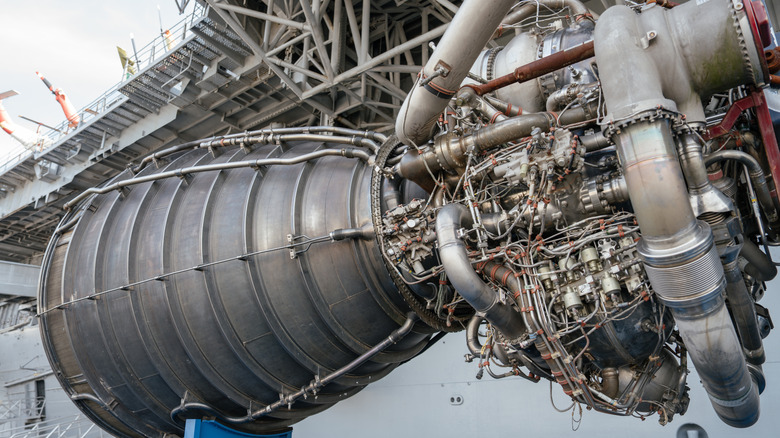
Throughout the history of rocketry and spaceflight, rocket engines have always used two distinct fuel types, and each has its own advantages and disadvantages. Liquid-fueled rockets store fuel and oxidizer separately and are brought together in a combustion chamber where burning happens. Solid-fuel rockets are packed into rocket cylinders and can be stored for long periods of time, and will only burn once exposed to heat from an igniter. While liquid-fueled rockets can be shut down by stopping the flow of fuel, solid rockets cannot be stopped until the solid propellant is exhausted, or the rocket is destroyed.
Solid rocket fuel was discovered in China around 220 B.C. in the form of black powder, which has been used in many different forms to power smaller rockets. Solid rocket motors only began to see large-scale application in different forms between 1936 and 1980, when Caltech and the Institute of Chemical Physics in Russia conducted independent streams of research into this kind of propulsion. The most notable application of solid rocket fuel was its use on NASA's Space Shuttle stack in the form of two semi-reusable solid rocket boosters.
The liquid-fueled rocket engine was pioneered by Robert H. Goddard, who wrote his first paper on the concept as far back as 1909, and eventually launched the world's first liquid-fueled rocket on March 16, 1926, on a farm in Auburn, Massachusetts. Liquid-fueled rockets are by far the most widely used in spaceflight today. They have seen success as far back as NASA's earliest rockets, to the Space Shuttle orbiter, and all of SpaceX's vehicles including Starship.
Pros and cons of solid and liquid fuel
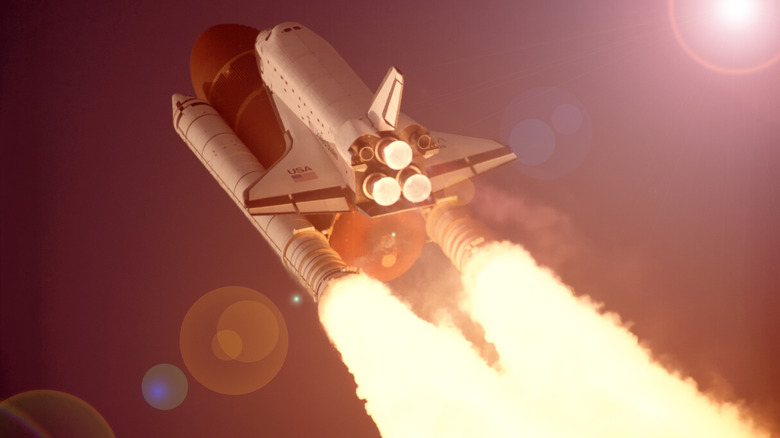
When compared to liquid-fueled rockets, solid fuel rockets have advantages in being simple and powerful. The solid rocket boosters (SRBs) on NASA's SLS moon rocket supply the majority of thrust needed to get the rocket off the ground. On the down side, solid fuel rockets tend to be hard to throttle, and the fact that they can only be shut off when fuel is exhausted introduces a lot of risk. NASA's short-lived Ares 1 prototype used a single repurposed Space Shuttle SRB, and was the only NASA rocket that relied solely on an SRB at launch. These kinds of boosters were at the center of the Space Shuttle Challenger accident investigation, where sealing rings on one of the SRBs failed, causing a burn-through that led to the loss of the vehicle.
Liquid-fueled rockets are the backbone of modern spaceflight, but are complex, and many years of development have been dedicated to making them more powerful and reliable. Liquid-fueled rockets have much needed throttling and shut-off capabilities essential for a launch from Earth. The use of liquid fuel also offers the ability to make finer adjustments that are critical when maneuvering in space, or conducting planetary landings.
How liquid fueled rockets will enable missions to Mars
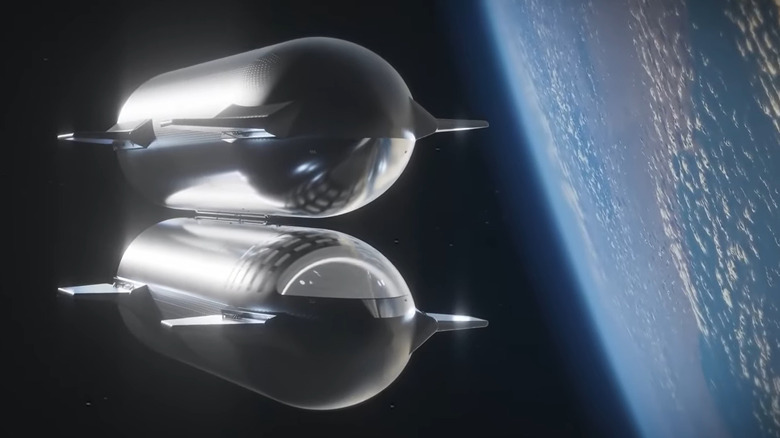
The most powerful liquid-fueled rocket on the planet is undoubtedly SpaceX's Starship. The Starship stack is capable of carrying 110 tons of cargo to space in a variety of configurations, and is fully reusable. The 236-foot-tall Super Heavy booster carries a staggering 4,000 tons of sub-cooled liquid methane and liquid oxygen. The booster has already seen two widely publicized tower catches, which will enable much more rapid turnaround times between flights.
The Starship program is set to pioneer refueling while in space, as part of its strategy of getting the vehicle to the moon or Mars. This would never have been possible with the use of solid-fuel rockets. Launching a Starship to orbit uses precious fuel that will also be required to perform landing and departure burns on the surfaces of other celestial bodies, and this is why SpaceX is testing this method of refueling. The transfer of liquid fuel between two Starship vehicles in orbit is a key milestone that the teams at SpaceX will have to reach before crewed space exploration to other planets can be unlocked.