

This New Scientific Breakthrough Could Lead To Magnets Without Any Rare Earth Metals

Scientists at the Ames Laboratory have developed an AI workflow to help discover rare-earth-free magnets (something AI has already demonstrated it can excel at). The pipeline uses AI models trained on real world physics and the behavior of electrons rather than just existing data to make educated guesses on the specialized materials necessary to build permanent magnets, which need to be able to maintain magnetization even under extreme conditions like high temperatures.
Ames National Laboratory is a U.S. Department of Energy (DOE) National Laboratory and the project is part of DOE's Genesis Mission. The program's official website describes it as an initiative that leverages government resources alongside academia in an effort to create AI resources aimed at "breakthroughs in energy dominance, discovery science, and national security."
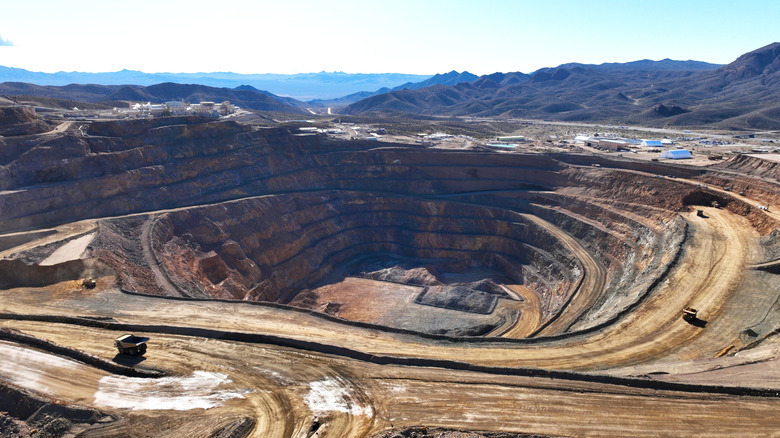
Permanent magnets are a good fit for that remit because they're frequently used in defense applications, ranging from radar systems and fighter jets like the F-35 Lightning II to submarines and UAVs. Despite a huge deal with Apple to sell the company rare-earth magnets, the U.S. currently only has a single rare-earth mine (in Mountain Pass, California) and exports over 95% of the minerals mined there to Asia for refinement, meaning a rare-earth-free solution could simultaneously solve both security and cost issues.
Defining the AI breakthrough
The Ames Lab breakthrough is based on an existing AI model, called DuctGPT. DuctGPT was originally designed to help find materials that could survive inside fusion power plants (like the rare earth superconducting magnets developed by MIT). This means materials able to withstand tremendous heat, radiation, and mechanical stress, but still ductile (able to be stretched and formed without losing toughness) enough to be made into workable parts. The key advancement in DuctGPT is that it incorporates physics-based modeling, instead of just being trained on old data.
This essentially means that instead of just looking for patterns in previously gathered data, the AI has an understanding of the underlying science, and can use it to invent new materials. Rather than guessing from a limited sample, the AI has the rules of the game and can search for new materials rather than tweaking known ones.
The models can also take into account logistical considerations, like how expensive it might be to produce these materials, or how difficult it may be to source the base components. The idea is to ensure that the AI doesn't end up suggesting replacement materials that are as challenging to source as the rare earths they're meant to supplant.
New technology to solve old problems

Searching for a rare-earth-free replacement for permanent magnet materials isn't a new endeavor for Ames. In April of last year, the lab published a press release about a rare-earth-free magnet it had developed by combining bismuth and manganese. It was developed specifically for use in permanent magnet motors, which require magnets that can retain their magnetization despite extreme temperatures or other magnetic interference. Ames' scientists were able to develop a process whereby they coated the crystals within magnetic material with a polymer that prevented them from making contact with each other, which can cause cascading loss of magnetization.
The AI initiative seeks to accelerate the discovery of materials like the manganese/bismuth composite while ensuring they're commercially viable. Reducing dependence on rare earth elements could have implications far beyond defense, like supply chain flexibility for industries including renewable energy, transportation, and consumer electronics. Materials developed using DuctGPT's physics-trained models could also expand the range of materials available to engineers designing next-generation technologies.