

Star Trek Warp Drives Might Be Possible - But The Fuel Costs Trillions Per Ounce

In many science-fiction settings like "Star Trek," vessels are equipped with some manner of faster-than-light (FTL) travel, like the Warp Drive. As with many scientific advancements, the ubiquity of FTL travel in media has encouraged scientists to research ways in which such technology could be realized, and in the most technical sense, a Warp Drive is actually possible according to various studies. Obviously, humanity doesn't possess the technology to go faster than the speed of light, but in theory, it's possible to achieve interstellar speeds of around 19,000 miles per second, about 10% of the speed of light.
The problem, rather than one of technology, is one of fuel economy, and the absurd time and investment it would take to create the only fuels capable of such speed. In order to achieve even 10% of the speed of light, scientists would need a power source with essentially perfect fuel economy, something that converts 100% of its matter into 100% propulsion power. Current space travel propulsion systems are built around chemical propulsion, which only draws out a small portion of potential power from the chemical components. There are potential next-gen fuel sources that could solve this problem, such as antimatter, but at least as of now, that fuel would both take a ridiculously long time to create and cost more money than the combined economic weight of every country in the world.
We could technically make the fuel, but neither quickly nor cheaply
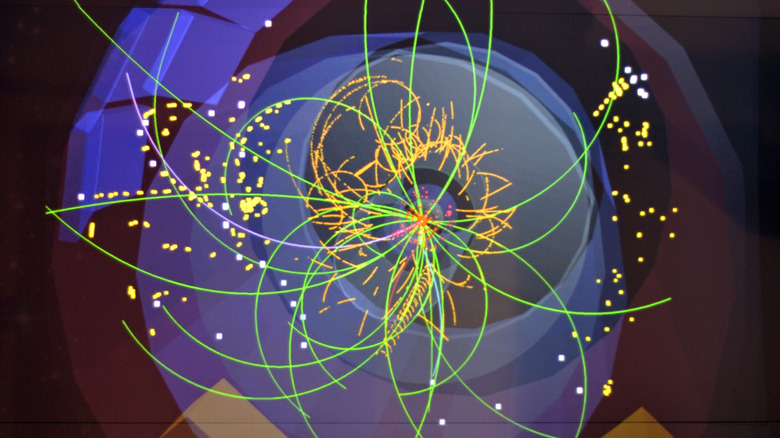
The most promising avenue for that theoretically perfect fuel source would be antimatter, particles whose existence mirrors that of reality's normal particles, but with reversed electrical charges. When antimatter particles come into contact with regular particles, both of them are completely and utterly destroyed, with their combined mass converting into 100% energy. If humanity could harness antimatter particles as a fuel source, it would be possible to generate thrusting power exponentially greater than anything modern chemical-based thrusters could ever reach. There's a bit of good news and bad news with this.
The good news is that the technology to generate antimatter particles exists, specifically CERN's famous Large Hadron Collider. This gargantuan particle accelerator is can create 10 million antiprotons per minute. Unfortunately, 10 million antiprotons isn't that much. In order to generate a single ounce of antimatter-based fuel, the Collider would need to run continuously for billions of years, the energy costs of which would run into the quintillions of dollars. That's not even mentioning the fact that antimatter is unstable, with generated particles fizzling out of existence in a fraction of a second.
To date, the highest concentration of antimatter that physicists have been able to generate at once adds up to less than 20 billionths of a gram. Warp Drives aren't happening any time soon, and even if they did, they wouldn't even be able to go faster-than-light. It may end up being more feasible to go in the other direction, such as slowing the speed of light to something more attainable.