

50 Years Later, NASA's Voyager Probe Is Reaching A Big Milestone For Space Travel
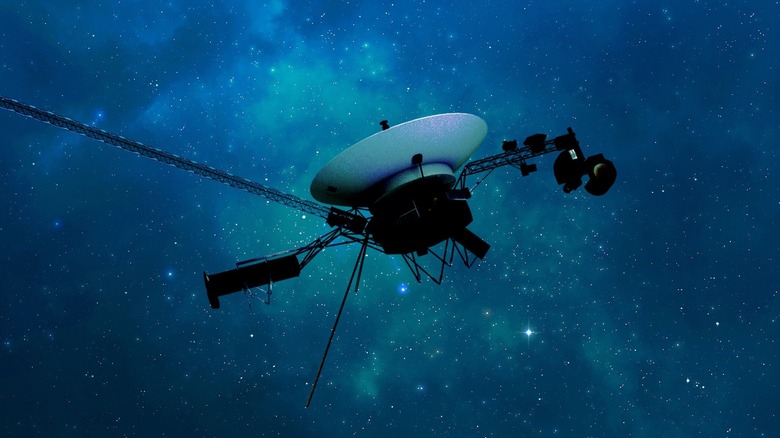
NASA's Voyager 1 spacecraft will hit a remarkable milestone on November 18, 2026 when it reaches a distance of one light-day from our planet. In other words, the point at which it takes light, or any other electromagnetic signal, one entire day to reach Earth, equivalent to 16.1 billion miles.
Voyager 1 is extraordinary on many levels, but perhaps the most remarkable part is that it's still functioning nearly 50 years after its launch. When it lifted off from Florida's Space Coast in September 1977, Jimmy Carter was the president, the era of the personal computer was just getting underway, and "Star Wars" had already become a cultural phenomenon after its hugely successful release four months earlier.
Currently hurtling through deep space at 38,000 mph relative to the sun, or 10.6 miles per second, Voyager 1 is now some 16 billion miles from Earth, making it the most distant human-made object ever. That's almost impossible for anyone to get their head around, so let's explain that colossal distance in a few other ways. For example, if you were to climb into your car and tootle along at 50 mph, it'd take almost 37,000 years to cover the same distance. Even traveling at the speed of a passenger jet at around 550 mph, it would take about 3,300 years to get that far. And thinking of NASA's recent crewed trip to the moon, it would take about 34,000 round trips to cover the same distance. By any measure, Voyager 1 is a very, very long way away.
Staying in touch across billions of miles
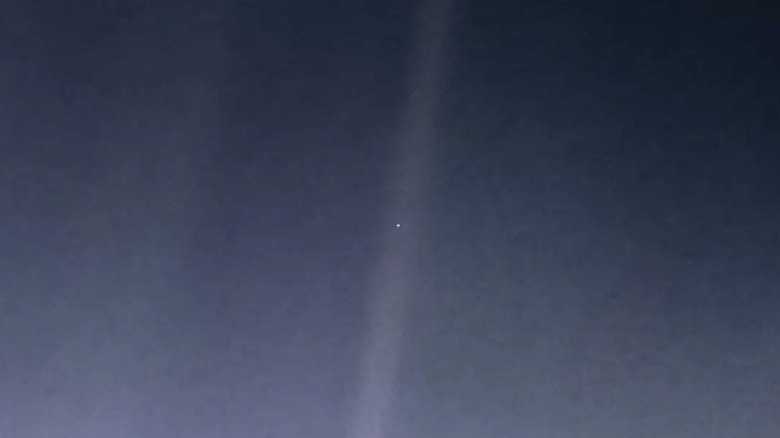
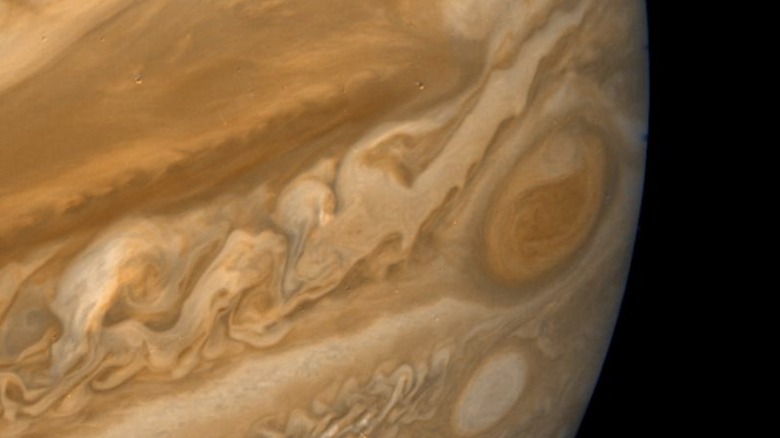
The Voyager 1 mission was designed to make close flybys of Jupiter and Saturn, studying the planets, their moons, rings, and environments — goals it achieved in 1979 and 1980, respectively. Successes include landmark images and data from both planets that enabled the discovery of things like Jupiter's faint ring system and the detection of volcanic activity on Io, a Jovian moon that scientists have suggested could harbor microbial life. Voyager 1 also captured the iconic Pale Blue Dot image of Earth (above) in 1990, and in 2012 became the first spacecraft to enter interstellar space.
Today, Voyager 1 still communicates with a NASA team back on Earth, but it's a time-consuming process. The distance between Earth and Voyager 1 means that data sent between the two takes about 23 hours to arrive. This delay was highlighted in 2023 when Voyager 1 experienced a communications glitch preventing it from sending usable data to Earth. NASA needed several months to resolve the problem, partly because tests and responses took so long to travel back and forth. After much work, the spacecraft was able to resume sending data in April 2024.
Remarkably, Voyager 1 still has a couple of functioning science instruments from its original suite. One is a magnetometer, which measures magnetic fields and helps scientists study the boundary between the sun's influence and interstellar space. The other is a plasma wave subsystem, which detects plasma waves in the surrounding environment and provides insight into conditions in interstellar space when such signals are present. Eventually, due to its dwindling power, communications with Voyager 1 will be lost, but it'll continue heading into deep space.
Voyager 1's 'twin'
Voyager 1 has what NASA often refers to as a "twin," called Voyager 2. It actually launched a couple of weeks before Voyager 1, but was assigned the "2" as it was taking a different, more extended route, while Voyager 1 took a faster path to Jupiter and Saturn. Voyager 2 has the distinction of being the only spacecraft to have performed a close flyby of both Uranus and Neptune, during which it discovered numerous moons around both planets. Voyager 2 reached interstellar space in 2018, six years after its twin, and is currently around 21.3 billion miles from Earth, with communications between the mission team and the spacecraft currently taking about 19 hours one way.
Just like Voyager 1, to preserve power and prolong communications, NASA has turned off some of Voyager 2's science tools, including the plasma science instrument. Active ones include the cosmic ray subsystem, which measures the energy spectrum of cosmic ray particles, providing data on how these particles are produced and how they move through space. However, this instrument will also be powered down some time in 2026.
Voyager 2's story is every bit as remarkable as Voyager 1's, from its unique route through our solar system's outer planets to its continued work in interstellar space. With that in mind, NASA's trailblazing twins are a testament to the agency's brilliant engineering and its determined quest, spanning almost half a century, to explore our solar system and beyond.