

Bananas Might Be The Key To New, Sustainable Textiles
The textile industry is often overlooked in the fight against anthropogenic climate change. With transportation and agriculture consuming so much of the attention placed on environmentalism, few people recognize the impact of the clothing on their back. The fashion industry is the second-largest consumer of water and is responsible for as much as 8% of global carbon emissions, a number that is set to grow dramatically in the near future as textile production has been rising exponentially. Worst of all, the vast majority of textiles ultimately end up in the dump, contributing to microplastics in the environment. How can humanity curb this worrying trend? According to some, our best hope lies in the natural fibers found in banana plants.
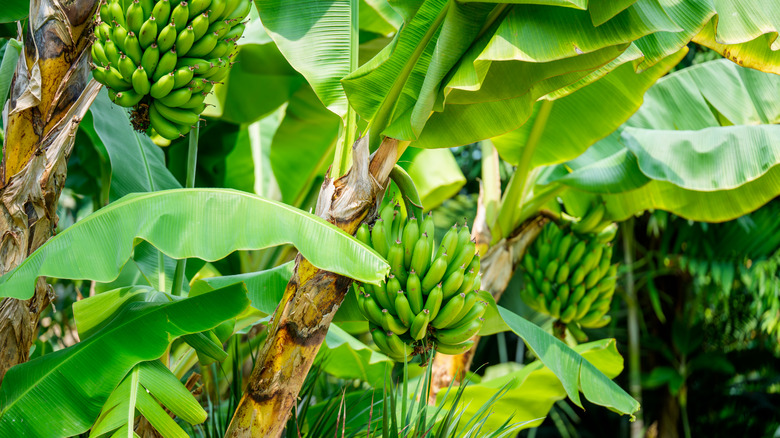
Banana plants are technically herbs, meaning they do not have wooden trunks or stems. But then, what is the thick trunk of a banana plant made of, if not wood? Bananas actually grow from pseudostems, which are composed of a thin soft core surrounded by layer upon layer of dense leaves. These leaves are composed of strong cellulose fibers, but banana pseudostems almost always go to waste, sometimes even being burned. A 2023 study published in the Journal of Natural Fibers estimated that this waste amounts to roughly 220 tons for a single hectare of banana farmland. That's a lot of pollution, but the study's authors, along with other forward-thinkers in the textile industry, have proposed turning that waste into fabrics. The process wouldn't even be that complicated.
How to turn a banana into a shirt
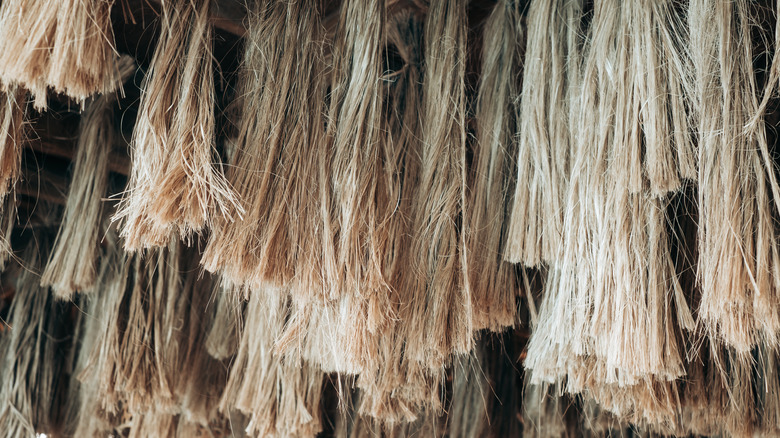
A banana plant only fruits once in its lifetime, and after the bananas themselves are harvested, the bare pseudostem is uprooted to make room for a new crop. Each fully-grown pseudostem has between 20 and 25 layers of leaf sheaths to extract fiber from. This can be done by hand, but for mass production, a machine called a decorticating machine is used, which has blades to scrape away the fibers from the leaf sheaths. The fibers aren't ready to use just yet though, as they are naturally coated in gummy residue from the plant, and they essentially need to be purified. This is done via a process called water retting, in which bundles of fiber are submerged in water to introduce bacteria that naturally eats away all the excess tissue, leaving pure strands of fiber behind.
These processes are already used in the mass-production of other textiles, so the technology to do the same with banana plants is well-established. However, the world will need to shake off its reliance on cotton for real change to come. Cotton dominates the textile industry, and is very water-intensive to grow. However, banana fabric may actually be superior. A 2022 study published in the journal Industrial Crops and Products found that banana plant fabric is 22% more resistant to tearing than cotton fabric, and it offers superior air flow and tensile strength as well. The upshot is clear; now we just have to see if this unusual fashion trend catches on. And if you're still unsure about bananas, they might be the key to cancer prevention.