

The Unexpected Solution To Sustainable Fuel Might Be Hiding In Your Kitchen
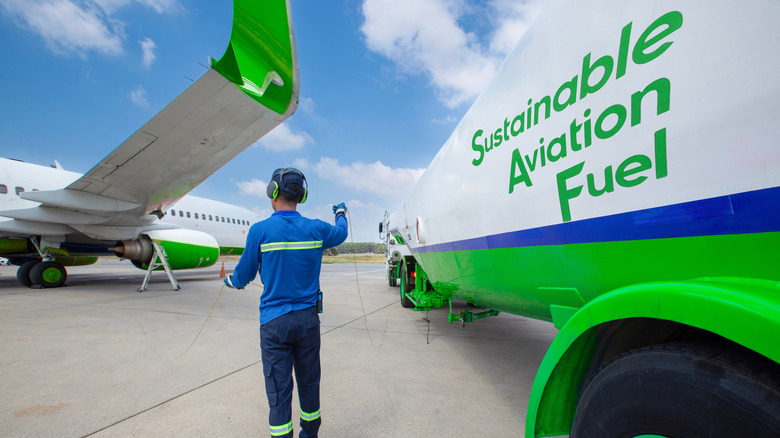
Finding sustainable fuel sources for aviation is challenging. Planes can't really use batteries because they're too heavy. So, plain old fossil fuel is currently the best option. But researchers from the University of Illinois Urbana-Champaign might have a better solution; producing viable jet fuel from food waste, an unexpected energy source that can be reused as fuel. In a study, published in Nature Sustainability, the team explains how they use a process called hydrothermal liquefaction (HTL) to convert food waste into crude oil, which can then be refined into jet fuel.
The key benefit is that HTL mirrors the natural way crude oil forms, but that usually takes millennia — HTL converts it far more quickly. To treat the crude solution, it's first distilled to remove contaminants, and then goes through multiple processes, including hydrocracking with an iron-zeolite catalyst and hydrotreating over palladium. This returns a substance rich in cycloalkanes, the cyclic hydrocarbons that add density to the fuel. This is important because typical HTL biocrude oil is riddled with nitrogen, oxygen, and other contaminants which can muck things up even when strengthened by other fuel like kerosene.
The process resulted in fuel with 70.5% cyclic hydrocarbons, a higher heating value than Jet A fuel, and a freezing point of -60 degrees Celsius versus -40 for Jet A. Deoxygenation measured 98%, all sulfur was removed, and the HTL-derived fuel meets flash point and viscosity constraints required for aviation use. Importantly, it can be 100% dropped in without additional blending.
There is still work to be done
The HTL fuel is not ready for real world use yet. In its current form, only small amounts can be produced for testing, so once perfected, the operation will need to be scaled up to handle commercial demand. More importantly, the process will need to be more economical as the current setup will increase costs, especially when dealing with the HTL byproduct — a harmful aqueous substance. Researchers are attempting to treat this waste, but that adds further complexity and costs.
Finally, collecting and transporting food waste to an HTL facility is challenging as most of it is dumped in landfills or treatment plants. Gathering waste from these types of facilities requires specialized equipment, but a workaround could involve treated wastewater for the HTL process. This is just one example of how versatile food waste can be as a resource. Research teams are currently exploring using a tiny bug to turn food waste into nutrient-rich biofertilizer, and Japan is turning uneaten food scraps back into edible food. Of course, those don't go so far as creating burnable jet fuel, which could have a significant impact on reducing carbon emissions.