

This Breakthrough Cancer Treatment Is A Surgery-Free Wearable Skin Patch
Scientists have found a new way to potentially treat melanoma. Melanoma is a type of skin cancer that can be caused by exposure to ultraviolet light, though some melanoma develops in areas that often have little light exposure, such as internal tissue. According to the American Cancer Society, over 100,000 people are expected to be diagnosed with melanoma in 2026 alone, with over 8,000 predicted deaths. Current treatments for melanoma include chemotherapy and surgery, but a new non-invasive option could be in the future.
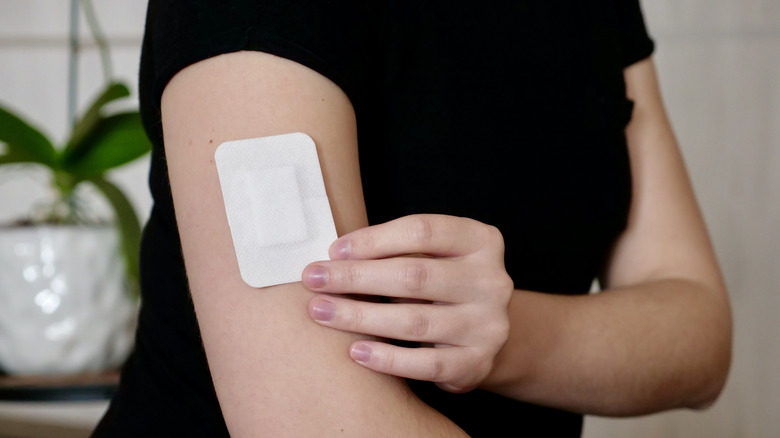
A team of researchers has developed a wearable, stretchy patch that can be placed on the skin. It uses sunlight to heat the patch, which in turn releases copper ions that attack the melanoma cancer cells. It requires no surgery, no needles, and no radiation. The patch is extremely thin, only 230 micrometers. It also able to stretch to about 184% of its original length to be able to adapt to different bodies and areas that need treatment. While this research, published in ACS Nano, is in its early stages and not approved for human use yet, it is an exciting discovery that could revolutionize melanoma treatment.
How this wearable skin patch works

The patch is made up of three key components. First there is a porous graphene layer created by using a laser on the plastic material of the patch. This is important because graphene can convert light into heat. The second is copper oxide embedded into the graphene so that when the patch heats, it can release copper ions. Finally, polydimethylsiloxane helps the patch conform to the wearer's skin.
The patch uses what is called photothermal therapy to make cancer cells self-destruct. The light that hits the patch is converted into heat. It doesn't get too hot since that would make it dangerous for the wearer. Instead, this temperature-controlled patch stresses the cancer cells in an effort to kill them. While the stress of the heat alone can be enough to kill the cells, the research also found that the copper oxide in the patch contributes to killing the cells by giving them an excess amount of copper.
The patch did even more beyond just killing the melanoma cells. It also caused these damaged tumors to release damage-associated molecular patterns, or DAMPs. These have the potential to send signals to the immune system and create a broader antitumor immune response. In other words, it could boost the immune system to more aggressively attack cancerous tumors.
When will it be ready for human use?

Advances continue to be made in the study and treatment of cancer, including an AI breakthrough to detect cancer early. Although this research is promising, it is still in the animal testing stages. The research team implanted mice with melanoma and tested mice with the patch against a control group. All the mice in the control group died, whereas the patch group had an 80% survival rate after a month with melanoma tumors.
The research team is looking toward the future and planning more animal trials. If those are successful, human trials would be the next step. Something very positive about these patches, though, is that they have been proven to be reusable up to three times without any loss of their capabilities. A future for those suffering with melanoma to have treatment that could possibly be as simple as wearing a skin patch is an exciting one, and it will be interesting to see what is discovered in the years to come.