

Nothing Ear (3a) Review: Raising The Bar For Budget Earbuds

Nothing has been building some of my favorite wireless earbuds for a while now — not just for the money, but overall. The new Nothing Ear (3a) earbuds are part of that lineup, offered as the budget-tier sibling to the $179 Nothing Ear (3), at a fairly affordable $99. They're a successor to the original Nothing Ear (a) earbuds, which were released a couple of years ago.
On paper, the Ear (3a) offers more than you might expect at this price point. That includes Bluetooth 6.0, LDAC support for high-resolution audio, wideband active noise cancellation, and some relatively unique features, like the ability to record audio directly on the earbuds themselves. So, how much do you actually give up by saving $80 over the Ear (3)? I've been using the Ear (3a) to find out.
Design
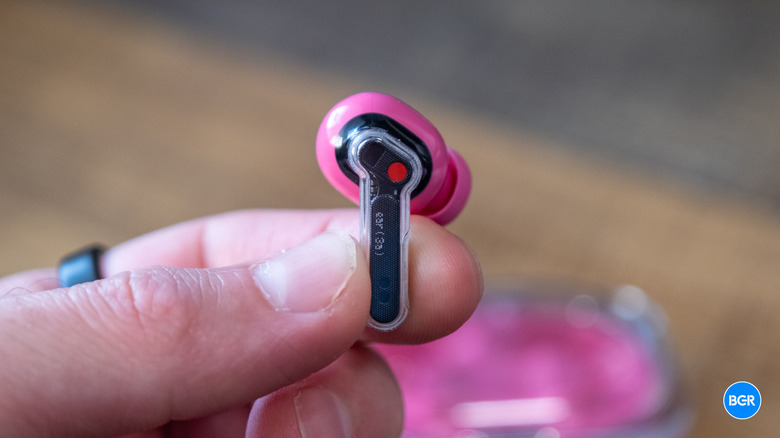
There's one thing that hasn't changed much since the original Nothing Ear (a), and that's the design. I'm glad to see it — I really like the design of Nothing's earbuds, and while they're not as compact as the standard Nothing Ear (3) earbuds, the Nothing Ear (3a) still look unique and stylish.
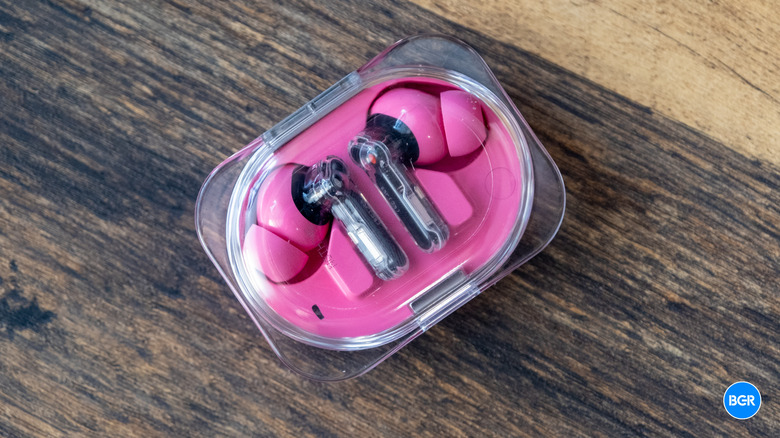
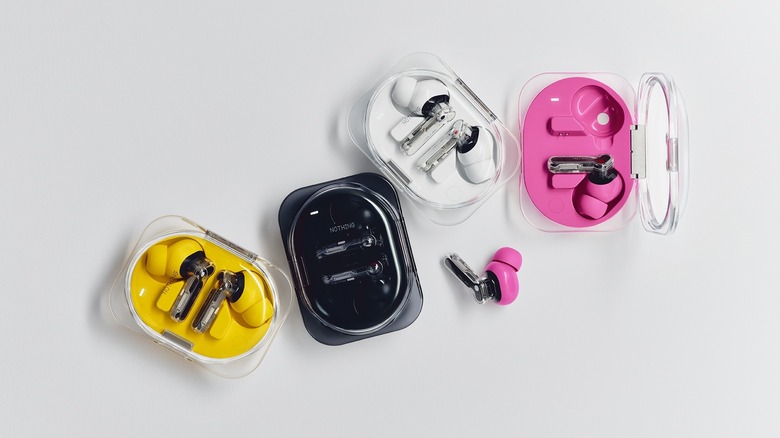
For the original model, the signature color was yellow, and this time around it's pink. I really like the look. Sure, it's probably not my general daily style, but I love to see companies experimenting with bright color options. Only five or so years ago, it was uncommon to see colorful tech, but these days, it's almost standard. There are other color options, too, including the original white, black, and yellow.
The Ear (3a) keep Nothing's signature, partially-transparent design, with visible internals that still manage to stand out in a market full of anonymous pebble-shaped buds. Nothing says the shape this time was inspired by bubbled pill packaging and a pink Love Hultén synthesizer.
The earbuds themselves are very lightweight and carry an IP54 rating, so they'll handle dust, sweat, and rain without issue. That's the same rating the AirPods Pro 2 had, for reference, and it's good enough for workouts and commutes — just don't take them swimming. The charging case is also IP54-rated, which is nice to see. Often, charging cases don't have any IP rating at all, which means that if you forget they're in your pocket and jump in the pool, you're out of luck. Unfortunately, that's still the case here — IP54 isn't protective enough for full submersion — but at least if you get caught in the rain, a few drops on the case won't do any damage.
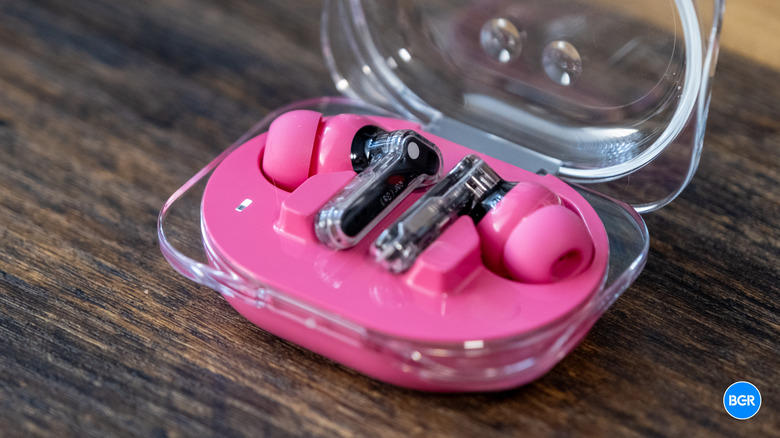
The case has been redesigned with a rounder silhouette and a new status light that communicates battery level, pairing, and charging states more clearly than before. Controls stay on the earbud stems, using pinch gestures rather than taps. I'm a fan of this approach — taps trigger accidentally when you adjust the buds, while pinches basically never do. Apple's squeeze controls are still the gold standard here, but Nothing's implementation is close.
Compared to the Ear (3), there are two notable features missing. The case drops the flagship's integrated "Super Mic," which the pricier model uses to improve call quality, and the finish feels a touch less premium in hand. Neither is a dealbreaker.
Comfort

Nothing has always offered some of the most comfortable earbuds on the market, and the Nothing Ear (3a) earbuds continue that tradition. The stem-based earbuds seem to be shaped perfectly to my ears — they're snug without being too tight and enough to not move around much during use, even during workouts.
Nothing includes four sizes of silicone ear tips in the box, and this generation adds an extra-small option. It's worth spending a few minutes finding the right size, because a good seal makes a real difference to both sound quality and noise cancellation.
Features and noise cancellation
The headline change here is the upgraded wideband ANC, which Nothing claims cuts up to 45dB of noise and operates effectively up to 5kHz. Whether or not that's accurate, I did find the ANC on these earbuds to be pretty good for the price. It's not going to beat the likes of the AirPods Pro 3, but it's as good as or better than anything else at this price point. It's also nearly as effective as the ANC on the more expensive Nothing Ear (3). In daily use, on transit and in busy cafes, I struggled to find situations where the extra $80 would have bought meaningfully more silence.
There's an adaptive ANC mode and a transparency mode, too, and both are decent rather than exceptional. The adaptive mode occasionally behaves a bit weirdly, though it worked well enough most of the time. The transparency mode is usable for quick conversations, but it doesn't sound super natural, and you'll probably want to leave it disabled most of the time. Apple is still the king here.
Connectivity is pretty strong as well. The earbuds connect over Bluetooth 6.0 and support multipoint across two devices and LDAC alongside AAC and SBC. Multipoint worked reliably between my phone and computer, and LDAC at this price is uncommon.
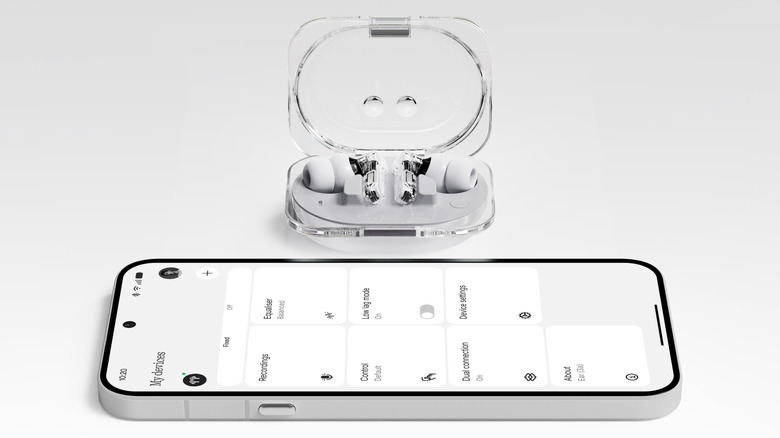
The earbuds connect with the Nothing X app, which is available on iOS and Android. I actually quite like this app. It's pretty easy to navigate, and it supports features like custom control mapping and, thankfully, the "Advanced" EQ that was previously only available on Nothing's more expensive Ear (3) earbuds.
Perhaps the most unique feature on offer by these earbuds comes in the form of the recording. The Ear (3a) offers 32MB of onboard flash storage, enabling a feature Nothing calls Audio Snapshot — pinch both buds and the earbuds capture up to a minute of whatever you're listening to, including audio from before you triggered it, like a screenshot for sound. The same mechanism records up to two hours of phone calls directly on the buds, synced to the app afterward.
Technically, it all works well, but it is worth noting that, in some regions, it's illegal to record a call without the consent of both parties. There is an audio cue played to the person on the other end of the line to alert them that you've started recording, but it's still worth keeping the legalities in mind if you plan on using it. You can disable the feature entirely in the Nothing X app, and if you have no professional use for it, you may want to do so.
There are actually two different tiers of transcription on offer. There's a standard version, which runs on your phone for free, but there is also a Pro version that uses cloud-based processing for more accurate transcription. Pro Transcription is included for free for three months when you buy the earbuds, and you'll be able to transcribe up to 120 minutes per month in the Nothing X app. After that free trial, however, you'll have to pay a subscription fee for Pro Transcription. Unfortunately, we don't yet know how much that subscription will cost, but I suspect it won't be long before we find out as users approach the end of their free trials.
Battery
The battery life on offer by the Nothing Ear (3a) earbuds is decent, but not incredible. Nothing rates the Ear (3a) at up to 10 hours of playback with ANC off. Turn ANC on, and you're looking at roughly 6 hours, which is on the lower end — plenty of earbuds offer a much longer battery life with ANC enabled. For example, the AirPods Pro 3 hit 8 hours with ANC — though, to be fair, they also cost two and a half times the price. With the case, the Ear (3a) earbuds do get 42 hours with ANC off or 25 with it on. Again, not bad, but not incredible.
The case does support fast charging, which can help a little, though it's not as fast as some others. Five minutes of charging over USB-C will get you an hour of playback. Unfortunately, you won't get wireless charging, which is pretty disappointing. I think all wireless earbuds, even ones at this price point, should support wireless charging. You have to stick with USB-C for the Nothing Ear (3a).
Sound
The Ear (3a) earbuds use a new 12mm dynamic driver with a lightweight PMI center and flexible TPU edge — up from the 11mm drivers in the Ear (a). You'll get a frequency response from 20Hz to 40kHz, which is what's required for the LDAC codec. According to Nothing, the new driver delivers 5dB more bass than the previous generation, and whether or not that's true, they're certainly aggressive when it comes to bass — and arguably overly so.
To be clear, the stock tuning isn't subtle. It's energetic and bottom-heavy in a way that makes the earbuds perhaps a little better for those who like that big bass. On the other hand, it steamrolls the midrange on most tracks, and if you want something a bit more neutral, you'll need to spend some time in the EQ. It certainly does help that the more advanced EQ is available in the app for these earbuds, but it still means that you'll need to spend some time dialing them in if the presets don't appeal to you.
The good news is that the effort pays off. With the bass pulled down, the Ear (3a) earbuds sound quite good. They offer impressive detail for the price, with a warm midrange and a notably wide soundstage. Treble stays crisp without tipping into harshness, and complex mixes hold together well. There's a genuinely capable driver under that default tuning — Nothing just chose to voice it for maximum impact rather than accuracy.
The earbuds also have a spatial audio feature, which is adequate, but not something I would use regularly. It doesn't support head-tracking, but more than that, it's not as realistic or as natural as the spatial audio tech on the AirPods Pro 3, for example. For the most part, you'll want to disable it.
Against the Ear (a), this is a subtle upgrade rather than a transformation. The extra bass headroom and improved detail are audible if you go looking for them, but nobody should upgrade from the Ear (a) on sound alone.
Should you buy the Nothing Ear (3a)?
Unsurprisingly, the Nothing Ear (3a) earbuds offer excellent value for money — so much so that it can be hard to justify the price of more expensive earbuds. They look cool, sound good (with some tuning), and offer a few advanced features that much more expensive earbuds don't.
They're not perfect, though. The ANC is only fine, the battery could be better, the default tuning isn't great, and there's no wireless charging. These are all issues that could (and maybe even should) have been addressed by Nothing. But they're also issues most people can live with, given how well these earbuds perform in other areas.
And they do perform very well in those areas. If you're looking for a pair of wireless earbuds that can do all of the basics really well, plus offer some advanced and unique features, then these are the way to go. Just don't expect them to compete with the much more expensive best of the best wireless earbuds out there.
The Nothing Ear (3a) earbuds generally match or undercut the majority of both mid-range competitors and options much more expensive. Sure, above $200 it's easy to find something better — but below it, the Nothing Ear (3a) actually has most options beat. With that in mind, if you want a pair of earbuds that do everything pretty well, at a very reasonable price, the Nothing Ear (3a) are a great choice.