

Oppo Find X10 Pro Max Review: This Is Why America Can't Have Nice Things
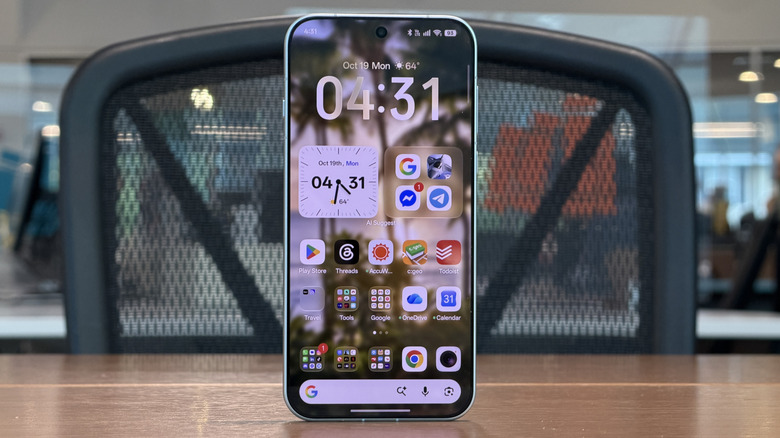
The Oppo Find X10 Pro Max evokes strong, mixed emotions in me. On the one hand, this is a fantastic phone in just about every way. It has excellent battery life, extremely good cameras, very good software, and is genuinely fun to use. Everything about this phone screams of quality.
On the other hand, I can't have it. I used to have it (mostly), but now I can't have it anymore. OnePlus and Oppo had (okay, still have) a solid relationship with each other. They used the same parts bin. What launched as an Oppo flagship elsewhere, generally became a OnePlus flagship in the U.S. Then BBK, the parent company of OnePlus, shut down that company outside of China. No more OnePlus phones for me, you, or anyone outside of its home country.
That's why the Oppo Find X10 Pro Max rankles so much: I hate it because I love it so much. I want it here in the U.S., and that is something I likely will never get. Many parts about this phone absolutely boggle the mind, and it's precisely because it was never designed for the U.S. That's a problem, but it's a problem for a different article. Today, I get to write about this phone, which is so, so good. I've been using the Oppo Find X10 Pro Max for almost a month, and these are my thoughts.
Premium parts
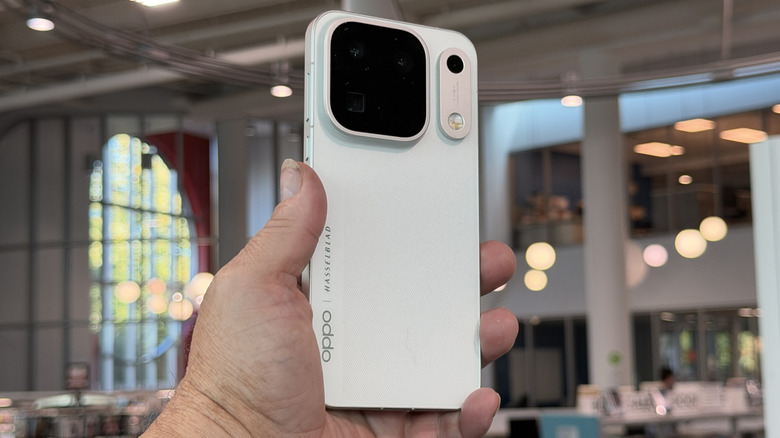
I first learned about this phone back at IFA 2026 in Berlin. Oppo invited us to come and take a behind-closed-doors look at its next flagship, and I've been chomping at the bit ever since. If there's a flagship specification you want in a phone, this phone has it.
The Find X10 Pro Max runs on the MediaTek Dimensity 9600 Pro Processor built on a 2nm process. It has a 6.8" 1.5K LTPO AMOLED display with 2,000 nits of peak brightness and 3840Hz PWM that refreshes at 144Hz. It has 12GB of RAM and starts at 256GB of storage. By the way, the phone is also IP68 and IP69 compliant, which makes it not only water and dustproof, but able to withstand high pressure jets and extremely hot liquids as well.
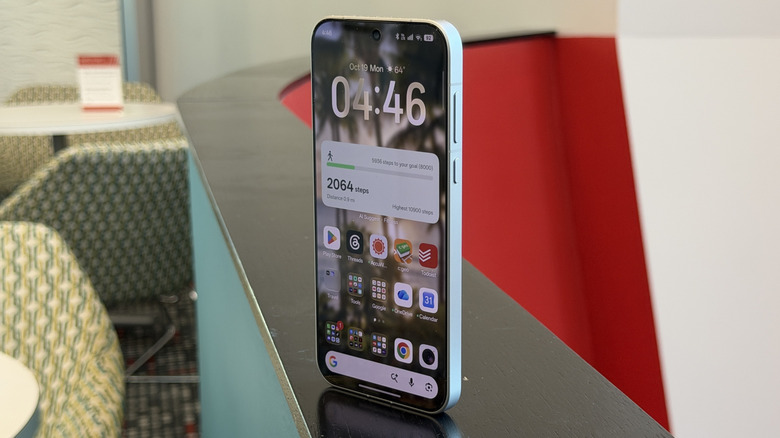
The camera island on the back holds a triple 200-megapixel camera setup with a separate narrow island for the flash. The phone has your typical power button and volume rocker on the right, and a programmable smart key on the left. The only thing this phone is missing is the dedicated camera/shutter button, which is surprising given how this phone puts photography front and center.
Simple app organization
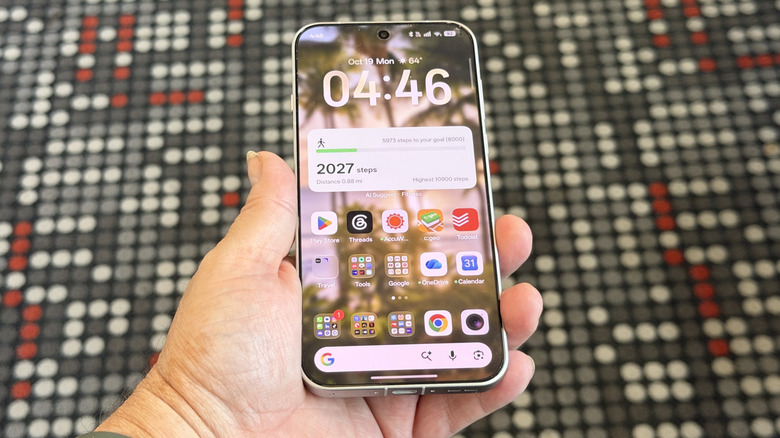
ColorOS tends to be pretty polarizing among those who use it. Personally, I have never really minded it; for me, it's more of a "take it or leave it" kind of situation. It's fine, and it works well. This is one of the few phones not made by Google that keeps a persistent Google search bar at the bottom of the phone, below the dock. I have always enjoyed that on any phone I've used that has it.
I'm a super organized person when it comes to my apps. I usually turn off the app drawers and put all my apps into folders. ColorOS makes that easy by not only allowing you to simply select apps you want to group together, but also allowing you to drag one folder into another in order to combine them. That is a feature I'd love to see Google steal for Android. I also like how you can increase the size of folders and app icons if you want. These features aren't unique to the Find X10 Pro Max, but I still like them.
Oppo ships the phone with an AI suggestion widget as well, which tries to guess what you might want to see at any given time. It's usually a collection of recent apps, the weather, your calendar, or a step counter, which popped up most of the time I was on vacation walking around an amusement park. I guess in that way it's "smart," but I didn't find it to be terribly useful. I think, overall, I would call the software simply "fine" and move on from there.
Exceptional battery life
Since this is a Chinese phone, it should come at no surprise to you that this phone ships with an 8,000 mAh silicone-carbon battery. It supports 80W of wired charging and up to 50W of wireless charging. As for battery life, I couldn't kill this phone in a day if I wanted to. Even at the amusement park when I stood in line, reading and watching videos all day, and spent the rest of my time capturing photos and videos; this phone just kept going.
We are quickly reaching a point where two days is going to be the standard for battery life on flagship phones (it almost already is). You should absolutely be able to forget to charge your phone one night and simply plug it in the next day for less than an hour to get back to full. Phones like the Oppo Find X10 Pro Max set this standard overseas, and the likes of Apple and Samsung really need to catch up here. It's infuriating that they haven't already.
One thing that continues to frustrate me — and this is true of the Find X10 Pro Max as well — is the lack of magnets in the body for magnetic wireless charging. One case that Oppo sent over, which I'll discuss in a moment, has a magnetic ring on the back for charging, but it almost feels like that was included for photography mounting, rather than charging. All the same MagSafe/Qi 2.2 will work with that case on, so I can't complain too much — but I can complain a little.
In another dimension
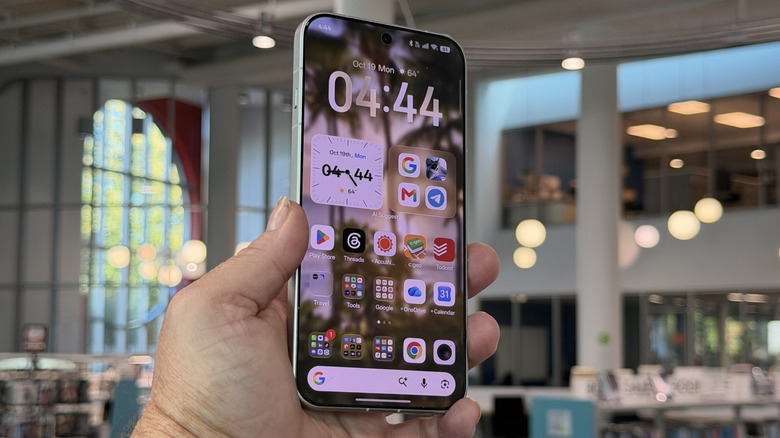
As for performance, the Mediatek Dimensity 9600 Pro is fabulous, and is very quick for anything you might want to do. Most of what I did with the phone is scrolling, reading, and videos.
I play a couple of games specifically to test the processor; "Metalstorm" and "Asphalt: Legends," both with graphics maxed out. The phone handles both of them with aplomb, and every other task at the same time. Of course, performance also affects the battery, which as noted above is also excellent.
As for Geekbench, the Oppo Find X10 Pro Max returns 3,052/10,439 single/multi-core scores, which are pretty good. Qualcomm's latest Snapdragon 8 Elite Extreme Gen 6 clocks faster scores in general, but MediaTek has come a long way in a few short years, and it can stand toe-to-toe with every other phone processor out there. Despite the Dimensity 9600 Pro's numbers being a little shy of some others, for most users, it won't matter. It comes down to "blazing fast" or "slightly more blazing."
These cameras, though
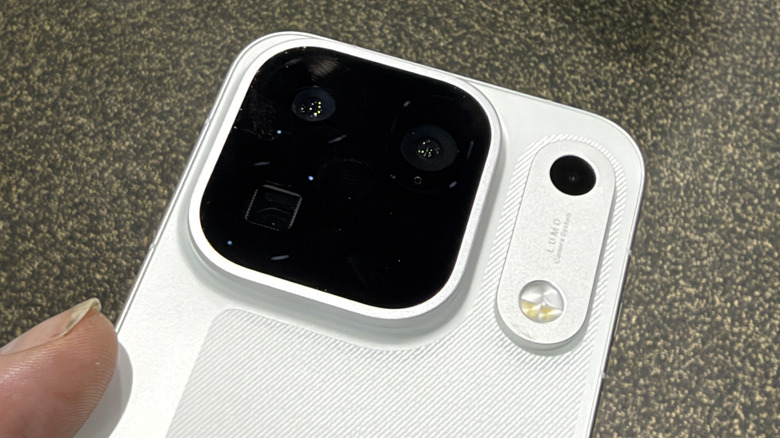
Of course, the headline of this phone has to be that triple 200-megapixel camera set, and it's one of the best I've used so far. We'll talk about my favorite part of the camera shortly, but the three main cameras have similar strengths and weaknesses that you'll see in a lot of flagships these days. Daytime performance, when the lighting is optimal, performance is spectacular.
 Adam Doud/BGR
It's at this point that I should mention that Oppo was quick to point out that this phone can handle up to 17 stops of dynamic range. To be honest, I don't really know how to take advantage of that, but it's worth mentioning for those of you that do.
 Adam Doud/BGR
But the phone just rocks during the day, and especially excels at portrait mode. I had a lot of fun shooting in portrait mode, because the bokeh in particular is quite good, often picking up individual hairs around a subject's head without losing them in the background.
When night falls

When the lights go down, you run into similar problems as a lot of other flagship phones; not as often as some others, but you still run into some hitches. That's not really surprising, but also a little bit disappointing. Considering how much Oppo has put photography at the forefront of this phone, I would have liked to have seen better results in this area, particularly in stills. I'll start with the good points.
Generally, low light shots are very good, particularly with the main camera. You can get good results with the ultrawide and telephoto lenses, but the main camera is going to be your best shot — no pun intended. Portrait mode is also quite good at night, as a visit to a haunted house taught me.
 Adam Doud/BGR
The ultrawide camera has difficulty with floodlights in darkness, and you get a lot of that kind of environment this time of year. The telephoto lens can sometimes have trouble with focusing at night as well. Finally, moving subjects are the bane of this phone, even with Action Mode turned on.
Video performance is just average for a flagship. The main issue I found is with stabilization at night: Even with a subject in frame, things got a little juddery. Nighttime video is the holy grail of smartphone photography though, so I can't fault Oppo more than I fault anyone else. Long story short, take a lot of photos, and you'll find a good one in the lot.
Teleconverter addiction
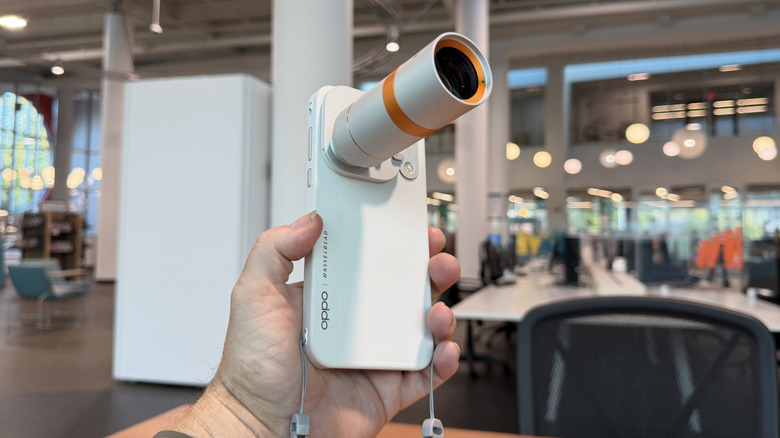
The part of this camera that I absolutely adore is the teleconverter conversion kit. Basically, Oppo will happily sell you a teleconverter that gives you 10x optical zoom with the 200-megapixel telephoto lens. The kit has a case (with a MagSafe ring), neck strap, an aluminum camera cover/mount, and the teleconverter itself, all in a little pouch. I carried mine on the neck strap with the phone.
 Adam Doud/BGR
When you want to zoom in (up to 40x), you slide the mount over the camera housing, attach the lens, and you're ready to go. While I used this lens for a lot of zoom shots, I mostly enjoyed it for the absolutely gorgeous macro shots it was capable of, with exquisite detail and bokeh that photo processing can't duplicate. I'm talking about spiderweb strands standing out against the background. It's so good and so addictive, I absolutely fell in love with the teleconverter kit.
 Adam Doud/BGR
It works great at night, too, giving you sharp detail on your subject while everything else falls into the background. It's so much fun to play with, and it's quite the conversation starter as well — ask the people in line around me at the park.
Conclusion
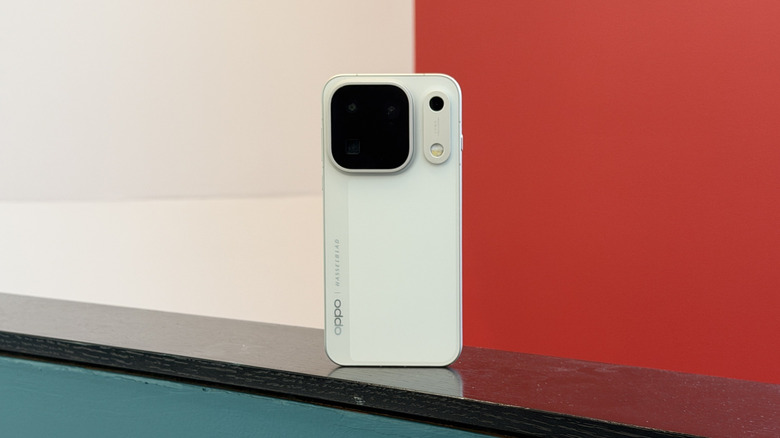
Overall, this is a wonderful phone from our friends at Oppo — I enjoy it quite a bit. It has a high price tag, though: Coming in at £1,499 in the U.K. — around €1799 — though that may vary depending on what country you're in. There are various deals and discounts, one of which is to choose an accessory to go with it, and the teleconverter kit is one of those options, so I recommend you get that.
The cameras are only part of the story, but they're a good part. The performance and battery life are both excellent as well. Anything you will want a phone to do, this phone can do, plain and simple. I would like to see better nighttime camera performance, but I want to see that with all phones, so that's nothing unique to Oppo. That's really my only complaint here, other than it not being sold in the U.S.
The competition
The closest competition you'll find in the U.S. is the Samsung Galaxy S26 Ultra, which is itself a great phone. I think this one beats it out in a few categories, but the S26 has some tricks up its sleeve too. The privacy display in particular is attractive to me, and I can't wait until other vendors pick that up. But in terms of cameras and battery life, there's no contest for Oppo.
Should I buy it?
If you can, yes; but that's the thing. You can buy this overseas, but not in the U.S. unless you import it.