

Scientists Just Released A Huge Invasive Python Back Into Florida — Here's Why
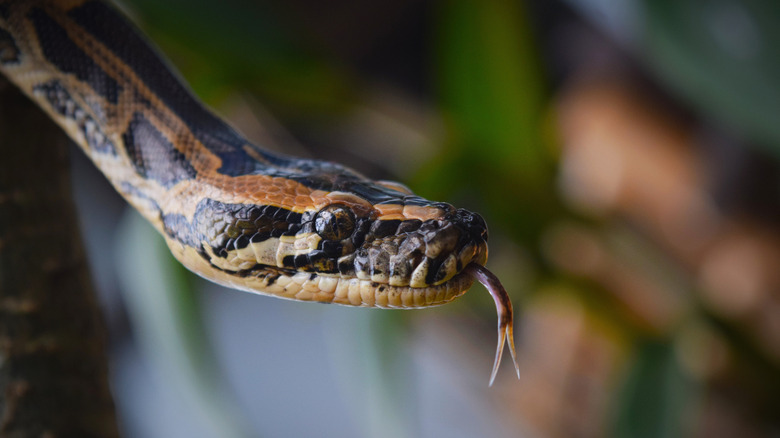
Releasing a giant 16-foot, 150-pound Burmese python back into the Florida Everglades sounds like a terrible idea. The state has long fought a grueling battle against these invasive predators, and officials have long relied on capturing and removing the enormous reptiles one at a time. Recently, though, wildlife researchers snagged one of these pythons, slapped a tracker on it, and intentionally let it slither right back into the swamp.
No, this isn't the concept for a giant monster movie (although those are great). Really, it's a calculated move within this ongoing battle, and a tech-driven Trojan horse that scientists are betting on big. Why? Because Burmese pythons are notoriously tricky to find in the wild, and for the researchers trying to track their nesting and breeding patterns, that ups the difficulty level to nearly impossible. Beyond that, tracking them on foot is slow and expensive, as the reptiles are easily camouflaged in the Everglades' dense marshland. But by tagging one giant snake with a special radio transmitter and releasing it, they can take the hunt to the skies.
These unmanned drones will pick up the snake's radio signals quickly, far faster than ground crews ever could. This drone program could make field work more efficient and reduce time spent crawling through the wetland. By taking the search airborne, wildlife researchers and management teams alike can cover more ground and find these elusive predators. They'll be able to learn more about them as they find more, and it'll finally give the state the upper hand for managing its python problem.
Spying from the sky to destroy hidden nests
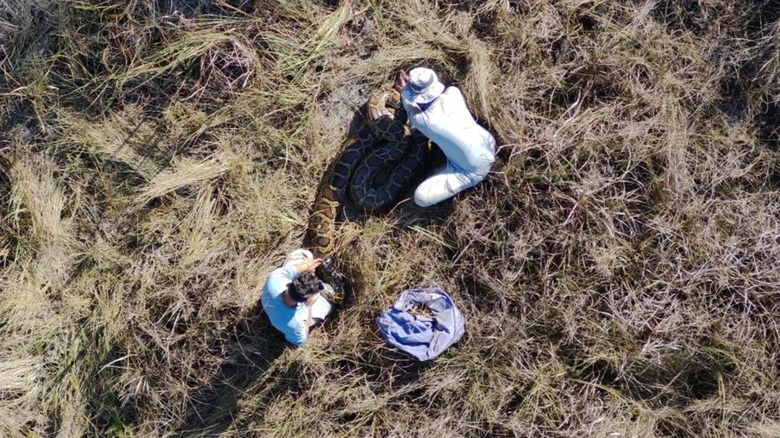
Tracking one extremely elusive snake is only a small piece of a much larger data puzzle that's aimed at saving Florida's native ecosystem, however. Burmese pythons have all but decimated local mammal populations in recent decades, and stopping them means finding the areas where they tend to nest and breed. By monitoring the tagged reptile from above, the researchers can more easily gather plentiful data on the mysterious nesting habits of the pythons that have eluded them for years.
Since single large female pythons can drop dozens of eggs at a time, gathering data quickly is important, as every undiscovered nest is a ticking time bomb. The location data collected via drone will help biologists be able to better map out these hotspots, and even tag future generations, too. Then, with that data, removal teams can strike right at the source rather than just hoping to stumble across individual snakes.
Still, while tossing a ravenous apex predator back into a vulnerable environment seems wild on paper, it's admittedly a pretty brilliant use of technology, especially if it has good odds of stopping an ecological disaster. Futuristic-feeling approaches to managing wildlife are exciting, and if this aerial tracking program succeeds, it's sure to become a must-have tool for controlling these pythons. In fact, drones are increasingly used in scientific efforts.